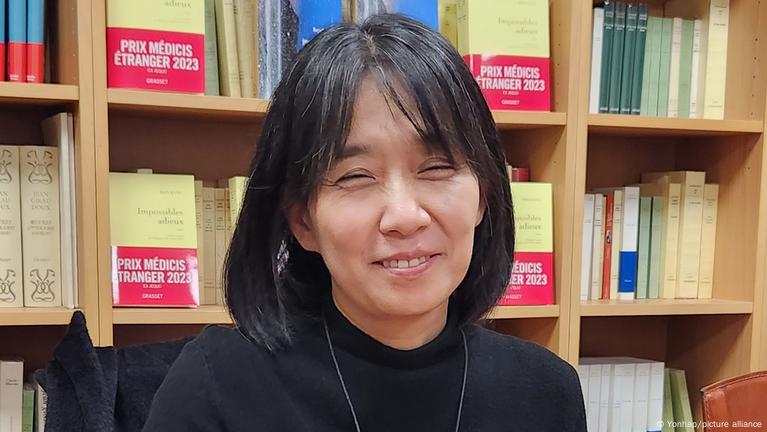
Seoul’s Han Kang wins the Nobel Prize in Literature in 2024
The 2024 Nobel Prize in Literature was given to South Korean author Han Kang for “her intense poetic prose that confronts historical traumas and exposes the fragility of human life,” the organization that gives the prize said Thursday.
It is worth 11 million Swedish crowns ($1.1 million) and is given out by the Swedish Academy.
“She has a unique understanding of the links between body and soul, the living and the dead,” Anders Olsson, head of the Nobel Committee of the Swedish Academy, said in a statement. “Her poetic and experimental style has made her an innovator in contemporary prose.”
In 1995, the short story collection “Love of Yeosu” was her first work of writing. In 1993, a collection of her poems appeared in the magazine Literature and Society. She was the first South Korean and 18th woman to win the literature prize.
She was born in 1970 and comes from a story-telling family; her father is a famous writer.
In 2016, Han Kang’s novel “The Vegetarian” won the Man Booker International Prize for literature. It was the first book of hers to be translated into English and was seen as her big break internationally.
Prior to the news, Chinese writer Can Xue and many other long-time candidates, such as Kenya’s Ngugi Wa Thiong’o, Australia’s Gerald Murnane, and Canada’s Anne Carson, were tipped to win.
Many people didn’t think Han Kang would win, but South Korean artist Ko Un has been a favorite to win the award for a few years now and was still seen as having a chance.
A news gathering heard from Mats Malm, who is the permanent secretary of the Swedish Academy. “I was able to talk to Han Kang on the phone.” “She was having an ordinary day, it seems, she had just finished supper with her son,” he added.
BEING A VEGETARIAN
For Yeong-hye, a good wife, having horrible dreams, “The Vegetarian” shows her going against social norms by giving up meat, which makes her family worry that she is mentally ill.
“She is exploited erotically and aesthetically by her brother-in-law, a video artist who becomes obsessed with her passive body (and) … sinks ever deeper into a psychosis-like condition expressed through the ‘flaming trees’, a symbol for a plant kingdom that is as enticing as it is dangerous,” as per the Academy’s description.
In an interview with the Booker Prizes that came out last year, Han Kang talked about how writing “The Vegetarian” had been a hard time in her life and made her wonder if she would be able to finish the book or even make it as an author.
“I was suffering from severe arthritis in my fingers, so I wrote the first two parts at a leisurely pace, using a felt-tip pen that glided smoothly across the paper, and then typed out the last part holding two ballpoint pens upside down,” she shared.
“To this day, I feel awkward when I hear about the novel’s ‘successes.”
TRAUMA IN HISTORY
Her novel “Human Acts” is about how the South Korean military killed hundreds of students and unarmed citizens in Gwangju in 1980. This event is related to her own childhood and shows how she deals with historical trauma.
“In seeking to give voice to the victims of history, the book confronts this episode with brutal actualization and, in so doing, approaches the genre of witness literature,” said the Academy.
She “conveys the power of the past over the present” in her newest book, “We Do Not Part,” which will come out in English in 2025.
Her books have been turned into movies. Lim Woo-Seong directed “The Vegetarian” in 2009, and he also directed “Scars” in 2011.
Alfred Nobel, a Swedish businessman and creator of dynamite, left money in his will that made the Nobel Prizes possible. The first one was given out in 1901.
Lots of people can get the literature prize, so when the Academy makes its decisions, they get both praise and criticism, often in equal amounts.
Over the last 100 years, the Academy’s decision to leave out great writers like Leo Tolstoy from Russia, Emile Zola from France, and James Joyce from Ireland has left many book fans puzzled.
People thought that giving the 2016 prize to American singer-songwriter Bob Dylan was a radical shift in the idea of what literature is, but they also thought it was an insult to writers who write more traditional types of literature.
There is, however, the prize money and the chance to join the ranks of great writers like the Irish poet W.B. Yeats (1923 winner), the American author Ernest Hemingway (1954 winner), and the Colombian Gabriel Garcia Marquez (1982 winner).
One dollar is equal to 10.3978 Swedish crowns.