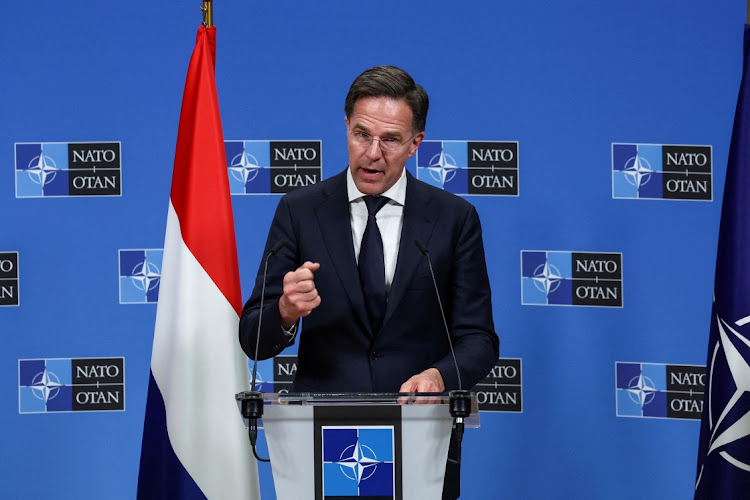
In light of Russian President Vladimir Putin’s increased rhetoric on nuclear weapons, NATO Secretary General Mark Rutte announced on Thursday that the alliance will start its yearly nuclear drill on Monday.
About 60 aircraft from 13 countries will participate in the Steadfast Noon exercise, which is being hosted by Belgium and the Netherlands, including F-35A fighter fighters and B-52 bombers, according to NATO authorities.
After meeting with Ukrainian President Volodymyr Zelenskiy and Prime Minister Keir Starmer, Rutte declared in London that “it is vital that we test our defense and that we strengthen our defense so that our adversaries know that NATO is ready, and is able to respond to any threat.”
“The whole exercise will particularly focus on the United Kingdom, the North Sea, but also Belgium and the Netherlands,” he stated.
There are no live weapons used in this training. However, officials stated that about 2,000 military men will be simulating missions in which jets carrying nuclear bombs from the United States are carried out.
According to representatives from the 32-member transatlantic military alliance, the drill will begin on Monday and run for roughly two weeks.
Putin has alerted the West on several occasions to the possibility of nuclear repercussions following Russia’s full-scale invasion of Ukraine in 2022.
He said last month that Moscow would view any attack on Russia backed by a nuclear state as a joint one and that Moscow may employ nuclear weapons in the event that it was attacked by conventional missiles.
NATO officials emphasized that the exercise was not a reaction to any recent statements made by Moscow and that it had been conducted yearly for over ten years.
NATO’s assistant secretary general for defense policy and planning, Angus Lapsley, stated, “We don’t… adjust constantly according to whatever is being said or not said on any given day.”
However, he claimed that drills like Steadfast Noon were crucial for showcasing NATO’s nuclear arsenal and acting as a deterrent to any potential assault.
At NATO headquarters in Brussels, he told reporters, “We seek to deter any adversaries, and principally Russia, in several different ways, including conventional deterrence.” “But it’s always been underpinned by nuclear deterrence.”
According to Lapsley, NATO’s present main priority is ensuring that its nuclear deterrence is reliable and credible.