 "Where Africa Comes to Stay Informed."
US Edition
"Where Africa Comes to Stay Informed."
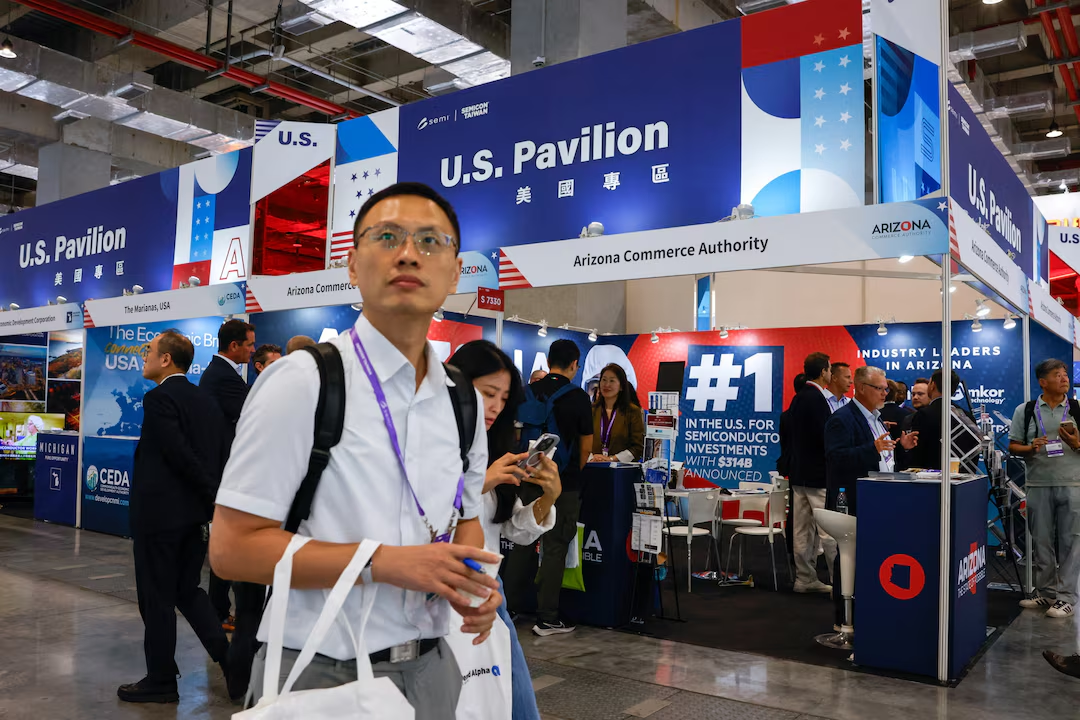
Taiwan utilizes its semiconductor supremacy to strengthen partnerships as the US and EU advocate for increased investment in chips.
Taiwan is utilizing its semiconductor expertise to enhance international collaborations as the United States and European Union advocate for increased investment from the island’s technology firms.
At the SEMICON Taiwan trade show last week, Taiwan showcased its position as a dependable and democratic supplier at the center of the global artificial intelligence revolution while expressing its readiness to share the advantages of its chip industry with like-minded partners.
Taiwan hosts companies such as TSMC, known for producing advanced chips that drive AI applications. The island, facing diplomatic isolation, has consistently leveraged its technological prowess to bolster international backing, while China contests these initiatives and asserts that Taiwan is an integral part of its territory.
The island is experiencing growing pressure from the United States, its key international supporter and arms provider, to enhance semiconductor manufacturing within American borders.
TSMC is committing $265 billion to the development of manufacturing facilities in Arizona as a key aspect of its expansion.
President Lai Ching-te, who notably spoke at two distinct events during SEMICON Taiwan on the same day, stated that Taiwanese companies were broadening their international presence to enhance global supply-chain resilience.
Taiwan’s Economy Minister Kung Ming-hsin, at the inauguration of the US pavilion, announced that Taiwanese companies are set to invest an additional $20 billion in the United States.
Taiwan and Washington reached an agreement earlier this year to boost Taiwanese investment in the US in exchange for lower export tariffs, though uncertainty still lingers regarding the final terms.
Last week, US Commerce Secretary Howard Lutnick announced that the US would apply semiconductor tariffs to companies that fail to manufacture chips within the United States.
Bill Frauenhofer, the Commerce Department official overseeing the tariff agreement with Taiwan, maintained an optimistic outlook at SEMICON.
He stated that the partnership between Taiwan and the US was phenomenal and effective. “Both of us have a strong interest in ensuring the agreement is successful.”
Taiwanese technology companies have recognized the growing necessity of expanding manufacturing beyond the island.
Young Liu, chairman of Foxconn, Nvidia’s largest AI server manufacturer, stated that companies must now expand their strategies regarding global manufacturing.
“Consider how to collaborate with Taiwan, not just within Taiwan, but also in the countries where the market exists.”
Tien Wu, the chief operating officer of ASE, the largest chip packaging and testing company globally, concurred during the panel discussion.
“It is the correct course of action from a political standpoint,” Wu stated. “Honestly, I believe we have no choice but to proceed with that.”
Taiwan is actively pursuing stronger economic connections with the European Union, which is looking to attract more investment from Taiwanese semiconductor firms.
The European Commission dispatched Kilian Gross to SEMICON to advocate for the bloc’s proposed Chips Act 2.0 to Taiwanese officials and businesses.
Taiwan has pursued closer collaboration with the EU, motivated in part by their mutual support for Ukraine amid its conflict with Russia and the shared challenges of trade and diplomatic tensions with China.
Deputy Foreign Minister Francois Wu, a leading diplomat from Taiwan, stated that Taiwan and France are united by their democratic values and dedication to a rules-based international order during his remarks at the opening of the French pavilion.
“We utilize technology to engage with the world, not to dominate it,” he added.



Comments
0