 "Where Africa Comes to Stay Informed."
US Edition
Thursday, August 27, 2026
"Where Africa Comes to Stay Informed."
The recent restructuring prompts a more significant inquiry into the extent to which Uber intends to streamline its operations as artificial intelligence and autonomous vehicles redefine the company’s focus.
Uber is eliminating thousands of jobs despite experiencing business growth, as indicated by the company's recent employee memo and second-quarter earnings report. This restructuring appears to be more than just a standard reaction to low demand.
The Uber layoffs will result in the loss of approximately 3,300 jobs, which accounts for around 10% of the workforce, as reported by Reuters. CEO Dara Khosrowshahi informed employees that the company aims to eliminate management layers, streamline teams, and reallocate resources toward what leadership identifies as its most significant opportunities. Uber's announcement signifies its most significant round of job reductions since the COVID period.
Uber's internal message indicates that it has informed affected employees, except in countries where local labor regulations necessitate a different approach. The company announced a reduction in roles mainly centered on coordination, decreasing the number of employees positioned seven or more reporting layers beneath the CEO by 20% and nearly halving the number of small teams with only one or two reports.
Khosrowshahi characterized the issue as one that was, in part, a result of Uber's own growth.
“We have developed new products, ventured into new markets, connected with more consumers, supported a higher number of earners, and transformed into a significantly larger and more robust company.” However, this growth has also introduced complexity: increased layers, greater coordination, more fragmented ownership, and in certain instances, structures that were effective when the businesses were smaller but no longer function optimally at our current scale,” Khosrowshahi stated in Uber’s published employee memo.
That restructuring will impact more than just the company’s headcount. Uber has announced that it is merging its distinct delivery operations teams for restaurants, retail, and direct delivery. Additionally, the company will be unifying its core services engineering and science teams. Uber plans to focus on consolidating more employees in specific office hubs, such as San Francisco and New York for global teams, stating that only around 1% of employees will continue to work fully remotely. The current requirement for office attendance three days a week will continue as is.
There is one significant detail in the reported numbers. While Reuters and other outlets reported approximately 3,300 cuts, representing roughly 10% of Uber’s workforce, Uber’s June 30 filing with the Securities and Exchange Commission indicated that the company had approximately 36,600 global employees at the end of the second quarter. Uber’s September memo refers to the reduction as “about 10%,” suggesting that both the percentage and the reported job total are estimates and may indicate a different internal headcount or timing.
What makes the Uber layoffs particularly significant is that they are occurring at a time when the company is achieving robust financial results. Uber’s second quarter results indicate that gross bookings hit $58 billion, reflecting a 24% increase from the previous year on a reported basis, while revenue rose by 12% to $14.2 billion. Uber announced an operating income of $1.9 billion, and for the first time in its history, trailing twelve-month free cash flow surpassed $10 billion.
That implies the cuts are more focused on determining where Uber intends to allocate its resources and employees, rather than merely a matter of survival. In its remarks for the second quarter, Uber indicated that it anticipates committing over $10 billion in the coming years through investments, infrastructure, and vehicle commitments related to autonomous vehicles. The company announced that autonomous vehicles are currently operating through Uber in seven cities and could expand to as many as 15 cities by the end of 2026. Additionally, partners have pledged around 120,000 vehicles to its network in the upcoming years.
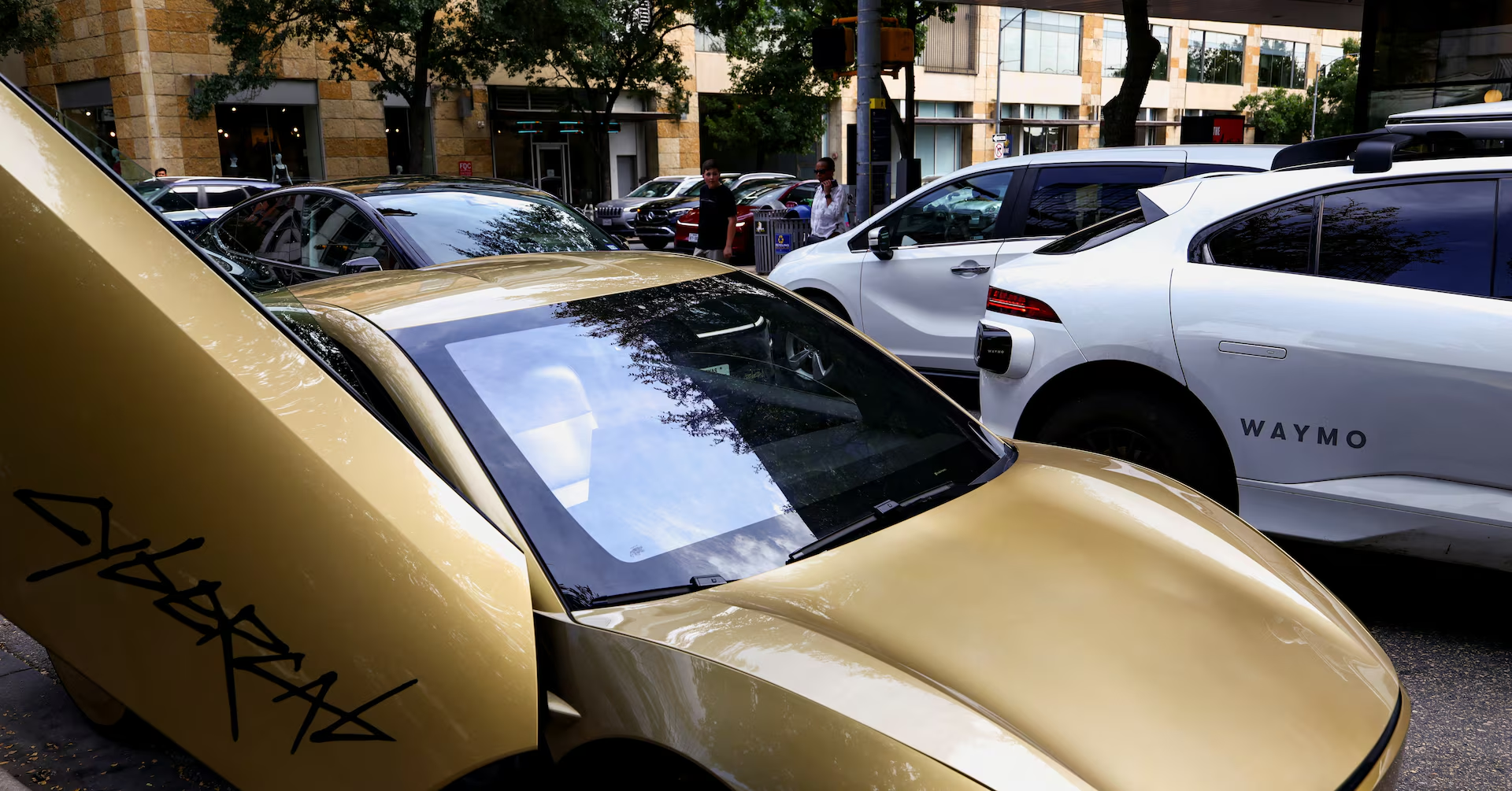
The push for robotaxis is significant, as autonomous transportation has the potential to transform the economics of Uber’s fundamental ride business. Uber’s recent SEC filing explicitly names Waymo, Tesla, and Amazon-owned Zoox as competitors in the development of autonomous vehicle technology. It cautions that these rivals could negatively impact Uber if they accelerate the scaling of autonomous rides or provide more affordable transportation options. As reported by Reuters, Uber aims to establish itself as the platform where various autonomous vehicle operators can connect with riders, rather than letting those companies operate independently of Uber.
Artificial intelligence plays a significant role in the workforce narrative, although Uber has not explicitly attributed the September reduction to AI. As reported by Reuters, Khosrowshahi did not describe the recent 3,300 job cuts as being driven by AI. Uber’s remarks to investors in August indicated that the company was already scaling back its hiring plans compared to its initial projections for 2026, partly due to “AI-related productivity gains” and broader efforts to enhance organizational efficiency. Uber also stated it would persist in seeking methods to enhance efficiency while reallocating resources toward investments that promise more robust long-term returns.
The distinction holds significance as Uber had previously implemented more targeted cuts prior to this latest announcement. In June, Bloomberg reported that Uber reduced its People and Places division by 23%. This division encompasses human resources, recruiting, workplace facilities, and culture. However, these cuts accounted for less than 1% of the company's total workforce. In July, Bloomberg reported that Uber's customer service operation had reduced its workforce by approximately 10% as part of a strategy to streamline operations and incorporate artificial intelligence.
Uber has previously experienced significant workforce reductions. As reported by Reuters in May 2020, the company cut approximately 6,700 jobs in the initial months of the pandemic, which represented around 23% of its workforce due to the significant decline in ride demand. Subsequently, Reuters reported in 2023 that Uber had reduced its workforce by cutting 200 recruiting positions, following the elimination of an additional 150 jobs at Uber Freight earlier that year.
That history, along with the reductions in June, July, and September 2026, makes it clear that the possibility of further Uber layoffs should not be overlooked. No further companywide round has been announced, and Khosrowshahi informed employees that leadership favored implementing one significant organizational shift rather than a series of smaller changes, as stated in Uber’s memo from September. Nevertheless, the company's own investor comments indicate that hiring moderation, AI productivity, organizational efficiency, and resource reallocation continue to be key priorities.
That does not demonstrate that another round is imminent. It indicates that workers may closely monitor individual departments as newly merged teams identify overlapping responsibilities, while Uber invests more heavily in automation, artificial intelligence, and autonomous transportation. The broader implication of these Uber layoffs is that substantial profits and increasing revenue no longer ensure an expanding corporate workforce, especially when management thinks that technology and a streamlined organization can achieve more with fewer levels.



Comments
0