 "Where Africa Comes to Stay Informed."
US Edition
Thursday, August 27, 2026
"Where Africa Comes to Stay Informed."

Ghana's local refining mandate seeks to keep a greater share of gold wealth within the country, generate employment opportunities, and bolster the nation's gold sector.
Ghana has mandated that specific gold exporters refine gold ore domestically prior to exporting it, a decision intended to enhance the value retained from the nation's gold sector.
The Ghana Gold Board (GoldBod) announced that the requirement became effective on September 1. This regulation applies to Self-Financing Aggregators (SFAs), who are prohibited from exporting gold ore acquired under agreements with approved off-takers unless it has been refined in Ghana first.
Dore is a form of semi-refined gold that necessitates additional processing prior to its conversion into bullion.
The directive, issued by GoldBod’s Compliance Directorate on August 24, enacts the Ghana Gold Board Act, 2025 (Act 1140), which designated GoldBod as the authority tasked with the buying, selling, assaying, refining, and export of gold in Ghana.
The policy aims to enhance local value addition and minimize the revenue that Ghana forfeits when gold is processed abroad.
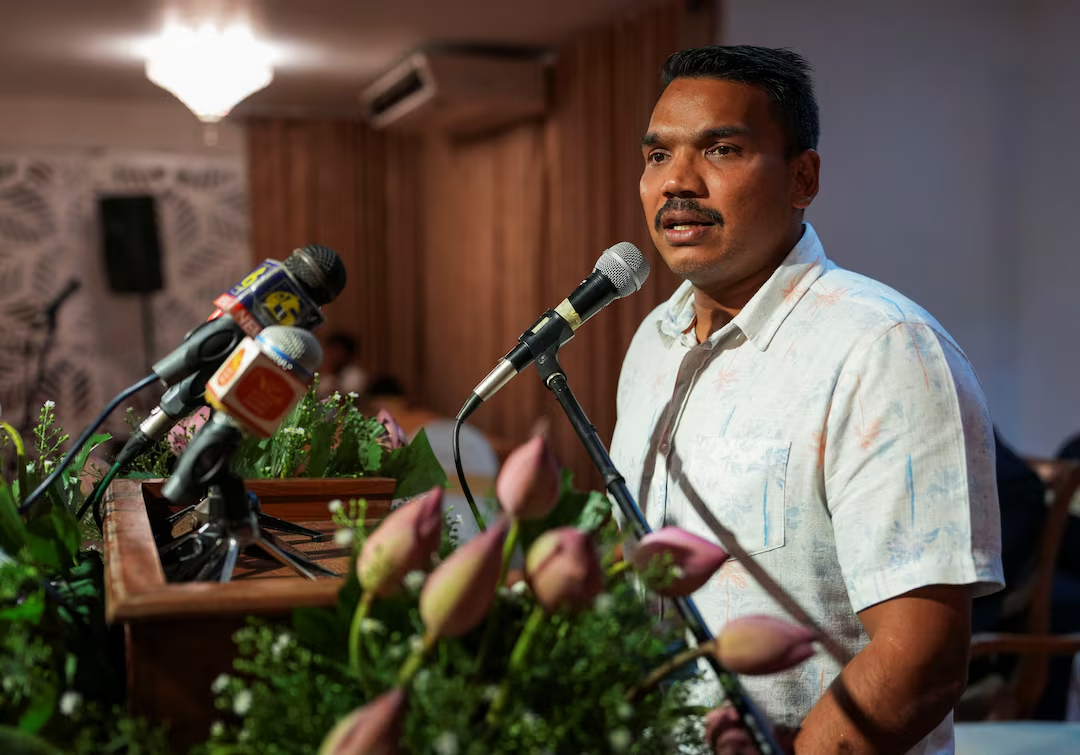
Clement Edem Asare Morjah, chief executive of United Gold International Limited, a licensed SFA, characterized the policy as a significant change in the management of Ghana’s gold resources.
“For the first time since independence, we have a government committed to ensuring that Ghana reaps the benefits of our most significant resource, gold,” he stated.
Morjah stated that local refining would allow Ghanaian businesses to retain margins that foreign processors have traditionally kept.
“Throughout the entire value chain from refining to raw processed gold, there are significant margins in the associated costs.” For decades, we have historically lost these revenues to the outside world. This initiative marks the initial instance where a conscious government policy is attempting to tackle this anomaly,” he stated.
However, he noted that the short notice has posed challenges for companies with existing contracts, which may now require renegotiation or amendment.
GoldBod instructed SFAs to revise current offtake agreements by August 31. It was stated that export applications would be processed only after confirming that the gold had been refined locally, applicable charges had been paid, and other regulatory requirements had been fulfilled.
Prince Kwame Minkah, the media relations officer for GoldBod, stated that the policy aims to guarantee that Ghana secures a greater share of the economic advantages produced by its gold resources.
Ghana ranks among the leading gold-producing nations globally, and it is essential to fully leverage the national advantages. Value addition is essential," he stated.
Minkah stated that the policy is in line with President John Mahama’s vision of ensuring that Ghana’s natural resources are exported with a higher degree of value addition by 2030.
“The enhancement of value is what will lead to the establishment of a gold industry in Ghana,” he stated.
He mentioned that local refining could generate employment, decrease payments to foreign processors, and provide refined gold to industries such as jewelry manufacturing.
Minkah also mentioned that GoldBod intends to create a gold village inspired by Dubai’s Gold Souk.
Ghana has four licensed gold refineries, which include Gold Coast Refinery and Royal Ghana Gold Refinery.
Gold Coast Refinery, established in 2016, has a declared capacity of up to two tons per week, whereas Royal Ghana Gold Refinery, which began operations in August 2024, is capable of processing 400 kilogrammes of gold each day.
GoldBod has established supply agreements with both refineries. Under its agreement with Gold Coast Refinery, the board provides a minimum of one metric ton of gold each week.
Gold Coast Refinery has established a partnership with South Africa’s Rand Refinery.
Minkah mentioned that GoldBod was also working on what he referred to as “the largest refinery on the African continent” in Ghana.
Ghana is striving for enhanced domestic value addition as its gold industry experiences significant growth.
The country produced almost six million ounces, which is approximately 185 tons, of gold in 2025. Small-scale mining produced approximately 3.1 million ounces, or 96 tons, an increase from 1.9 million ounces, or 59 tons, the year before.
Gold export earnings reached approximately $20 billion in 2025, almost double the $10.3 billion recorded in 2024. Total merchandise exports reached approximately $31.1 billion.
The growth has bolstered the government's efforts to bring a greater portion of the gold value chain under domestic control.
George Darkwa, an expert in gold and minerals, characterized the refining requirement as a favorable advancement.
“This is a constructive step that will improve value retention and formalization," he stated, encouraging foreign investors to back Ghana’s initiatives to advance its domestic gold sector.
GoldBod cautioned that exporting or attempting to export unrefined ore in violation of the new requirement would be considered a breach of license conditions.
Possible sanctions may involve the refusal or suspension of export approvals, the suspension or revocation of licenses, administrative penalties, and various enforcement measures.
The board stated that the directive would enhance regulation while ensuring that a greater portion of Ghana’s gold value is retained within the country through refining and other methods of value addition.
Morjah stated that the advantages would reach beyond the companies that are directly impacted by the policy.
He stated that refining gold into bullion would enhance its quality and value predictability while enabling Ghana to secure a larger portion of the value derived from its natural resources. “Give it time,” Morjah remarked. Everyone will recognize the advantage. In the realm of business, considerations extend beyond the singular advantage of your company. You should consider the body corporate as if it were a nation.


Comments
0