 "Where Africa Comes to Stay Informed."
US Edition
"Where Africa Comes to Stay Informed."
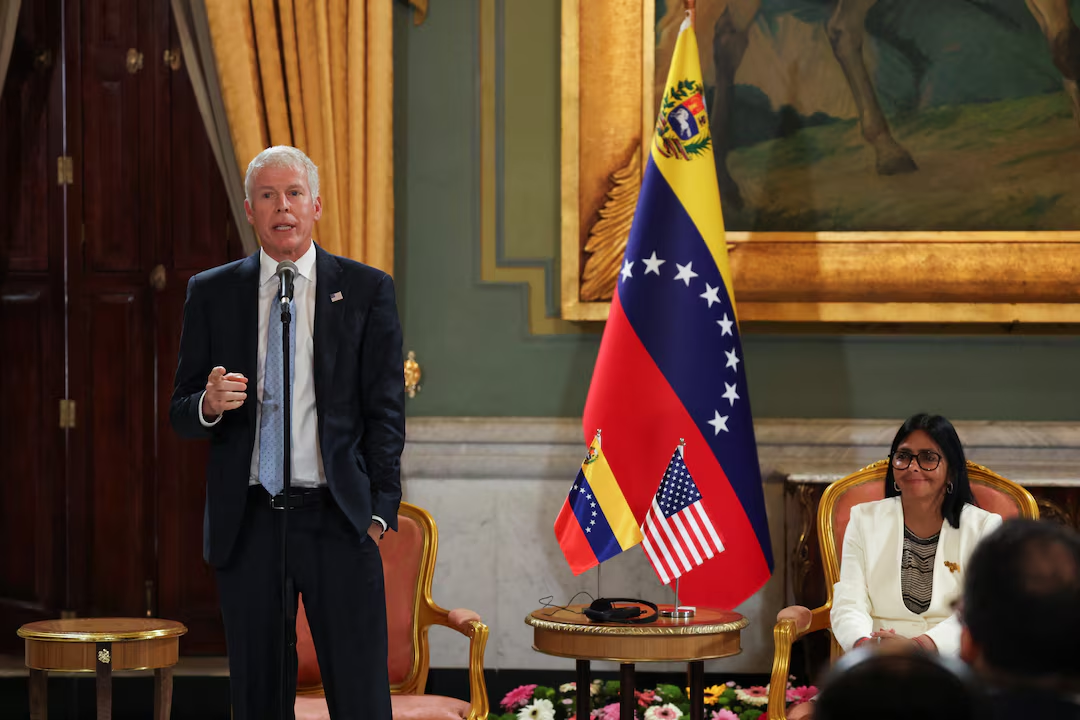
The U.S. government has organized its 35% stake in a Venezuelan oil venture through warrants, which safeguard Washington's investment from dilution due to new capital raises, according to a U.S. official.
On Thursday, an official discussed the deal announced last week by President Donald Trump, explaining that the Pentagon structured the stake using "penny warrants" in North American Blue Energy Partners (NABEP). This arrangement provides the Pentagon with the right, but not the obligation, to purchase the equity at a later date. Penny warrants may be exercised at a nominal price.
NABEP, under the control of Venezuelan businessman Alejandro Betancourt, has been awarded 100-year rights to 17 oilfields that are estimated to contain 65 billion barrels of reserves, following the recent agreement between Washington and Caracas.
The concessions were granted without a competitive process. The U.S. has been actively engaged in revitalizing the oil sector of the South American country following the capture and removal of former President Nicolas Maduro from power in January by American forces.
The official, speaking on background, clarified that the structure was intentionally designed to uphold U.S. ownership levels while NABEP seeks funding to meet the project's capital requirements.
Expanding offshore oil fields necessitates a substantial investment of billions.
The warrants protect against dilution, which the U.S. keeps until the project matures, "ensuring that the U.S. government will capture 35% of the project's total value ... once it achieves mature production, rather than being diluted during the interim," the official stated.
Importantly, the official stated that the arrangement still allows the U.S. to receive dividends prior to the exercise of the warrants. The official stated that the structure "provides the United States with all the advantages of being an equity holder today while safeguarding us from dilution during the project's development.
The official also confirmed that the Pentagon possesses a distinct right of first offer to acquire NABEP's oil output. Twenty percent can be acquired at a price that mirrors the company's production cost, rather than prevailing market rates, while the remaining portion is obtained at market prices.
The agreement has attracted attention because authorities in both the U.S. and Europe have examined Betancourt's previous business transactions. He has not faced any charges and has consistently denied any wrongdoing. Earlier this week, other U.S. officials defended the arrangement, portraying the pact as a step toward aligning the country's energy industry with U.S. interests.
Venezuela's oil production has declined since reaching over 3 million barrels per day in the late 1990s, currently hovering around 1.1 million to 1.2 million barrels daily due to sanctions and mismanagement. U.S. Energy Secretary Chris Wright indicated this week that this figure could potentially more than double in a few years, following the implementation of separate agreements with Chevron, Eni, ONGC, GeoPark, and GE Vernova announced on Wednesday.
Separately, the official stated that the Pentagon mandates officials who have previously been employed by Cerberus Capital Management, which is not connected to the Venezuela oil deals, to abstain from any transactions related to the private equity firm's assets. Such deals must be directed to Commerce Secretary Howard Lutnick for review and approval.
Lawmakers have called for increased transparency regarding contracts associated with Cerberus-affiliated companies and have urged for a clear separation between Deputy Secretary of Defense Steve Feinberg, a founder of Cerberus, and procurement decisions.
Cerberus has yet to provide a response to the request for comment.



Comments
0