 "Where Africa Comes to Stay Informed."
US Edition
"Where Africa Comes to Stay Informed."
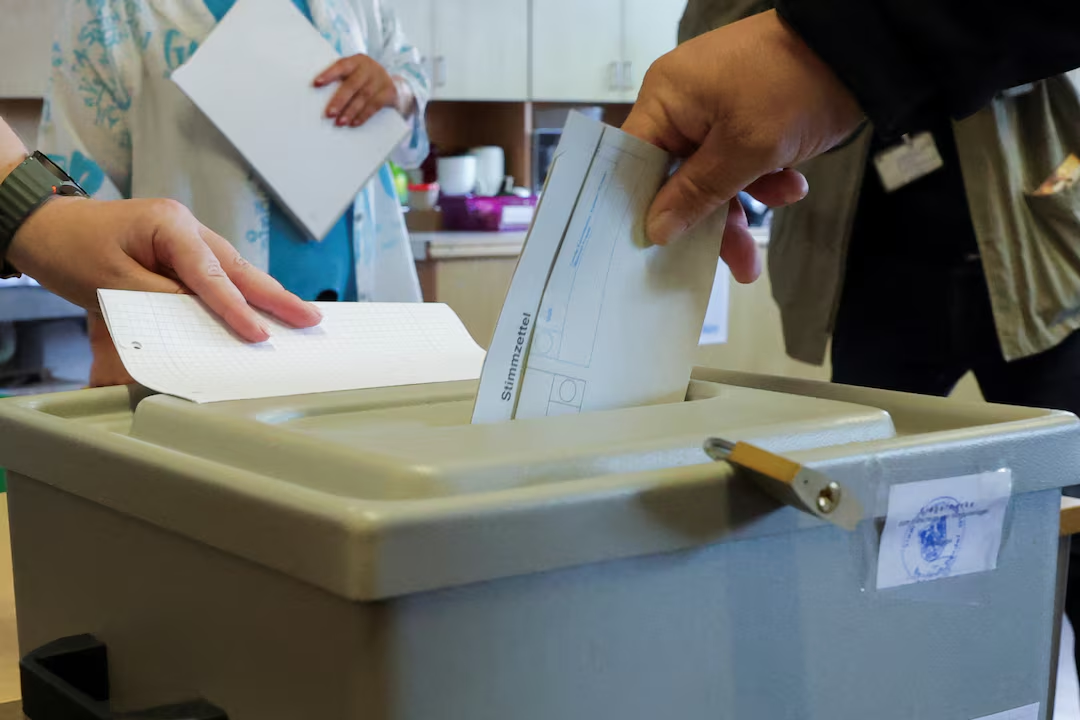
Voting commenced in the eastern German state of Saxony-Anhalt on Sunday in a closely monitored election that may result in the Alternative for Germany (AfD) becoming the first far-right party to govern a state since World War Two.
Under the leadership of its 35-year-old candidate Ulrich Siegmund, the AfD has consistently polled above 40% for several months and stands a genuine chance of securing an absolute majority, provided that several smaller parties do not surpass Germany's 5% threshold to gain entry into parliament.
The precise percentage required for an absolute majority will vary based on the number of parties that surpass that threshold. However, Siegmund has indicated that his goal is to achieve 45% or more of the vote.
The vote is regarded as an indicator for Chancellor Friedrich Merz, whose administration has sought to diminish the AfD's appeal by adopting a firmer stance on migration and security.
Approximately 1.7 million voters have until 6 p.m. (1600 GMT) to submit their ballots before the polls close, with initial results anticipated shortly thereafter.
Turnout was significantly higher than in the previous state election in 2021, with 34.72% of eligible voters having cast their ballots by noon, in contrast to 22.4% previously, according to the state election commissioner.
Recent surveys indicate that the AfD stands at just over 40%, while Merz's Christian Democrats (CDU) trail at 23%.
An outright majority would enable the party to bypass Germany's political "firewall," which prevents mainstream parties from governing alongside it.
In Germany's proportional electoral system, reaching an absolute majority presents a significant challenge, as the system was intentionally crafted to promote coalition governments and complicate the ability of a single party to govern independently.
If the AfD does not succeed, a CDU-led government under the current state premier Sven Schulze is the most probable result, although the outcome will largely hinge on which smaller parties gain entry into parliament.
The state's constitution mandates that the newly elected parliament must convene within 30 days of the vote, with a final deadline of October 6. However, there is no specified deadline for the election of a new state premier.
AFD 'IS UNSTOPPABLE'
For the AfD, Saxony-Anhalt serves as a trial for its broader aspirations of attaining national influence in the upcoming federal election scheduled for 2029.
Regardless of the result of tomorrow's election, we have already made history," stated Siegmund during a concluding rally on Saturday evening.
What we have initiated here in Saxony-Anhalt—a movement that is currently spreading throughout all of Germany—cannot be halted," he addressed the audience in the state capital, Magdeburg.
If elected, the AfD intends to encourage schools and cultural institutions to adopt more traditional values, limit immigration, and reform public broadcasting.
However, lacking an absolute majority, the AfD, labeled as "far-right extremist" by the state security service, would face challenges in entering government due to the firewall.
Siegmund, arriving to cast his vote in his hometown of Tangermuende on a blue Simson moped, was greeted by throngs of excited fans and has ruled out coalition talks with other parties.
If that does not happen, it would lead to complex coalition negotiations among the other parties.
Polls indicate that one of the CDU's current coalition partners, the Free Democratic Party, is likely to miss the threshold for entering parliament, while the other partner, the Social Democratic Party (SPD), is polling below 10%.
The small left-wing populist Sahra Wagenknecht Alliance (BSW), the only party that has not dismissed the possibility of a coalition with the AfD, faces the risk of missing out as well.
That could leave Schulze, who is favored in polls as voters' top choice for leader, in a position where he must scramble for a viable majority.
One possibility might be a minority government led by Schulze, relying on passive tolerance from the Left Party—a model implemented in the neighboring eastern German state of Thuringia.
Schulze, casting his vote in Magdeburg amidst a smaller crowd, expressed his hope for a high turnout following what he characterized as a physically and mentally taxing election campaign.



Comments
0