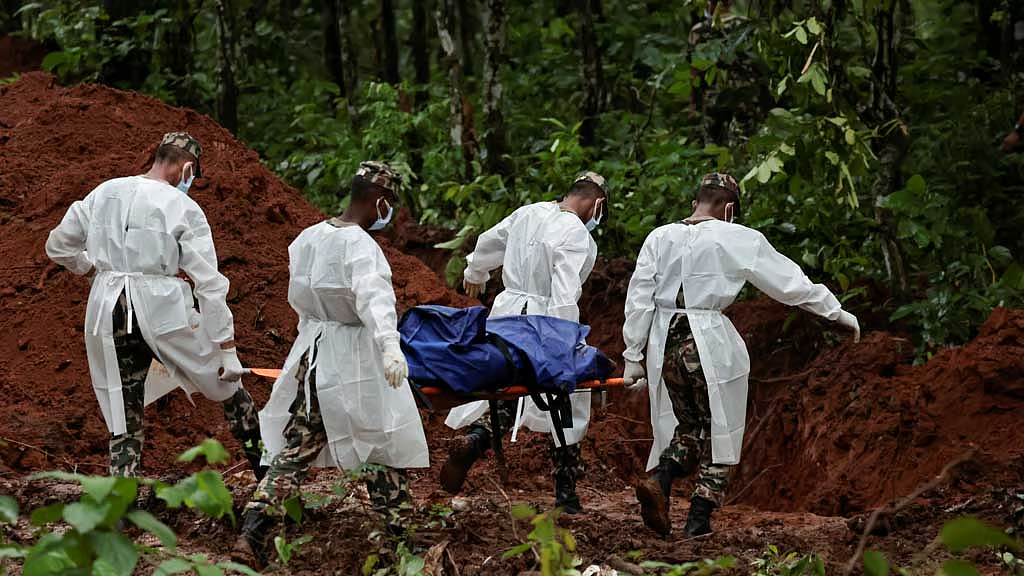
Nepal has commenced mass burials for unidentified flood victims, while families continue their search for missing loved ones
Nepal’s picturesque Chitwan district, renowned for its lush forests and flowing rivers, has emerged as the location for mass burials of hundreds of unidentified victims whose bodies were carried away by the deluge that ravaged the Himalayan region just days ago.
In the plains, almost 200 kilometers from the flood-affected valleys of Rasuwa, where the disaster occurred on Wednesday, authorities have excavated hundreds of graves in the Devghat forest of Chitwan.
Until recently, the forest trails served as a favored location for morning walks. They now function as a temporary resting place for remains that are too far gone to be recognized. “We found ourselves with no alternative and had to proceed with this decision. “Our concern was the risk to public health posed by the rapid decomposition of the bodies,” stated Ganesh Aryal, chief district officer of Bharatpur, Chitwan.
Authorities interred 96 unidentified bodies in the forest on Saturday and intended to bury over 100 additional remains on Sunday, as recovery teams persist in retrieving victims from rivers and heaps of debris.
Approximately 750 individuals have lost their lives, and over 3,000 are reported missing following a flash flood caused by a glacial collapse that ravaged valleys along Nepal’s border with China, resulting in devastating destruction.
Around 100 rescue workers, police officers, and other officials were assisting in documenting the deceased, photographing remains, aiding relatives with identification, and preparing bodies for burial.
Authorities stated that each burial site was meticulously documented, with identification markers positioned both above and below ground, along with accurate location data recorded.
DNA samples were gathered from the unidentified deceased by the Nepali authorities, enabling them to locate and exhume remains if victims are identified later through family claims, official records, or genetic testing.
India has dispatched a forensic team that will collaborate with their Nepali counterparts to assist in the analysis of DNA samples. Nepal is coordinating with a team from China.
HAUNTING IMAGES AND ODOR
At Bharatpur Hospital, the foul odor of decay wafted through the air at the entrance, roughly 200 meters from a makeshift morgue where approximately 50 police officers and hospital staff managed the bodies that had been recovered, many of them donning only simple surgical masks.
Officials permitted a Reuters reporter to have a brief look at the facility from the entrance.
Approximately 125 bodies were found on the floor, with many exhibiting advanced decomposition after spending days in floodwaters, which overwhelmed a morgue intended to accommodate only 50 bodies.
The bodies are decaying rapidly,” stated Inspector Anil Thapa, who is in charge of one of the facilities managing the deceased in the disaster-affected district. “Of the bodies we have retrieved thus far, over half are unrecognizable,” Thapa informed Reuters. Numerous individuals lack discernible faces.
A few hundred meters away, the Chitwan Expo Center has emerged as the central location for families in mourning who are seeking their missing loved ones.
Over 200 individuals assembled outside a hall where images of recovered bodies were anticipated to be shown for visual identification purposes. Numerous individuals in the crowd were seen with backpacks and luggage, indicating that they had journeyed from far-off areas.
Several families reported that they had arrived the day before but had yet to be permitted entry into the hall.
Nearby, an aging single-story house has been transformed into a temporary storage facility for bodies awaiting identification.
Three tents were set up outside the building, featuring a Nepal Red Cross helpdesk and a police registration point. Incense smoldered beneath the desks, yet it offered scant respite from the lingering odor.
As the Reuters reporter drew near, a police officer passed a mask, while another directed fellow officers to restock mask supplies if they became insufficient.
The dimly lit interior housed rooms filled with body bags arranged on bunk beds. Dry ice was placed near the entrances as air conditioners and an industrial cooling unit operated continuously to mitigate decomposition.
Recovery operations are currently in full swing.
As recovery operations progressed, a vehicle transporting 13 bodies reached the facility. By 10 a.m. local time, six ambulances were stationed outside, while another vehicle awaited its turn to unload.
Families stood outside, hoping for news about whether their loved ones had been among those recovered.
The continuous influx of bodies highlighted the magnitude of the disaster and the difficulties confronting authorities in identifying the deceased and offering answers to families still seeking their missing loved ones.
The toll was clear on those managing the bodies.
Once I arrive here to work, I find it impossible to think about food,” Thapa remarked, his uniform soaked with sweat. I can’t even muster the energy to drink water.