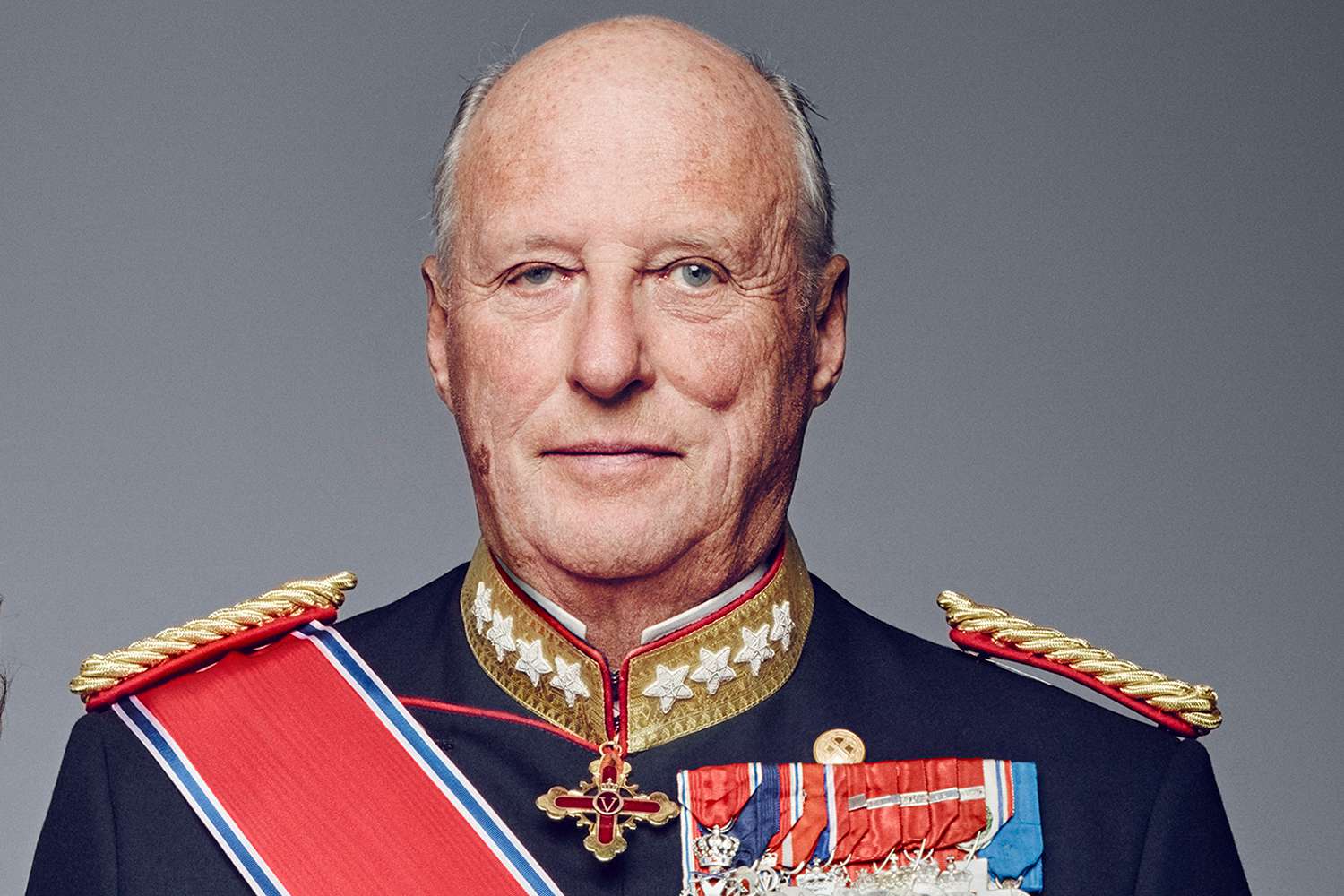
Norway’s King Harald V has passed away at the age of 89, concluding a remarkable 35-year reign on the throne
Norway’s King Harald V has passed away at the age of 89 after a remarkable 35 years on the throne, leaving behind a legacy as the nation’s cherished unifying monarch.
Norway’s King Harald V has passed away at the age of 89, as announced by the royal palace. His death marks the conclusion of a 35-year reign during which he significantly transformed the monarchy and became one of the nation’s most cherished public figures.
The king passed away peacefully at 06:35 local time (04:35 GMT) on Friday at the National Hospital in Oslo, where he had been undergoing treatment for a rare blood condition.
The royal flag at the palace was lowered to half-mast after the announcement was made.
Members of the royal family visited Harald during the last 24 hours of his life, as crowds gathered outside the palace to lay flowers in his memory.
Harald is succeeded by his 53-year-old son, Crown Prince Haakon, who is anticipated to convene an extraordinary council of state with the Norwegian government later on Friday.
King Charles III conveyed his deepest sympathies, while Sweden’s King Carl XVI Gustaf referred to Harald as “a valued friend to me, my family, and Sweden.”
He also extended his wishes for “success and good fortune” to his godson, the new King Haakon.
Harald took the Norwegian throne in January 1991 after the passing of his father, King Olav V.
Throughout the next thirty years, he earned a reputation as a relatable and accessible monarch who updated the institution while preserving its traditional function as a symbol of national unity.
Royal observers characterized him as the “People’s king” and a “grandfather” of the nation.
“He has always been open about his emotions, humor, and vulnerability, which has made him feel very relatable,” royal expert Caroline Vagle stated.
Historian and royal correspondent Ole-Jørgen Schulsrud-Hansen noted that Harald contributed to making the monarchy more egalitarian and transparent, particularly in aspects like finances and health.
Tove Taalesen, royal correspondent for Nettavisen, characterized him as “one of us,” while Vagle remarked that he had “always been very close to the people.”
Harald was the first king of Norway to be born in the country since the 14th century.
His reign featured numerous instances where he leveraged his position to foster national unity.
Following the 2011 terrorist attacks in Oslo and on the island of Utøya, where 77 people were killed by far-right extremist Anders Behring Breivik, Harald called on Norwegians to support one another and resist fear.
In a televised address weeks after the attacks, he spoke emotionally about the victims and their families.
“I can only imagine the depth of your pain. As king of this nation, I feel for each and every one of you,” he said.
Historian Schulsrud-Hansen described the moment as an enduring example of what a modern monarchy could represent.
Harald also helped reshape the Norwegian monarchy through his personal life.
He married Sonja Haraldsen, the daughter of a businessman, in 1968 after a nine-year struggle to secure his father’s approval.
King Olav had hoped his son would marry a European princess, but Harald made clear that he would remain unmarried rather than abandon Sonja.
The couple eventually married at Oslo Cathedral on 29 August 1968 and remained together for almost 58 years.
His decision helped pave the way for his children to marry commoners and contributed to a less traditional and more egalitarian royal family.
Harald’s modernizing approach also shaped his public views.
In a widely praised speech in 2016, he celebrated Norway’s diversity of religion, ethnicity, and sexual orientation, declaring that Norwegians came from countries including Afghanistan, Pakistan, Poland, Somalia, and Syria.
He also noted that Norwegians could believe in God, Allah, or the universe, or have no belief at all, and he supported acceptance of same-sex relationships.
Harald was born on February 21, 1937, at the Skaugum estate close to Oslo.
At just three years old, he experienced the invasion of Norway by Nazi Germany during the Second World War.
His mother escaped with Harald and his siblings across the border to Sweden before the family journeyed to the United States at the invitation of President Franklin D. Roosevelt.
After the war, they went back to Norway, where Harald finished his education and fulfilled his mandatory military service.
He ascended to the position of Crown Prince in 1957 and subsequently pursued studies in social science, history, and economics at Balliol College, Oxford, from 1960 to 1962.
An accomplished sailor, Harald represented Norway at three Olympic Games and maintained a strong connection to the sport throughout much of his life.
He was an environmental advocate and one of the founders of the Norwegian branch of the World Wide Fund for Nature, where he held the position of president for twenty years.
Harald’s public engagements diminished as his health worsened, leading to a permanent reduction of his official duties in April 2024.
Recently, he underwent cortisone treatment for hemolytic anemia, a rare blood condition that decreases the number of red blood cells in the body.
He was admitted to the hospital on 17 August, after which Crown Prince Haakon took on his responsibilities as regent.
His later years were marked by controversies surrounding his family members.
His daughter-in-law, Crown Princess Mette-Marit, encountered criticism due to her previous connection with convicted sex offender Jeffrey Epstein, while her son, Marius Borg Høiby, was found guilty in June of several offenses, including rape.
Høiby, who received a four-year prison sentence and has filed an appeal, visited Harald shortly before his passing.
Mette-Marit has encountered significant health challenges and underwent a lung transplant following a diagnosis of a rare form of pulmonary fibrosis.
Princess Märtha Louise, daughter of Harald, has drawn attention due to her relationships and business endeavors, particularly her upcoming marriage in 2024 to American self-proclaimed shaman Durek Verrett.
Despite the scandals, royal observers noted that criticism was rarely aimed at Harald himself. “When issues arise within the royal family, it appears that the king is often spared from blame,” remarked historian Trond Norén Isaksen.
Harald is survived by his wife, Queen Sonja, with whom he shared nearly 58 years of marriage; their daughter, Princess Märtha Louise; their son, King Haakon; and six grandchildren.
Haakon now ascends to the throne during a challenging period for the Norwegian monarchy.
Recent controversies and health issues within the royal family have led to a decrease in public support for the institution, as indicated by an Aftenposten poll showing support at 54%, down from 72% in 2024.
Haakon is anticipated to endure ongoing examination regarding the controversies linked to his family, especially those concerning Mette-Marit and her son.
Nevertheless, royal observers believe that he has shown commendable leadership in addressing the challenges.
Currently, the emphasis in Norway is expected to remain on grieving for a monarch who dedicated over thirty years to portraying himself as a king connected to everyday people.
Vagle expressed that the dominant public sentiment was unmistakable: “Everyone has loved King Harald.”