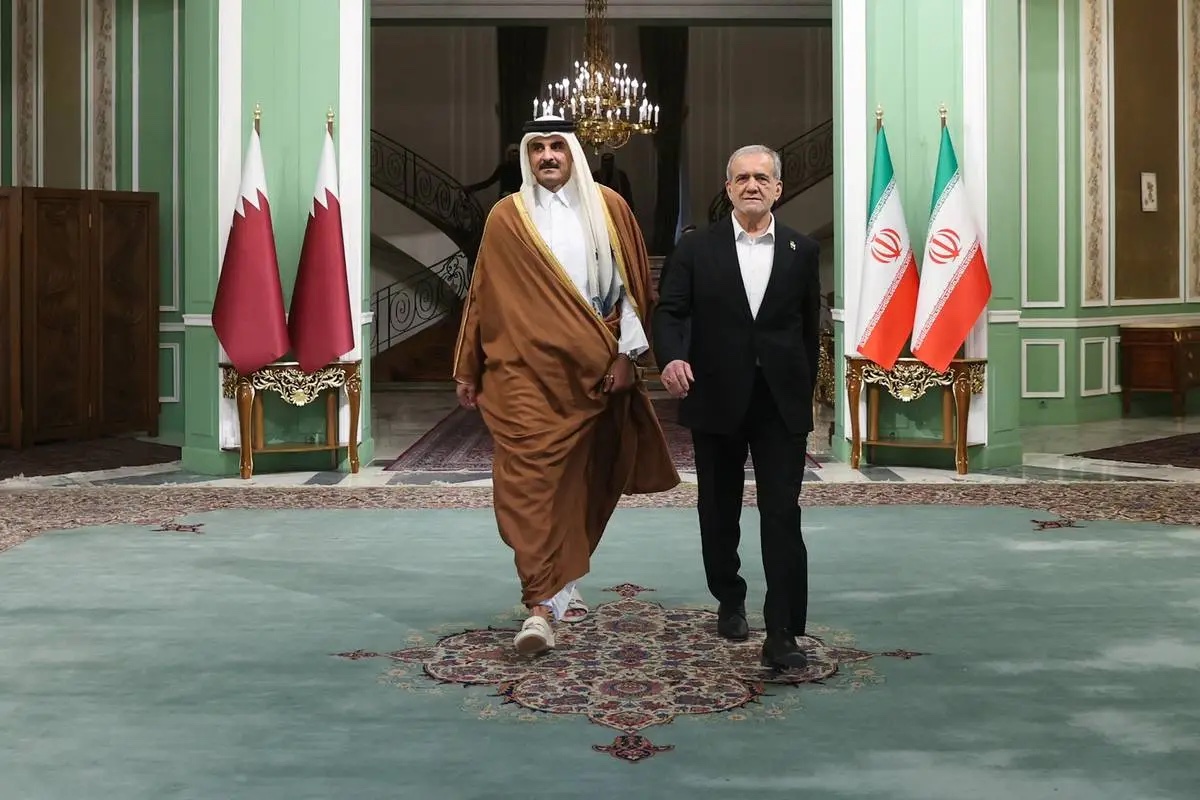
Qatar’s prime minister travels to Iran to advocate for de-escalation discussions amid rising worries over security in the Strait of Hormuz following recent tanker attacks.
Qatar’s Prime Minister, Mohammed bin Abdulrahman Al Thani, is currently in Iran for discussions focused on reducing tensions between Tehran and Washington, in light of ongoing disruptions in the strategically significant Strait of Hormuz.
Qatar, having acted as a back channel between the United States and Iran, announced that Al Thani would travel to Tehran to explore methods for alleviating tensions and fostering an environment suitable for dialog.
A spokesperson for the Qatari prime minister announced on X that Al Thani is set to meet with various Iranian officials during the visit.
“The discussions will also address freedom of navigation in the Strait of Hormuz and the necessity for it to revert to the status quo that existed prior to February 28,” the spokesperson stated.
The diplomatic outreach occurs amid ongoing concerns regarding maritime security in the Strait of Hormuz, following yet another reported attack on an oil tanker.
The UK Maritime Trade Operations agency reported that an oil tanker was hit by an unidentified projectile early Thursday off the coast of Oman.
The fire was put out, all crew members are safe, and an investigation into the incident is currently in progress, according to the agency.
Shipping traffic through the Strait of Hormuz has consistently stayed well below pre-war levels, even with US initiatives aimed at easing the movement of vessels along the Omani side of the waterway.
On Tuesday, only five ships completed confirmed crossings, a decrease from seven the day before and significantly lower than the over 130 vessels that crossed the strait daily prior to the war, as reported by shipping data firm Kpler.
According to Kpler, all five vessels utilized a unilateral route designated by Iran for shipping.
The recent tanker incident brings new scrutiny to US President Donald Trump’s claim that the strategic waterway has been cleared of mines and is safe for navigation.
On Wednesday, Trump stated that the Strait of Hormuz had been completely cleared of mines, referring to it as “a functioning strait.”
“Yes, occasionally there will be a drone or a rocket or something launched, but it is a very operational strait.” “A significant amount of oil is spilling out,” Trump stated.
Nonetheless, US allies continue to express doubts regarding the complete removal of Iranian mines from the waterway, as reported by Bloomberg.
Iran and Oman have reached an agreement on a temporary maritime corridor designed to ensure safer passage through the strait.
Iran’s Deputy Foreign Minister, Kazem Gharibabadi, stated that the waterway will not completely reopen until Washington meets its obligations under the interim peace deal framework signed in June, which has since expired.
The US military has upheld a naval blockade against Iranian vessels and has utilized the southern Omani lane to escort oil tankers through the Gulf.
The security situation has been exacerbated by Washington’s recent sanctions campaign against Iran, which the Trump administration has characterized as an “economic onslaught” aimed at disrupting Tehran’s financial ties globally.
The escalation has added further complexity to the prospects for renewed peace talks between Washington and Tehran.
In an interview with Al Jazeera on Wednesday, Trump stated that he had “no time schedule” for resuming negotiations with Iran to conclude the six-month war.
When asked if economic pressure was more effective than military strikes, Trump responded, “I think they are both effective.”
Meanwhile, Iranian Foreign Minister Abbas Araghchi has urged the United Nations and its member states to denounce the US sanctions campaign, labeling it as “economic terrorism.”
Araghchi stated that the UN holds a “legal and moral responsibility” to condemn the sanctions, which he described as illegal and criminal.
Al Thani’s visit to Tehran comes at a pivotal time, as Qatar aims to leverage its diplomatic channels to alleviate tensions while the quest to ensure safe navigation through the Strait of Hormuz remains unsettled.