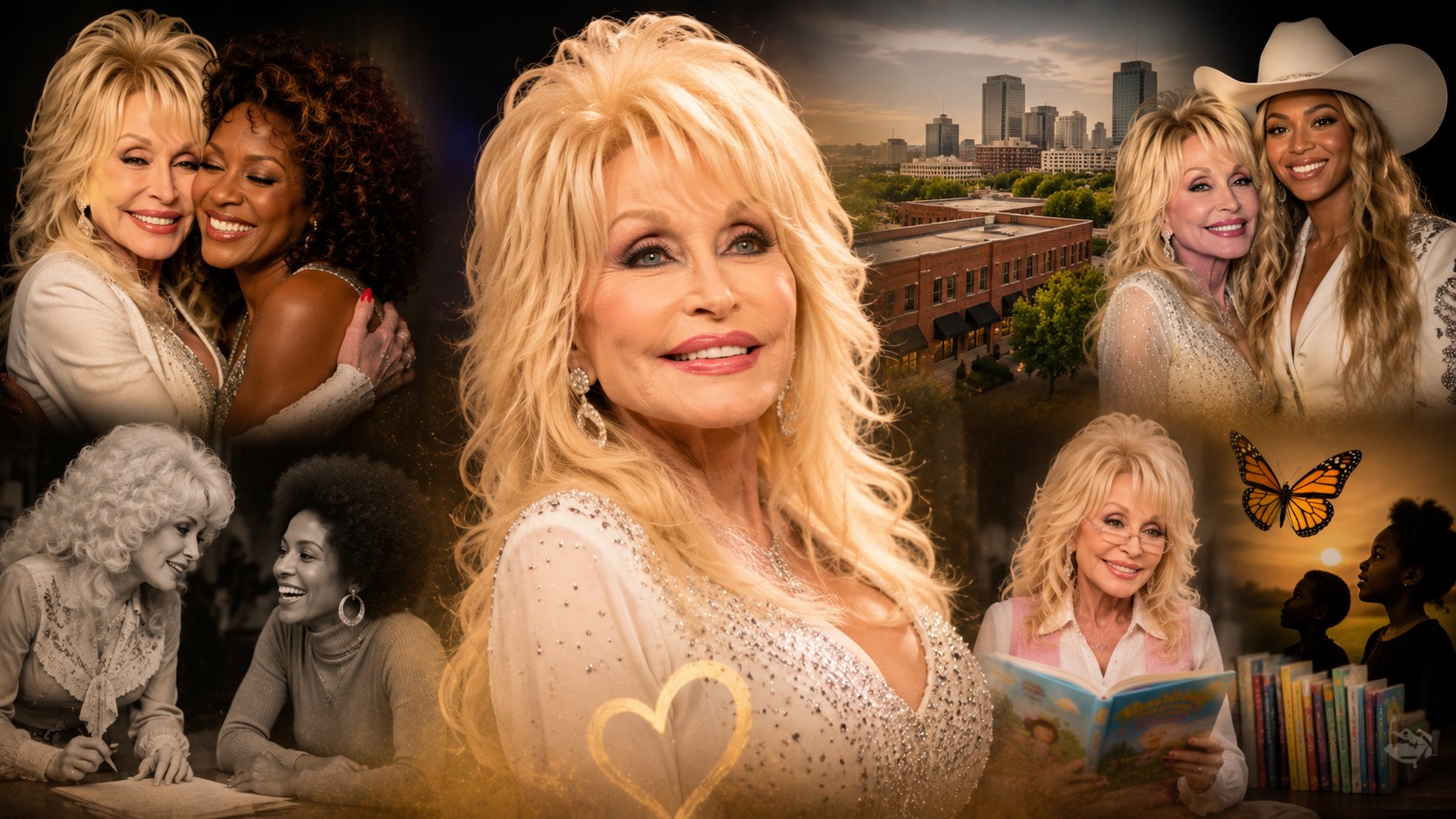
Dolly Parton’s influence on the Black community is more profound than many realize
Beyond “Jolene” and “9 to 5,” the country icon has quietly established a legacy marked by generosity, accountability, and respect for Black artists and communities.
Dolly Parton has passed away at the age of 80, leaving behind a remarkable seven-decade career characterized by timeless music, prolific songwriting, and a warmth that made fans from all backgrounds feel like family. Parton’s catalog is well-known, featuring hits like “9 to 5,” “Jolene,” and the ballad famously associated with Whitney Houston, “I Will Always Love You.” While her chart success and business empire, from Dollywood to her Imagination Library literacy program, will justifiably be the main focus in most retrospectives, Parton’s relationship with the Black community deserves its own recognition, as it runs much deeper than many casual fans understand.
The connection to Whitney Houston alone weaves a significant narrative. When Houston’s rendition of “I Will Always Love You” became one of the best-selling singles of all time from “The Bodyguard” soundtrack, Parton reaped significant songwriting royalties. Instead of merely keeping the money for herself, she invested those royalties into acquiring an office building located in a predominantly Black neighborhood in Nashville. Years later, while reflecting on her decision during an appearance on “Watch What Happens Live,” Parton articulated her reasoning with clarity. “I believed this was the ideal place for me, especially since it was Whitney. I felt, ‘This is wonderful; I’m going to be here with her people, who are also my people.’” It was a subtle yet significant act, linking her own financial achievement directly to the Black artist who had contributed to it.
Decades later, Beyoncé revitalized Parton’s catalog by reinterpreting “Jolene” for her 2024 album “Cowboy Carter,” changing the lyrics and offering her own powerful take on the classic. Parton openly welcomed the new interpretation, expressing pride in witnessing her song being embraced by one of the biggest artists globally and incorporated into a project that challenged the historically limited gatekeeping of the country genre regarding Black artists.
Parton’s connection with the Black community extended beyond musical partnerships. In 2018, she decided to rename her popular Pigeon Forge dinner show from Dolly Parton’s Dixie Stampede to Dolly Parton’s Stampede, eliminating the word “Dixie” due to its associations with the Confederacy. The move occurred two years before similar rebrands from groups such as the Dixie Chicks and Lady Antebellum. When Billboard inquired about the decision in 2020, Parton addressed the question directly and acknowledged her own past oversights without minimizing them.
“There exists a form of innocent ignorance, and many of us find ourselves culpable of it,” she remarked. Once you recognize that an issue exists, it is important to address it promptly. Don’t be foolish. That is the place where my heart resides. I would never consider causing harm to anyone intentionally. In that same interview, held during the nationwide protests after the murder of George Floyd, Parton made one of the most straightforward political statements of her career, telling Billboard directly, “And of course Black lives matter.” Do we believe that our small white behinds are the only ones of significance? No!
Parton’s generosity toward Black communities also reached areas she seldom highlighted publicly. Writer Michael Harriot confirmed that Parton has been a financial supporter of choir and band programs at predominantly Black high schools for years, doing so without ever publicizing those donations. This detail only gained wider public attention when others started sharing their own stories of her discreet generosity. That pattern aligns with the wider impact of her Imagination Library, the complimentary book mailing initiative she established that has touched the lives of millions of children nationwide, including many in underserved and predominantly Black communities who otherwise would not have had consistent access to books at home.
None of this diminishes the complexity of Parton’s role as a white country music icon whose early career unfolded within an industry that has historically marginalized Black artists and their contributions to the genre’s roots. Parton’s readiness to recognize her own blind spots, address them openly, and invest genuine resources in Black communities and Black artists distinguishes her from many of her contemporaries. This commitment is a key reason why numerous Black fans, artists, and commentators have expressed admiration for her over the years, extending beyond mere appreciation of her music.
As tributes continue to flow in after the announcement of her passing, Parton’s catalog will justly be honored for its breadth and exceptional songwriting talent. Her legacy within the Black community, established through royalty checks reinvested into Black neighborhoods, a readiness to openly acknowledge and rectify her own errors, and discreet support for Black students and institutions, is equally significant in portraying the complete essence of who Dolly Parton was.