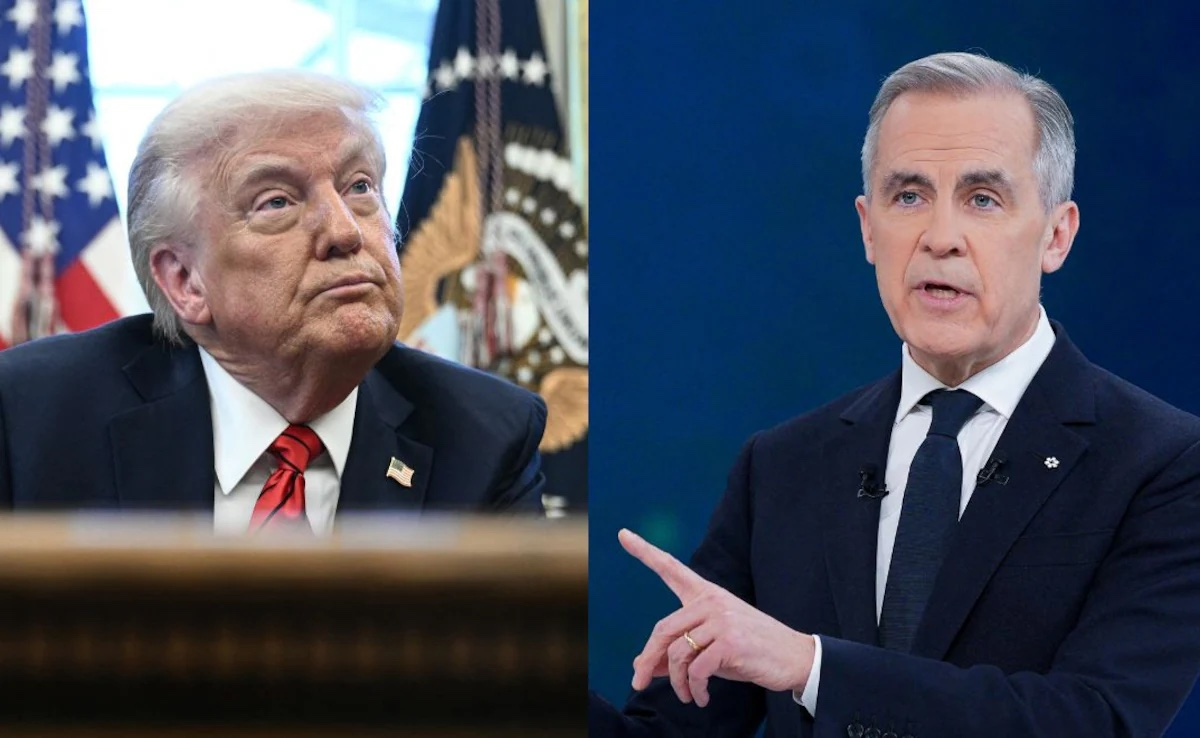
Trump has temporarily halted the 50% tariffs on Canada for three days, while Carney indicates that there is still work to be done
Trump has decided to pause the implementation of new 50% tariffs on Canadian goods for a period of three days, following Carney’s statement that substantial progress has been achieved.
US President Donald Trump announced late on Tuesday that he would be pausing the implementation of new 50% tariffs on Canadian goods for a period of three days, stating that a deal had been reached between the two countries.
The tariffs were set to take effect at midnight.
One hour later, Canadian Prime Minister Mark Carney announced that significant progress had been achieved, yet additional efforts were required.
“Significant advancements have been achieved, yet there remains crucial work ahead.”
Trump stated in a post on Truth Social that he suspended the tariffs “based on the fact that Canada and the U.S.A., subject to the finalization of documents, have a DEAL.”
Trump and Carney had a conversation on Tuesday afternoon. It was their second conversation of the week, as negotiators continued discussions that had been ongoing for several weeks.
“As we pursue this endeavor, Canada is dedicated to fostering a more robust, self-sufficient, and competitive economy domestically,” Carney stated.
The office of US Trade Representative Jamieson Greer stated that the agreement would encompass “comprehensive market access for all American goods, economic security commitments, and digital trade alignment,” along with other provisions.
In a statement shared on the White House website, Trump announced that he had secured Canada’s assurance to tackle US concerns regarding tariffs on dairy products, alcoholic beverages, and motor vehicles.
US officials provided no additional information. The Canadian government did not provide confirmation regarding the contents of any agreement.
According to two industry sources familiar with the negotiations, existing US auto tariffs had been a significant obstacle.
The suggested tariffs would have encompassed approximately $20 billion in imports. They would have applied regardless of the qualification of Canadian goods for preferential treatment under the US-Mexico-Canada trade agreement, which has shielded a significant portion of Canadian industry from previous US tariffs.
Trump also stated that the Keystone XL pipeline, a project that was canceled by former President Joe Biden in 2021 following years of opposition from Indigenous groups and environmental advocates, “may be awoken from the grave.”
He did not offer additional information.
Trump has prioritized tariffs in his foreign and trade policies, facing legal challenges and criticism from certain analysts along the way.
Tariffs may have resulted in job losses.
Trade experts and industry officials cautioned that the new tariffs might lead to job losses and business closures in vulnerable Canadian sectors such as lumber, wine, and dairy.
They also cautioned that the disagreement might complicate broader USMCA negotiations.
Canada’s minister responsible for US trade, Dominic LeBlanc, and chief trade negotiator Janice Charette have been in Washington since last week for discussions.
On Monday, Canadian officials engaged in a nearly two-hour meeting with Greer and Commerce Secretary Howard Lutnick.
Greer has consistently expressed worries regarding the Canadian tariffs implemented following the initial US tariffs, Canada’s dairy management system, and the reluctance of certain provinces to carry US liquor.
In a statement released late on Tuesday, the Distilled Spirits Council of the US expressed its approval of Trump’s announcement and urged for “a negotiated solution that reinstates American spirits on retail shelves across all Canadian provinces and restores the spirits sector to a zero-for-zero tariff framework.”
The two sides have engaged in discussions regarding the potential reduction of US Section 232 tariffs on Canadian vehicles from 25% to 15%. Additional reductions may be considered based on the level of US content in each vehicle, according to sources.
Disagreement Regarding Tariff Reductions
A significant dispute arose regarding the calculation of tariff deductions based on vehicle content.
Washington sought to have only US-produced content recognized, while Canada advocated for the inclusion of all North American content, including contributions from both Canadian and Mexican sources, as reported by sources.
On Tuesday, the US Commerce Department announced new regulations mandating that automakers exporting from Canada and Mexico must certify their existing levels of US content to qualify for tariff deductions.
The rules now streamline the certification process to occur once a year instead of twice.
However, the notice in the Federal Register stated that automakers are required to re-certify the US content of vehicles by September 30 to claim deductions under the new annual cycle starting on December 1.
A source from the Canadian government indicated last week that all options remained available if the new tariffs were implemented.
Those options encompassed governmental assistance for impacted domestic sectors and a potential halt to bilateral trade discussions.
The source indicated that Canada continued to be optimistic about the US’s willingness to come to an agreement.