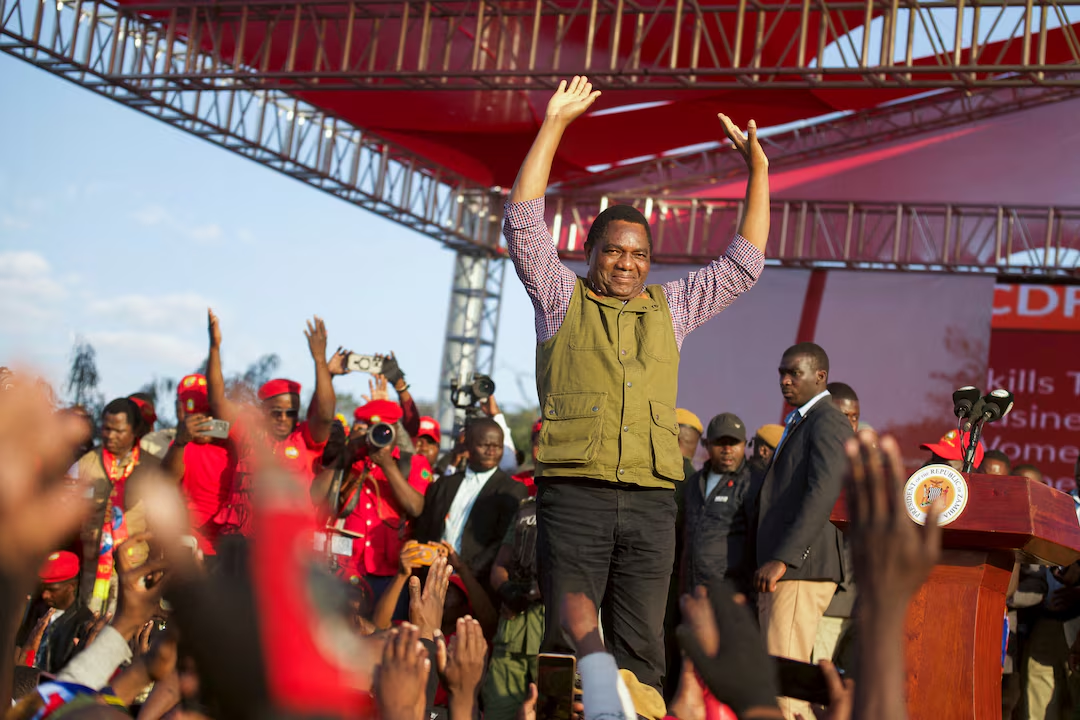
Zambian President Hakainde Hichilema’s re-election offers investors the policy continuity they desired, while discussions on a new International Monetary Fund program present an initial challenge to determine if a second term can transform economic stabilization into lasting growth.
The copper producer is recovering from years of economic challenges after being the first African sovereign to default during the COVID-19 pandemic in 2020. Hichilema’s initial term included an extensive debt restructuring process and IMF-supported reforms, while challenges such as drought, power shortages, and a depreciating currency tested the recovery.
The election commission released results in the early hours of Tuesday morning, indicating that Hichilema garnered approximately 60% of valid votes, while his main challenger, Brian Mundubile, received around 38%.
Hichilema provides a sense of continuity for investors,” stated Stuart Culverhouse, chief economist and head of fixed-income research at Tellimer. The challenge now will be to build on gains in macroeconomic stability, lower inflation, and fiscal discipline while accelerating growth and investment, he stated. His government has already indicated it would pursue a new IMF program if re-elected, which may serve as the initial test for investors.
Zambia’s 2033 dollar bond, the country’s only international bond, was bid at 97.72 cents on the dollar on Tuesday, remaining largely stable despite a challenging environment for African debt markets.
Zambia is pursuing a new program with the IMF.
The southern African nation seeks to establish a new IMF program by the end of the year following the expiration of its previous $1.7 billion arrangement in January. Finance Minister Situmbeko Musokotwane informed Reuters prior to the election that new investment is essential for stimulating growth and generating employment. However, he noted that it remains premature for Zambia to reenter international bond markets, as the government aims to strengthen its partnership with the Fund.
Investors believe that a future Eurobond issuance may assist in drawing foreign capital.
If they were to reissue debt in the international market, that would also be beneficial, as it would provide the companies in the country a benchmark for pricing bonds,” said Philip Fielding, portfolio manager at Fidelity International. It would simply create a curve,” he stated, alluding to a wider array of bond maturities that would provide investors with greater options.
Jetro Siekkinen, head of emerging markets fixed income at LGT Capital Partners, which holds domestic Zambian government bonds, stated that the country has shown an “extremely strong performance from an economic perspective” and has implemented “many reforms.” He referred to the measures taken by the Hichilema government to address debt, fiscal discipline, and challenges related to the mining tax regime.
Siekkinen stated that investors are observing if the central bank upholds its independence and clear communication, as well as whether fiscal policy stays disciplined while the government shifts its focus to infrastructure spending.
Risks to Zambia’s outlook
Africa’s second-largest copper producer aims to achieve an annual output of 3 million metric tons, which is nearly three times the current levels, as it looks to take advantage of the increasing demand for the metal in industries like power grids and construction.
Thomas Christiansen, head of emerging markets fixed income at UBP, indicated that the El Niño weather phenomenon presents a risk to copper production, referencing the disruption experienced three years ago when drought affected hydropower output. Scientists indicate that the ongoing El Niño is intensifying and has over a 90% likelihood of evolving into a strong event.
Christiansen noted that during the previous period, Zambia sourced a significant portion of its energy from hydropower. During the drought, electricity production significantly decreased, leading to some rolling blackouts.
Consequently, there was a notable decline in copper production.