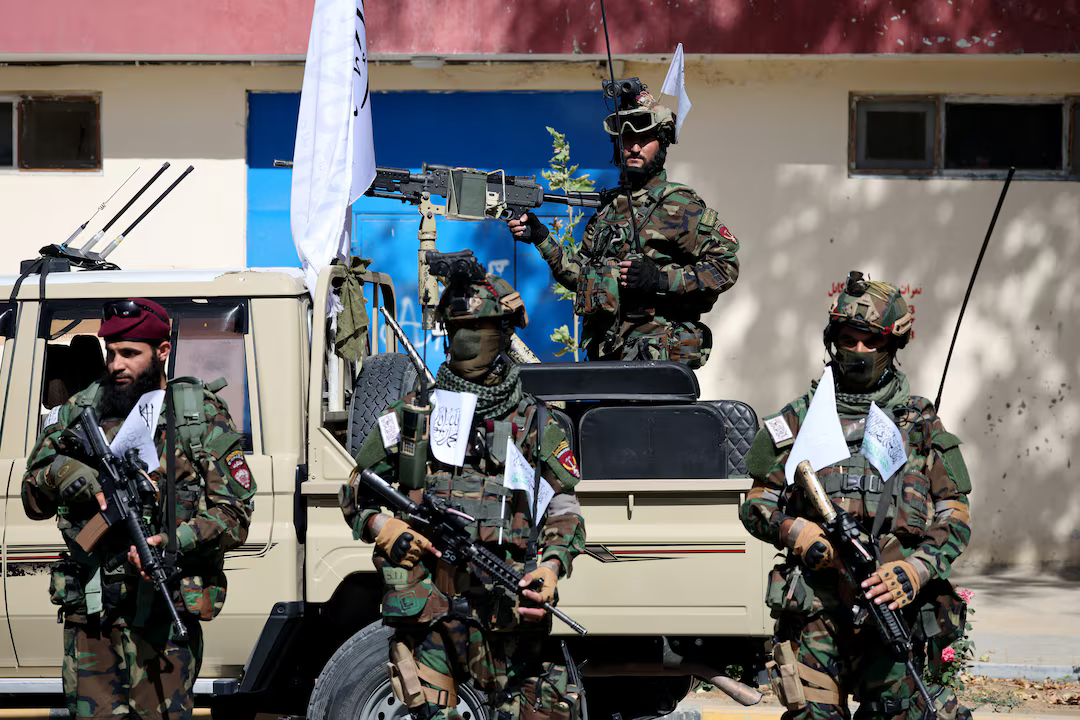
Taliban commemorate five years in authority as humanitarian organizations caution about an impending crisis
The Taliban celebrated five years in power on Saturday, aiming to present their government as stable, despite warnings from aid and rights organizations about worsening crises.
Outside the former U.S. embassy in Kabul, armored Taliban vehicles participated in a parade, showcasing flags and banners and commemorating what the government referred to as “victory day” over Western domination.
Sirajuddin Haqqani, the Taliban’s interior minister, stated in a video address that their resurgence to power was due to “morale, courage,” and “divine assistance.
However, he also made a rare acknowledgment of “issues and problems that may still exist.”
International organizations and the U.N. report that the Taliban have faced challenges in addressing the natural and humanitarian crises in Afghanistan over the past five years, partly due to the severe restrictions placed on Afghan women.
The Taliban have encountered a series of assassinations targeting important regional officials in the northeast of the country in recent weeks.
In late July, an attack killed the Taliban’s information director in Badakhshan province, and Islamic State later claimed responsibility. The mayor of the province’s capital was also reported to have died in an attack on Thursday, according to local media.
Officials from the Taliban have not yet provided confirmation regarding the reports.
Diplomatic advancements
When the Taliban regained control in 2021 during the withdrawal of the U.S. and its allies, they vowed to rule with greater liberalism compared to their regime in the late 1990s and early 2000s — a time characterized by public executions, the harboring of Osama bin Laden, and the obliteration of the Bamiyan Buddhas.
However, those assurances soon weakened, according to human rights groups. The Taliban have enacted extensive restrictions on women and girls since 2021, preventing 2.5 million of them from attending secondary schools and universities, as reported by UNESCO, and curtailing their freedom of movement.
According to data released by U.N. Women on Wednesday, half of Afghan women now leave their homes only once or twice a month.
The Taliban claim to uphold women’s rights in alignment with Islamic sharia law.
Five years later, their government continues to lack international recognition, with Russia being the sole country to have officially acknowledged it.
Relations between the Taliban and Pakistan, once their most significant ally, have become strained, with Islamabad alleging that Kabul is providing support to Pakistani insurgents.
Numerous former embassies in Kabul have stayed vacant since the Taliban regained control, including the U.S. embassy that served as the backdrop for Taliban celebrations on Saturday.
Analysts suggest that the Taliban have made subtle diplomatic progress, as certain countries consider the boundaries of their influence in Afghanistan and the necessity of engaging with the government.
The Taliban are actively pursuing agreements with European countries that are looking for methods to deport a higher number of Afghans. The government in Kabul is leveraging its geographical position at the intersection of South and Central Asia and the Middle East to forge economic agreements.
Zia Ahmad Takal, a deputy spokesman for the Taliban’s foreign ministry, informed Reuters that ceremonies commemorating the government’s fifth anniversary are anticipated to take place in the capitals of Pakistan, China, Uzbekistan, Iran, Turkey, and Malaysia. “My hope for the future of Afghanistan is that we will move toward development, God willing,” expressed Najibullah Ghorzang, a 28-year-old shop owner who participated in Saturday’s ceremonies in Kabul. “We defeated a great empire, and we will defeat them again,” he remarked regarding the U.S. and its allies.
Existential concerns
The International Rescue Committee cautioned on Friday that Afghanistan’s humanitarian needs have reached unprecedented levels, influenced by droughts, the aftermath of devastating earthquakes, and the deportation of Afghans from neighboring Iran and Pakistan.
While foreign aid budgets have decreased, the number of Afghans requiring humanitarian assistance has increased by 3.5 million since 2021, according to reports. “Sustainable peace and prosperity necessitate more than merely the absence of conflict,” stated Georgette Gagnon, a senior U.N. representative on Afghanistan. Afghanistan’s future hinges on establishing a society that fulfills the rights and potential of all Afghans.
Fatima, 28, has faced challenges in her efforts to provide for her child. Following the Taliban’s resurgence, she escaped to Iran, where she was able to pursue her career as a make-up artist, despite the Taliban’s prohibition on women engaging in such professions in Afghanistan.
Last year, she was expelled from Iran and deported to Afghanistan. “Every morning, I wake up wondering how I will cover my basic living expenses, and every night I close my eyes with worries about my child’s future,” she expressed.