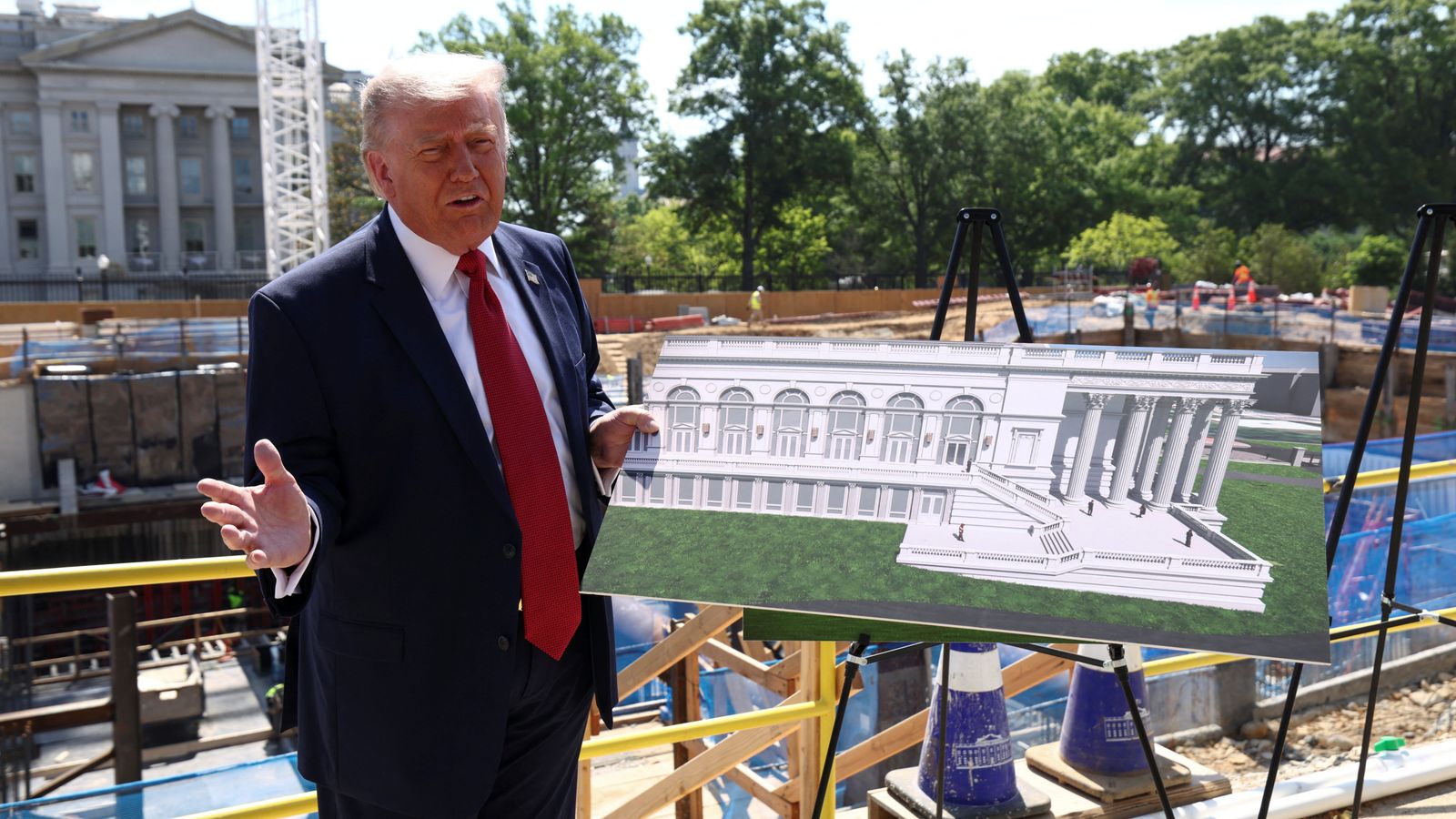
Trump’s $400 million White House ballroom project has been halted by a US Appeals Court
A US appeals court has put a stop to above-ground construction of Donald Trump’s proposed White House ballroom, stating that Congressional approval is necessary for the project to proceed.
A federal appeals court in the United States issued an order on Friday for Donald Trump’s administration to halt construction on a $400 million ballroom at the location of the demolished East Wing of the White House, presenting a significant setback for the Republican leader in a case that examines his presidential authority.
“Each president is a temporary tenant, not the owner, of the White House,” and cannot fundamentally reshape it without congressional approval, the Washington-based US Court of Appeals for the District of Columbia Circuit stated in a 2-1 opinion, Reuters reported.
The order upheld a preliminary injunction obtained by the National Trust for Historic Preservation, which filed a lawsuit last year after the administration demolished the East Wing and commenced construction on a 90,000-square-foot (8,360-square-meter) ballroom without obtaining authorization from Congress.
“The decision regarding the construction of a massive ballroom rests with Congress and is not an issue for executive president self-help,” stated the majority of the panel.
The appeals court has temporarily paused its ruling for 14 days, providing the Trump administration the opportunity to appeal to the U.S. Supreme Court.
Trump labeled the structure a “military center” in a post on Truth Social on Friday and announced that the administration would appeal to the Supreme Court, asserting that the ballroom project is essential for security. He described the decision as “horrendous” and politically motivated, stating that it left him, along with other White House officials and visitors, vulnerable to attack.
“This unjust decision must be completely overturned by the Supreme Court,” Trump wrote. He stated that the ballroom plan encompasses bomb shelters, medical facilities, and protection from drones and missiles, along with various other security features that are “all interconnected as one large, costly, and highly intricate unit.”
National Trust President Brent Leggs stated that the ruling signifies “a wonderful day for our country and for the American people’s right to voice their opinions about the historic places they cherish, including the White House.”
Trump filed an appeal following the decisions made by U.S. District Judge Richard Leon, who was appointed by former Republican President George W. Bush. The judge had twice prohibited above-ground construction at the site while permitting underground work to proceed.
The ballroom plan, deemed essential by the administration for accommodating large formal events and ensuring the safety of the White House, stands as the most ambitious of several initiatives by Trump to transform the architectural landscape of central Washington, including government buildings and national monuments.
A judge in a separate lawsuit recently stated that Trump’s name was unlawfully affixed to the exterior of the Kennedy Center performing arts venue and mandated its removal.
In the ballroom case, attorney Yaakov Roth from the Justice Department stated during D.C. Circuit arguments on June 5 asserted that the courts should not intervene in evaluating the privately funded project. He stated that the National Trust’s “architectural preference” ought not to take priority over national security issues, asserting that there is evidence suggesting the former East Wing left the president and others in the White House exposed to potential attacks.
The majority of judges on the appeals court, appointed by the Democratic Party—Circuit Judges Patricia Millett and Brad Garcia—stated that their order does not impose a permanent ban on the construction of a ballroom. However, it does pause above-ground work during the lawsuit and until the White House obtains approval from Congress.
The opinion stated that national security arguments do not serve as an automatic exemption from legal obligations.
“The audacious claim that the Executive can operate without regard for the law, demolishing cherished national monuments and jeopardizing individual rights, while remaining beyond the reach of the courts, undermines our constitutional framework,” the judges stated.
Circuit Judge Neomi Rao, appointed by Trump during his first term, expressed in her dissent that the trial judge’s injunction halting the project “is beyond the proper province of the federal courts” and asserted that construction should proceed.
“The district court took control of construction at the White House, and my colleagues concur with this judicial overreach,” Rao stated.