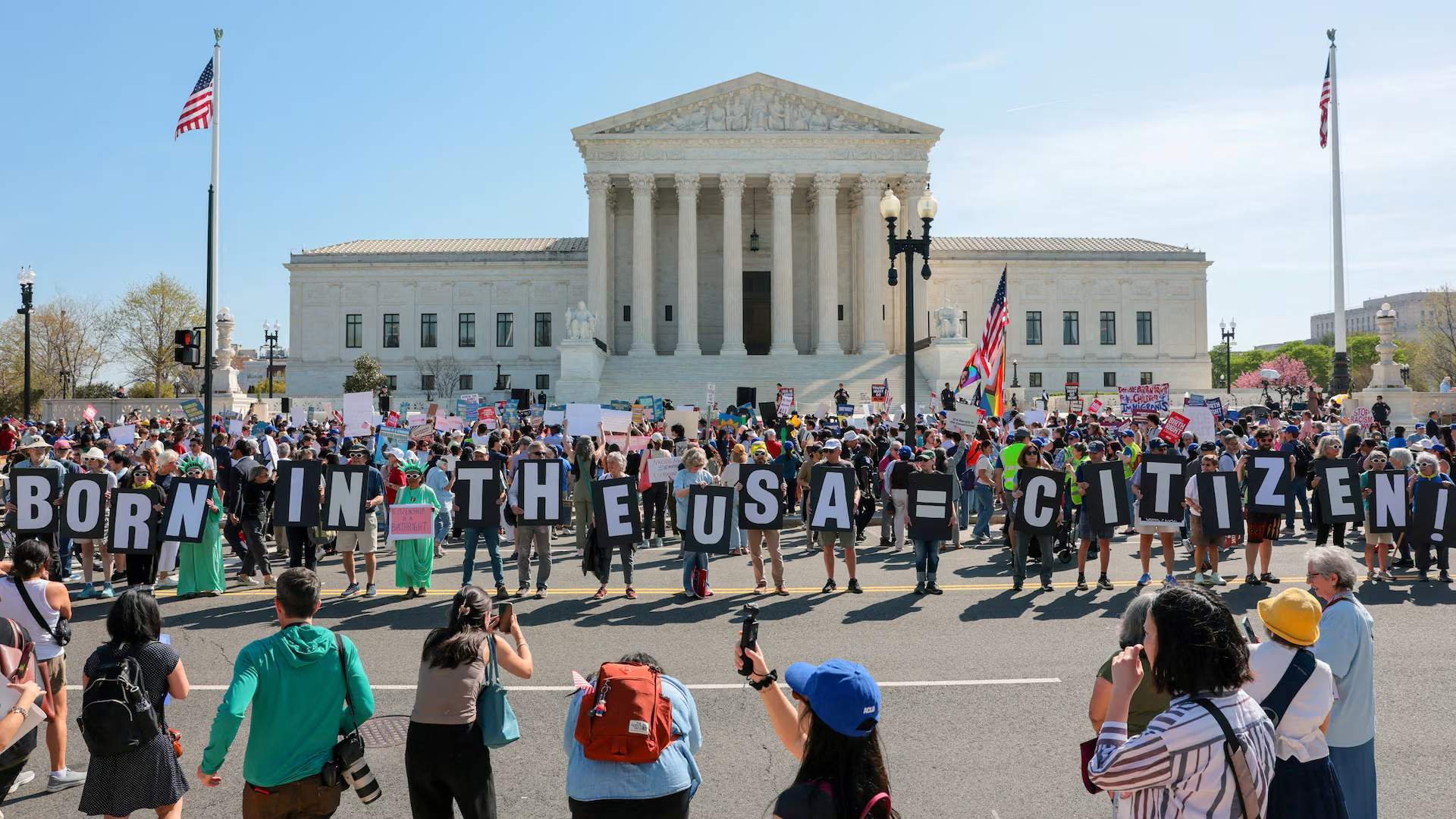
The Supreme Court has denied Trump’s attempt to limit birthright citizenship
The U.S. Supreme Court on Tuesday turned down President Donald Trump’s brave attempt to limit birthright citizenship in the U.S., a right that has been a part of American society for a long tiThis ruling was was one of Trump’s main goals in his crackdown on immigration and was a crushing loss for him.
The 6-3 decision was the second time this year that the court had thrown out a major Trump effort. In February, the court threw out Trump’s broad global tariffs.
A lower court’s decision to block Trump’s order telling U.S. agencies not to accept the citizenship of children born in the U.S. if neither parent is an American citizen or legal permanent resident, also known as a “green card” holder, was upheld by the Supreme Court.
People who were against Trump’s order said it went against the 14th Amendment of the U.S. Constitution, which says that individuals born in the U.S. and “subject to the jurisdiction thereof” are citizens.
“WE WILL KEEP THAT PROMISE.”
The ruling was written by conservative Chief Justice John Roberts. He said that Trump’s order goes against the 14th Amendment of the U.S. Constitution, which says that almost everyone born in the U.S. is a citizen, with a few small exceptions.
Citizenship, “then and now, was the right to have rights—to freely participate in our political community,” Roberts wrote. He also said that the 14th Amendment gave that promise to every free-born person in the country. “We keep that promise today.”
Trump has a long-standing record of exceeding the boundaries of presidential authority in both domestic and foreign policy. He signed the order on his first day back in office last year as part of a set of policies to crack down on both legal and illegal immigrants. Some people have said that the Republican president’s approach to immigration is biased against people of color and Christians.
They said that the Supreme Court had already decided on birthright citizenship in the case of United States v. Wong Kim Ark (1898). That case said that the 14th Amendment gives citizenship to anyone born in the United States, even if their parents are not citizens.
Roberts brought up that decision from 1898.
“Not surprisingly, then, in the 128 years since, we have repeatedly understood the rule of Wong Kim Ark to guarantee citizenship to all children born in the United States and subject to its power,” Roberts said. “We see no reason to depart from that view today.”
Roberts said that the Trump administration’s “dramatically revisionist view” of how to interpret the citizenship language of the 14th Amendment to limit birthright citizenship was “scarcely supported.” “If Congress intended to limit American citizenship to the children of those domiciled in the United States, nothing in the succinct language of the Citizenship Clause conveyed that design,” Roberts wrote.
Brett Kavanaugh, a conservative justice, agreed with the decision to reject Trump’s order, but he didn’t agree with the reasoning. In a separate opinion, he said that the order goes against a different federal rule that spells out birthright citizenship rights, but not the 14th Amendment itself.
The Supreme Court spoke about what it means to be an American citizen right before July 4, which is the holiday that marks the 250th anniversary of the beginning of the United States.
Before the decision, some experts said that Trump’s order could change the legal status of up to 250,000 babies born every year and could make the families of millions more babies prove that their babies are citizens.
A CASE UNDER CLASS ACTION
The Supreme Court, which has a 6-3 conservative majority, looked at a lawsuit against Trump’s order. It was a class-action lawsuit from parents and children whose citizenship was at risk because of the directive.
The 14th Amendment, enacted many years ago, ensured that all babies born in the United States are citizens. The only people who weren’t automatically citizens were children of foreign officials or members of an enemy occupying force.
The provision at issue, referred to as the Citizenship Clause, articulates: “All persons born or naturalized in the United States, and subject to the jurisdiction thereof, are citizens of the United States and of the state wherein they reside.
The administration says that “subject to the jurisdiction thereof” means that being born in the United States is not enough to become a citizen. They also say that babies of immigrants who are in the country illegally or whose presence is legal but temporary, like college students or people on work visas, are not eligible.
The administration has argued that citizenship is granted solely to the children of individuals whose “primary allegiance” lies with the United States, encompassing both citizens and permanent residents. Such allegiance is established through “lawful domicile,” which the administration’s lawyers define as “lawful, permanent residence within a nation, with intent to remain.
When the Supreme Court heard the case on April 1, Trump was the first sitting president to attend arguments before the highest court in the United States. He left in the middle of the proceedings, not long after the lawyer arguing against the government started.
The Supreme Court last year granted Trump an initial victory regarding birthright citizenship in a ruling that limited the authority of federal judges to restrict presidential policies across the country. That ruling, however, did not decide whether Trump’s order was legal or not.
Democratic state attorneys general celebrated the Supreme Court’s decision after initiating their own legal challenge to Trump’s birthright citizenship executive order.
Today’s decision reaffirms a core principle of American democracy: that every child born in this country, regardless of their background, is equal under the law and has the opportunity to pursue the American Dream,” stated California Attorney General Rob Bonta.
New York Attorney General Letitia James stated that birthright citizenship is “a constitutional guarantee that has defined this nation for generations.
‘BIRTH TOURISM’
During the arguments, U.S. Solicitor General D. John Sauer, representing the administration, stated that the promise of citizenship for nearly any baby born on U.S. soil has given rise to what he referred to as a vast industry of “birth tourism.
Sauer stated that “uncounted thousands of foreigners from potentially hostile nations have flocked to give birth in the United States in recent decades” to secure citizenship for their children. When asked to elaborate on the seriousness of the issue of “birth tourism,” Sauer mainly referenced media reports and acknowledged that “no one knows for sure.
The 14th Amendment was ratified in 1868 following the Civil War from 1861 to 1865, which abolished slavery in the United States. It also reversed a notorious 1857 Supreme Court decision that stated individuals of African descent could never be U.S. citizens.
During arguments, Sauer articulated what he perceived as the narrow intent of the 14th Amendment Citizenship Clause, stating it was enacted “to grant citizenship to the newly freed slaves and their children, whose allegiance to the United States had been established by generations of domicile here.
AN 1898 PRECEDENT
The administration argued that the 1898 precedent backed Trump’s order, as the court’s ruling in that case indicated that at the time of his birth, Wong Kim Ark’s parents had a permanent domicile and residence in the United States.
During the arguments, some justices expressed their reservations, with conservative Justice Neil Gorsuch addressing Sauer: “Well, I’m not sure how much you want to rely on Wong Kim Ark.
For years, Trump had issued threats regarding the limitations on who would qualify for citizenship at birth.
Trump expressed on social media last year: “Birthright citizenship was not intended for individuals who come for vacations to become permanent citizens of the United States of America and bring their families along, all while mocking us as ‘SUCKERS’!
However, the drug cartels are quite fond of it! Trump expressed that, in the interest of political correctness, America is perceived as a foolish country; however, he argued that this perspective is fundamentally contrary to the essence of political correctness and highlights another aspect contributing to the dysfunction within the nation.
In July 2025, U.S. District Judge Joseph Laplante, based in Concord, New Hampshire, permitted the plaintiffs in the case before him to challenge Trump’s order as a class, thereby enabling the policy to be blocked on a nationwide scale.
IMMIGRATION RULINGS
The court’s conservative majority has supported Trump on various significant immigration-related policies since his return to the presidency.
On June 25, the court allowed the Trump administration to proceed with plans to revoke the humanitarian status of hundreds of thousands of Haitian and Syrian immigrants, which had previously shielded them from deportation. On the same day, it supported him by endorsing the U.S. government’s power to reject asylum seekers when officials consider U.S.-Mexico border crossings too overwhelmed to accommodate further claims.
In other cases, it let Trump temporarily expand mass deportation efforts while legal issues are being worked out, such as ending humanitarian protections for certain migrants, sending people back to countries where they have no ties, and carrying out aggressive immigration raids that might focus on people based on their race or language.
The court, however, has not consistently ruled in Trump’s favor. In February, it annulled extensive tariffs he sought under a law intended for application in national emergencies. It prevented him from firing Federal Reserve Governor Lisa Cook on Monday.
Tuesday marked the conclusion of rulings for the court’s current term, which commenced in October.