Trump officials contemplated a ban on voting machines, referencing a conspiracy theory
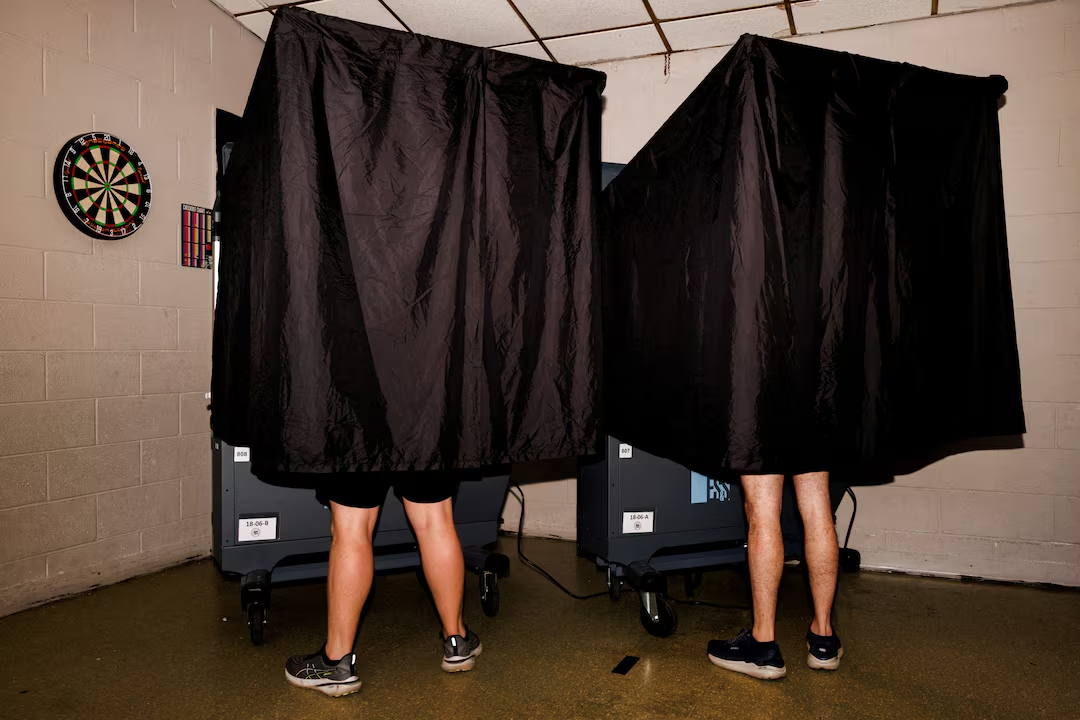
Officials in the Trump administration allegedly contemplated the idea of prohibiting voting machines rather than addressing allegations of fraud.
Officials in US President Donald Trump’s administration last year considered plans to restrict voting machines utilized in over half of American states, referencing election-fraud allegations that have consistently been debunked, according to sources familiar with the discussions.
The proposal reportedly focused on whether the US Commerce Department could categorize components utilized in Dominion Voting Systems machines as potential national-security threats.
The initiative was propelled by White House adviser Kurt Olsen, a lawyer closely linked to Trump’s persistent assertions that the 2020 presidential election was manipulated, even though courts and investigations have found no evidence of significant fraud.
Sources indicated that the discussions were part of wider internal conversations among administration officials regarding the enhancement of federal control over elections, a responsibility traditionally overseen by individual states according to the US Constitution.
Olsen reportedly advocated for the replacement of electronic voting systems with a nationwide system of hand-counted paper ballots, a proposal that has received repeated support from Trump. Election security specialists have contended that current systems that integrate electronic tabulation with paper audit trails tend to be more dependable and secure.
Multiple sources indicate that the proposal progressed sufficiently for Commerce Department officials to begin evaluating, in September, the legal grounds that could support restrictions on Dominion machines. The initiative subsequently came to a halt as the officials involved were unable to provide evidence substantiating the claims that the machines represented a security threat.
The episode underscores a broader initiative by the Trump administration to contest state authority regarding election administration in the lead-up to the US midterm elections. Reuters previously reported that officials in multiple states had pursued access to voting equipment, reopened voter-fraud investigations that had been dismissed by courts, and requested confidential election records.
Sources indicated that Olsen aimed to sideline Dominion machines prior to the upcoming midterms. Others said to be involved in the discussions were Paul McNamara, an aide to Director of National Intelligence Tulsi Gabbard, and Brian Sikma, a White House adviser linked to Trump’s Domestic Policy Council.
McNamara, who formerly headed an intelligence task force investigating vulnerabilities in voting machines, reportedly reached out to officials at the Commerce Department to inquire if Dominion software and chips could be classified as security risks.
Reuters reported that it was unable to verify if Commerce Secretary Howard Lutnick had direct knowledge of the discussions. A spokesperson for the department stated that Lutnick did not take part in any discussions related to the election.
Neither Olsen, McNamara, nor Sikma provided responses to requests for comment.
Democrats and advocates for election integrity have expressed worries that the administration’s actions may erode confidence in elections and provide a basis for contesting unfavorable outcomes through unfounded fraud claims.
The US Election Assistance Commission reported that over 98 percent of voting jurisdictions currently generate paper records for ballots cast, utilizing either machine-generated printouts or hand-marked ballots that are scanned electronically. Numerous election-security experts maintain their support for the existing system, as it facilitates audits and recounts through the use of voter-verified paper records.
Critics of hand-counted ballots contend that manual counting may lead to human error and heighten the chances for ballot tampering. University of Michigan computer-science professor Alex Halderman cautioned that transitioning completely to hand counting might lead to confusion and elevate the risks of manipulation.
A spokesperson for the White House characterized the Reuters report as misleading and reliant on selective leaks, while a representative from Gabbard’s office labeled certain elements of the report as inaccurate.
The discussions also revived long-discredited allegations linking Dominion voting systems to Venezuela and their use in manipulating the 2020 election. Numerous investigations, audits, and court cases have uncovered no evidence to substantiate those claims.
In 2023, Fox News reached an agreement to pay Dominion $787 million to resolve a defamation lawsuit related to false allegations of election rigging that were broadcast following the 2020 election.
In 2024, Dominion machines continued to see extensive use throughout the United States, with a minimum of 27 states depending on these systems. Liberty Vote USA, a Colorado-based firm, subsequently acquired the Denver-based company.
Reuters also reported that members of Olsen’s team investigated voting machines that were confiscated in Puerto Rico during a federal operation associated with the island’s 2024 gubernatorial election. Analysts have reportedly identified some previously known software vulnerabilities; however, they found no evidence of Venezuelan code or election hacking.
Sources indicated that officials examining the machines found components packaged in countries such as China, Japan, South Korea, and Malaysia. The US technology company Intel reportedly packaged one chip in China, although experts typically do not consider such components a national-security threat.
A subsequent meeting at the White House, which included cyber experts from the National Security Council, reportedly addressed the question of whether Dominion systems had any traces of software linked to Venezuela. Despite later internal reviews, officials from the Commerce Department ultimately decided not to take any action against the machines.