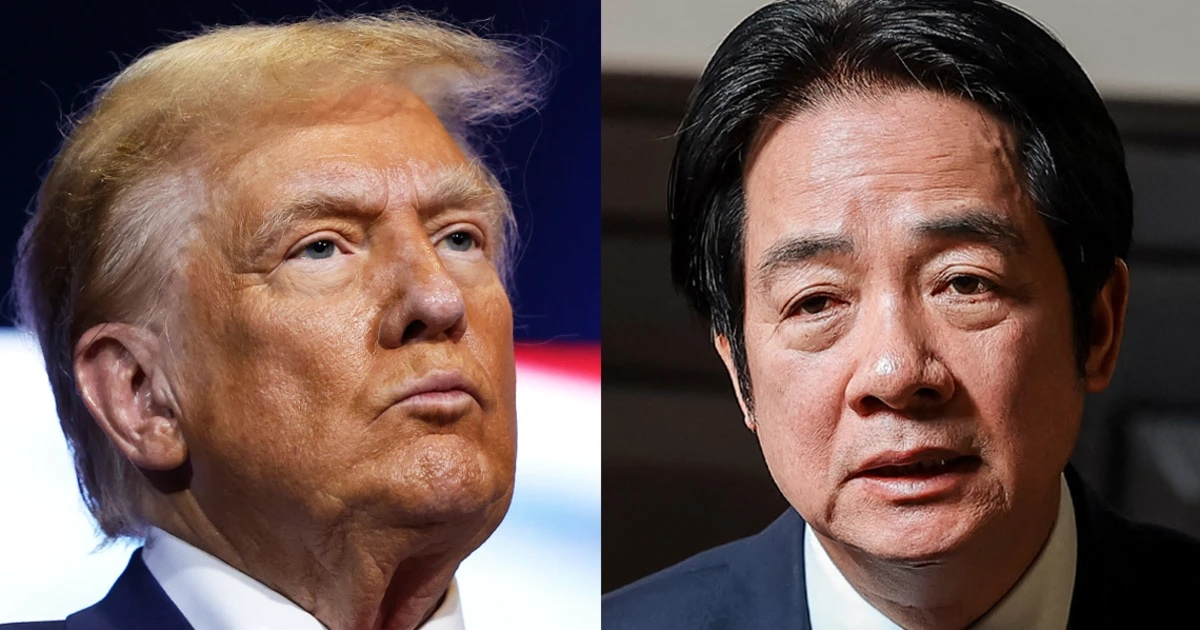
Donald Trump indicates potential direct discussions with Taiwan’s president amid escalating tensions regarding proposed US weapons sales.
US President Donald Trump announced his intention to engage in direct dialogue with Taiwan’s President Lai Ching-te regarding a potential arms sale to the island, a decision that signifies a significant departure from established US diplomatic protocol.
Trump’s remarks indicated a potentially important change in Washington’s approach to relations with Taiwan, whose leaders have not engaged in direct discussions with US presidents since 1979, when the United States officially recognized Beijing over Taipei.
Speaking to reporters on Wednesday, Trump stated: “I’ll speak to him.” I communicate with everyone… we will address the Taiwan issue.
The US president commented on a proposed $14bn arms package for Taiwan, which reportedly includes anti-drone systems and air-defense missiles.
The remarks followed Trump’s two-day summit in Beijing with Chinese President Xi Jinping, where Taiwan reportedly surfaced as one of the most sensitive issues between the two powers.
China promptly condemned the prospect of direct discussions between Trump and Lai, asserting its claim over Taiwan as part of its territory and not dismissing the option of using force to assert control over the island.
A representative from China’s foreign ministry stated that Beijing “firmly opposes official exchanges between the United States and Taiwan,” along with US arms sales to the island.
The spokesperson also urged Washington to “cease sending misleading signals to the separatist forces in Taiwan.”
Under the Taiwan Relations Act enacted in 1979, the United States is legally authorized to supply Taiwan with defensive weapons, even in the absence of formal diplomatic relations with Taipei.
Trump stated that he has not yet reached a final decision regarding the proposed weapons sale, noting that he will make a determination “over the next fairly short period.”
“I need to talk to the individual who is currently in charge of Taiwan, you know who I’m referring to,” Trump stated last week while on Air Force One after departing from Beijing.
Reports from the Financial Times indicate that Beijing has postponed granting approval for a scheduled visit by Pentagon policy chief Elbridge Colby until Washington provides clarity on its stance regarding the proposed arms package.
During last week’s summit, Xi reportedly cautioned Trump that improper handling of the Taiwan issue could result in “conflict” between China and the United States.
While Trump downplayed the likelihood of conflict, he recognized that Xi had strong feelings regarding Taiwan.
“I made no commitment either way,” Trump stated to reporters following the meeting.
Taiwanese President Lai has consistently emphasized that Taiwan is a “sovereign, independent democratic country” and has advocated for ongoing US arms sales as crucial for preserving peace and stability in the Taiwan Strait.
Taiwan’s foreign ministry later stated that Lai would be “pleased” to engage in discussions regarding regional stability directly with Trump.
This is not the first instance in which Trump has disregarded diplomatic norms concerning Taiwan. In 2016, shortly after securing the US presidency, he engaged in a conversation with then Taiwanese President Tsai Ing-wen, a decision that provoked anger from Beijing.
Trump also indicated that he had direct discussions with Xi regarding Taiwan arms sales during last week’s summit, a major departure from established US policy.
In 1982, Washington assured Taiwan that it would not consult Beijing regarding future arms sales decisions. However, Trump seemed to downplay the significance of that agreement, stating that the 1980s were “a long way” in the past.