Samsung shares go up as South Korea takes steps to stop a possible strike that would stop chip production
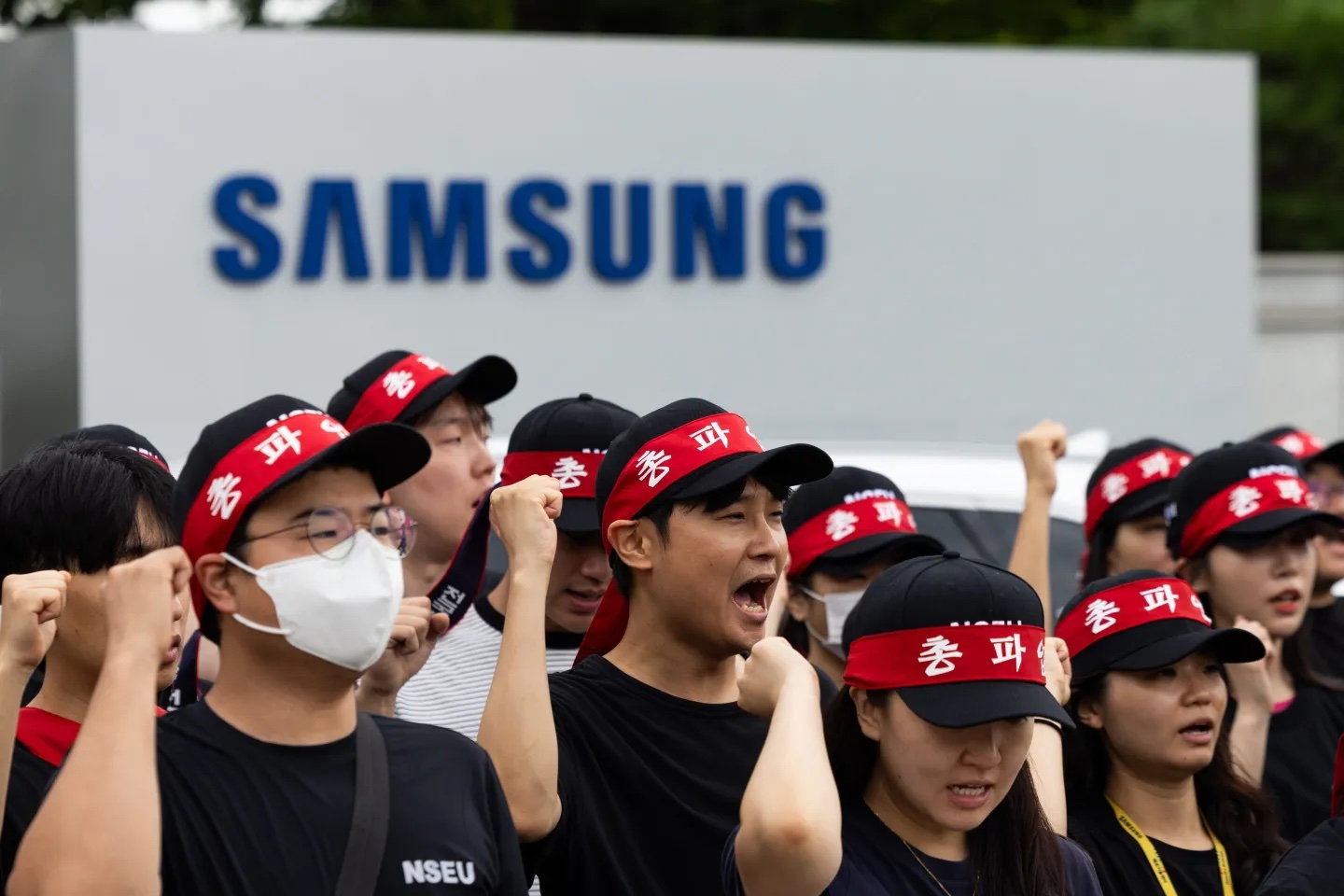
On Monday, Samsung shares went up a lot as South Korean officials rushed to stop a huge strike that could have shut down all of the country’s chip production.
On Monday, shares of Samsung Electronics went up because South Korean officials worked harder to stop an 18-day strike that could involve more than 47,000 workers and cause problems in the country’s semiconductor business.
South Korean President Lee Jae-myung asked both workers and managers to be calm before a strike that was set to start on May 21. This caused Samsung shares to rise.
Lee wrote on X in Korean, “Workers’ rights must be respected just as much as business rights, and HR rights must be respected just as much as workers rights.”
“Too much is not good; extremes cause reversal,” he said.
On Monday, shares of Samsung Electronics went up as much as 6.65% before losing some of their value and ending the day up about 3%.
Lee’s words came as Samsung management and the workers’ union were getting ready for the final round of talks on Monday, which they hope will stop the strike.
Samsung’s union seeks a change in the way the company distributes bonuses based on success. It wants, among other things, bonuses equal to 15% of the company’s operating profit, the end of caps on bonus payouts, and the creation of a formalized bonus system.
Yonhap, a South Korean news service, says that Samsung management has offered to give bonuses equal to 10% of the company’s operating profit and a one-time special pay package.
South Korea’s Prime Minister Kim Min-seok said on Sunday that the strike could do a lot of damage to the economy and that the government was ready to think of ways to step in quickly.
Kim reportedly stated, “The economic losses we will face will be beyond imagination.” He also said that Monday’s talks were the last chance to escape the strike.
He also said that if the strike looks like it could do “significant damage,” the government will look into “all possible response measures, including emergency adjustments.”
South Korean law says that if a disagreement is likely to hurt the economy or make daily life difficult, the labor minister can issue a “emergency adjustment” order to stop work stoppages for 30 days.
Kim thought that the strike could cause direct losses of one trillion won, which is about $664 million. He said Samsung could lose up to 100 trillion won if problems with making semiconductors force them to throw away chips that are already being made.
But Samsung’s workers’ union disagreed with the government’s assessment, saying that production had stopped in the past for inspections, upkeep, and process changes.
The union also said that the government was only looking at management’s claims and not properly reviewing the materials it sent in its defense.
Data from the government shows that Samsung Electronics is responsible for 22.8% of South Korea’s exports and 26% of the country’s market value. The office of the president of South Korea also said that Samsung’s sales make up 12.5% of the country’s GDP.
Analysts are now worried about concentration risks in South Korea’s economy and stock market. They say that the country is vulnerable to market volatility and geopolitical shocks, such as a slowdown in spending on data centers around the world, because it depends on a small group of big companies.
Last week, Koo Yun Cheol, South Korea’s finance minister, advised against any strikes by Samsung employees.
It’s important that strikes never happen, Koo wrote in a post on X.
Koo stated, “Samsung Electronics is under global scrutiny due to its size.” “Given the current state of management and how it affects the economy as a whole, both the labor and management sides must continue to work toward fair negotiations.”
South Korean media say that on Saturday, Samsung chairman Lee Jae-yong apologized to customers around the world for causing “worry and anxiety.” The apology was one of the few times that he did this in public.
The workers’ group said that more than 47,000 workers could join the strike. It was also said that a protest with 40,000 workers on April 23 caused foundry production to decline by 58% and Samsung’s memory production to drop by 18% that same day.
The union thought that a strike that lasts 18 days would cost Samsung 30 trillion won, which is about 20 billion dollars.