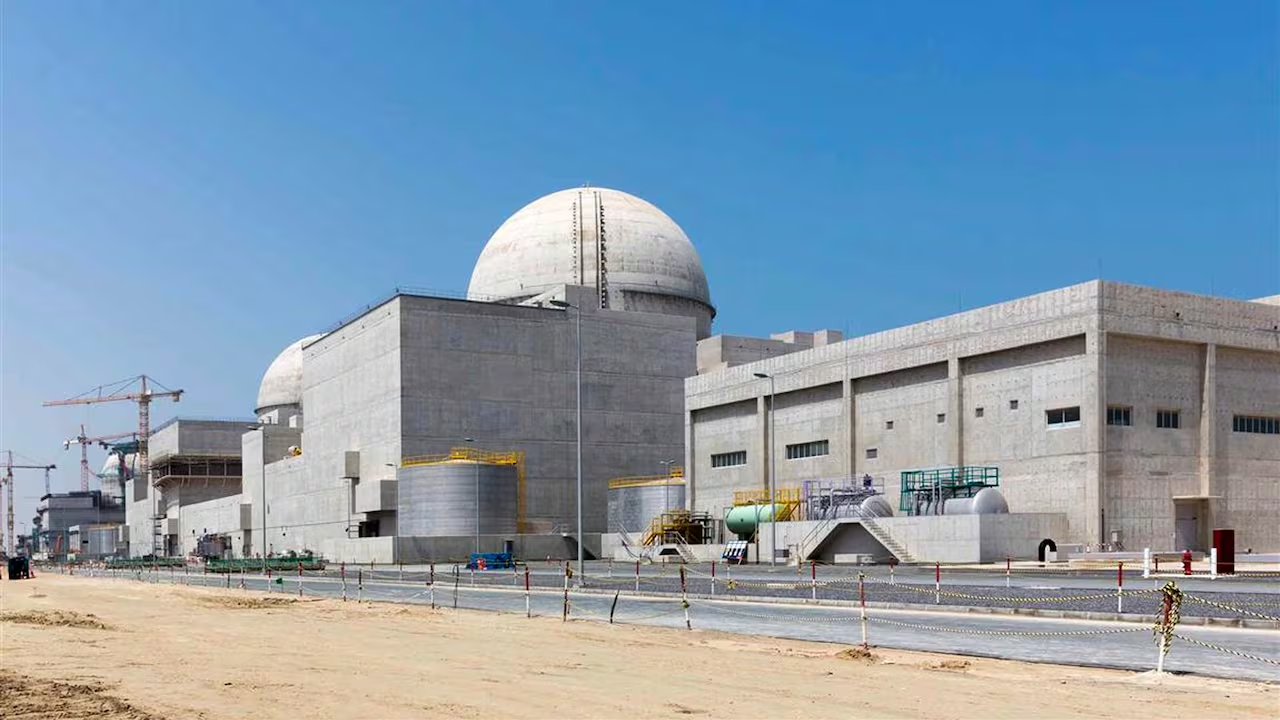
Officials in Abu Dhabi reported on Sunday that a drone strike ignited a fire at a nuclear power plant in the United Arab Emirates. This incident comes as efforts to resolve the U.S.-Israeli conflict with Iran and resume shipping in the Gulf seem to have reached an impasse.
Emirati officials stated that they were looking into the origin of the strike and emphasized that the UAE had the complete right to respond to such “terrorist attacks”. The UAE has previously accused Iran of targeting its energy infrastructure, describing this as an escalation of the ongoing conflict in the region.
The drone struck an electrical generator located outside the inner perimeter of the Barakah Nuclear Power Plant, according to the Abu Dhabi Media Office. It stated that radiological safety levels remained unchanged and that there were no injuries.
The International Atomic Energy Agency reported that emergency diesel generators were supplying power to the plant’s “unit 3” and urged for “maximum military restraint” in the vicinity of any nuclear power plant, noting that it was monitoring the situation closely.
The UAE defence ministry reported that two additional drones had been “successfully” neutralized, noting that these drones were launched from the “western border”. It failed to provide further details.
Since the onset of the conflict marked by U.S. and Israeli strikes on Iran on February 28, Iran has consistently targeted the UAE and other Gulf states housing U.S. military bases, striking locations that encompass both civilian and energy infrastructure.
Earlier this month, Iran intensified its attacks on the UAE following U.S. President Donald Trump’s announcement of a naval mission aimed at opening the Strait of Hormuz, which was suspended after 48 hours.
DIPLOMATIC IMPASSE
Over five weeks have passed since a fragile ceasefire was established in the conflict, yet the demands of the U.S. and Iran continue to diverge significantly, despite ongoing diplomatic attempts to resolve the war and restore access to the strait, which is crucial for global oil and gas shipping.
Washington has urged Tehran to dismantle its nuclear program and relinquish its control over the strait. Iran has called for compensation for war-related damages, the cessation of a U.S. blockade on Iranian ports, and a stop to hostilities on all fronts, including in Lebanon, where Israel is engaged in conflict with Iran-backed Hezbollah.
Trump engaged in discussions with Chinese President Xi Jinping this week, yet did not receive any indication from China regarding assistance in resolving the conflict. He has warned of resuming attacks if Iran fails to reach an agreement.
Abolfazl Shekarchi, a senior spokesperson for the Iranian armed forces, stated on Sunday that if Trump’s threats were executed, the U.S. would “encounter new, aggressive, and unexpected scenarios, and become ensnared in a self-created quagmire”.
Esmaeil Baqaei, spokesperson for the Iranian foreign ministry, stated that the U.S. and Israel have attempted to shift the blame for destabilizing energy markets after their “unprovoked military aggression against Iran.”
COMPETING BLOCKADES
The interruption of shipping in the Strait of Hormuz has led to the largest oil supply crisis ever recorded, resulting in a surge in prices. The U.S. has enacted a blockade of Iranian ports and announced that as of Sunday, it has redirected 81 commercial vessels and disabled four vessels to ensure compliance.
Ebrahim Azizi, the head of the Iranian parliament’s national security committee, announced on Saturday that Tehran has developed a mechanism to regulate traffic through the strait along a specific route, which will be revealed soon.
Thousands of Iranians lost their lives in the airstrikes conducted by the U.S. and Israel. Numerous additional casualties have occurred in Lebanon due to the conflict between Israel and the Iran-backed group Hezbollah.
On Friday, Israel and Lebanon reached an agreement to extend the ceasefire for an additional 45 days, although the truce has not succeeded in halting the ongoing clashes.