 "Where Africa Comes to Stay Informed."
US Edition
"Where Africa Comes to Stay Informed."
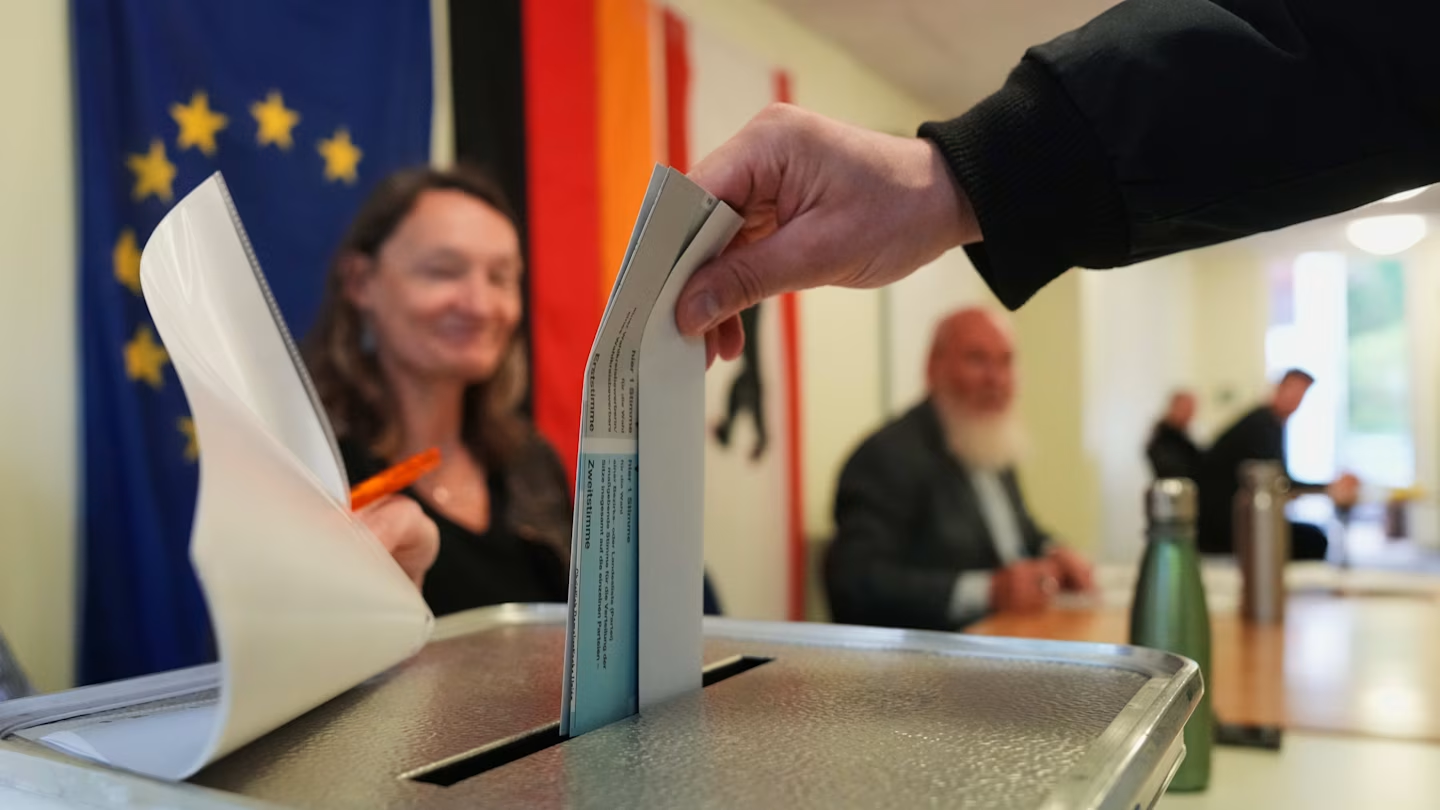
Germans voted on Sunday in a pair of state elections widely expected to deepen the trouble surrounding Chancellor Friedrich Merz, whose grip on the job has looked uncertain since the far right's breakthrough in another regional contest earlier this month.
The ballots covered Mecklenburg-Western Pomerania, a mostly rural state in the former communist east, and the capital, Berlin. Both followed the September 6 vote in Saxony-Anhalt, where Alternative for Germany (AfD) came within reach of an outright majority — a result almost unheard of in German state politics. Voting was due to end at 6 p.m. (1600 GMT), with the first projections expected shortly afterward.
State contests in Germany rarely attract attention beyond its borders. Saxony-Anhalt changed that. The AfD treats the win as the opening move toward the federal election due in 2029, and the result rattled capitals across Europe.
The party has covered enormous ground in a little over ten years, moving from the eurosceptic fringe to the top of national polling. Its platform calls for hard-line deportation of foreigners without the right to remain, a restoration of energy links with Russia, and an exit from the euro.
Neither of Sunday's races was expected to deliver another Saxony-Anhalt. What polling did suggest is that both would confirm how far the AfD has climbed — and put further strain on the so-called firewall, the understanding among the other main parties that none of them will govern in coalition with it.
Merz's approval has sunk to as low as 14% in recent surveys, and Saxony-Anhalt was only the latest in a run of setbacks that has his own Christian Democratic Union (CDU) wondering aloud whether he should stay on. In Mecklenburg-Western Pomerania the party was heading for the poorest showing in its history: the final Forschungsgruppe Wahlen poll, published Friday, had the CDU at 6%, close enough to the cutoff that it risked missing out on seats in the state parliament altogether.
He took office last year pledging reforms that would pull a stalled economy back into growth. Voters have not warmed to him since. Unpopular changes to pensions, tax and healthcare have piled up, and a steady run of communication blunders has made things worse.
CDU heavyweights have stood by him so far, though the calculation is partly practical — unseating a sitting chancellor is constitutionally awkward, and whoever replaced him would inherit exactly the same economic mess.
The disaffection nonetheless shadowed both campaigns, where energy bills and housing costs dominated. Merz rolled out a consumer relief package on Friday that included tax reductions on gas and diesel.
Cost of living came up repeatedly among those arriving at polling stations in Mecklenburg-Western Pomerania.
“Here in Schwerin, with these wages, you can hardly afford anything anymore,” voter Carlotta Heick told Reuters in the state capital.
An older man, who declined to give his name, objected to money going overseas. “We need our money here, for our country, for children and pensioners,” he said.
The contest in the rural state had been closing for weeks, with the center-left Social Democrats (SPD) building their campaign around Manuela Schwesig, the popular state premier. Friday's Wahlen poll showed the SPD nosing ahead of the AfD for the first time in months.
It put the SPD on 37% and the AfD on 36%, with the far-left Left Party at 9% and the Greens at 5% — precisely on the threshold for entering parliament. Either of the smaller two could serve as a coalition partner for Schwesig.
Closing her campaign, Schwesig spoke of “dark clouds” in reference to the AfD, which she described as a dangerous party. At the AfD's own final rally in the state, national leader Alice Weidel turned her fire on the chancellor.
“From next week, the chancellor's tone will become very quiet,” she said, telling the crowd that the power to remove him lay with them on Sunday.
In the capital, the Wahlen poll had the Left Party overtaking the CDU, putting the conservatives' hold on the mayor's office in doubt. The AfD has gained ground even in liberal Berlin, climbing into third.
The numbers: Left Party 22%, CDU 20%, AfD 18%, Greens 15%, SPD 12%. The far-left BSW — the only party to suggest it might cooperate with the AfD — sat just below the threshold on 4%.


Comments
0