 "Where Africa Comes to Stay Informed."
US Edition
"Where Africa Comes to Stay Informed."
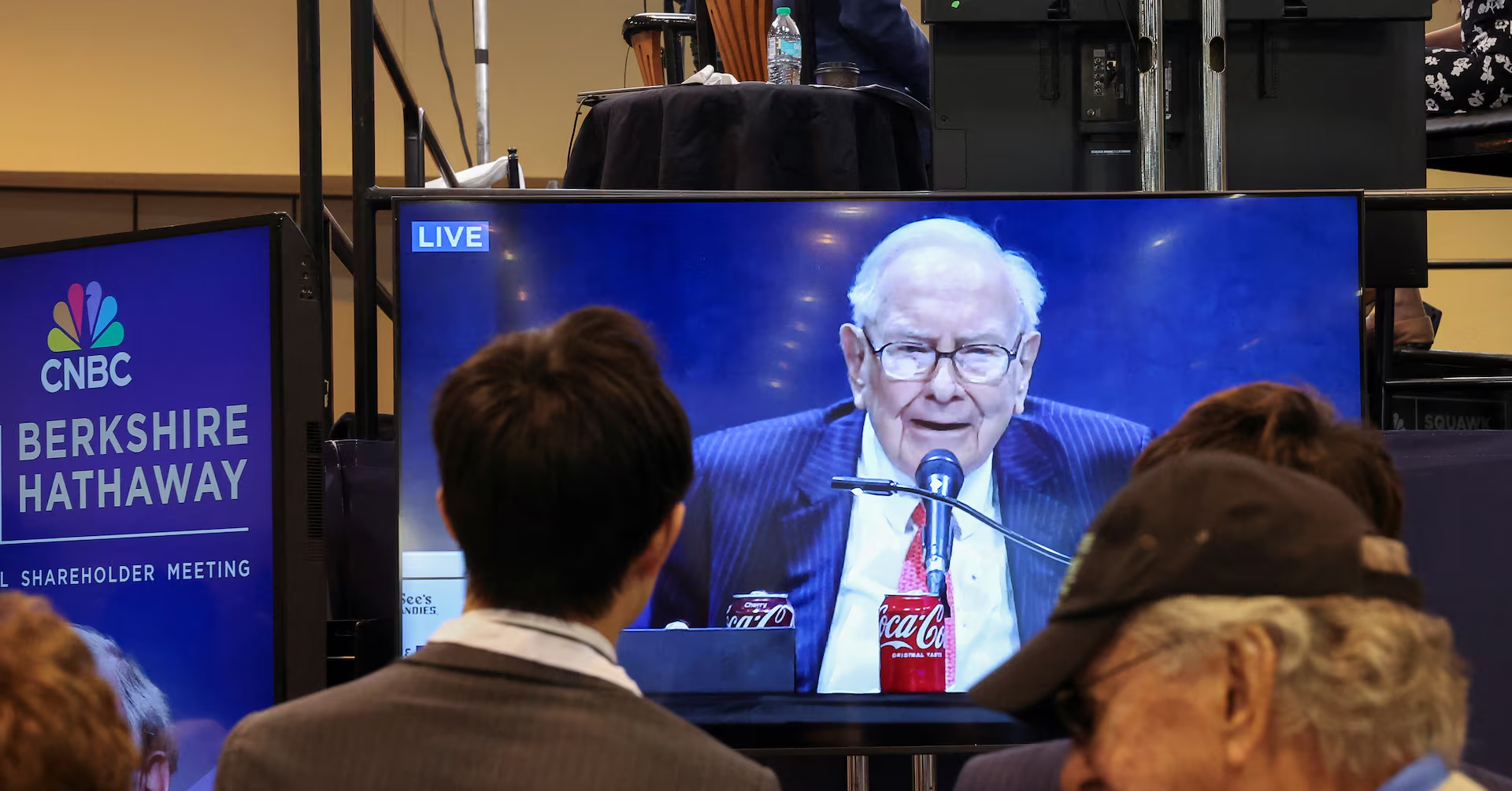
Berkshire Hathaway announced on Friday that Warren Buffett will transition from his role as chairman-to-chairman emeritus, effective immediately. This change comes nine months after he passed the CEO responsibilities to his longtime associate, Greg Abel. The company appointed his son, Howard Buffett, who has been a director since 1993, as chairman. Warren Buffett is recognized for turning Berkshire from a struggling textile business into a $1.1 trillion conglomerate, all while developing an investment philosophy that has shaped the thinking of countless investors and executives, establishing him as one of the most significant figures in contemporary corporate America.
Berkshire's Class B shares were recently down 0.3% in premarket trading. Buffett's reputation has been evident in the company's valuation, with investors for years attributing a “Buffett premium” to its shares. The conglomerate's price-to-book value has decreased since Buffett announced his decision to step down as CEO, dropping from approximately 1.62 to 1.53, according to data compiled by LSEG. Berkshire stands as the sole financial firm within the trillion-dollar market value club, which is primarily occupied by technology giants.
“It was always a matter of when, not if. Buffett has made a graceful exit,” remarked Brian Jacobsen, chief economic strategist at Annex Wealth Management. “Berkshire has had years to prepare for this transition, so the outcome feels more like the completion of a carefully planned succession than a sudden changing of the guard.”
Time ultimately prevails. “He has, however, been generous with me,” wrote Buffett, 96, who has been with Berkshire since 1965, in a letter to shareholders on Friday. Buffett's impact reaches well beyond Berkshire, influencing generations of corporate leaders and investors through his focus on long-term thinking, disciplined capital allocation, and clear management practices. “The culture that Warren established and the values he upheld will continue to be central to Berkshire, and Howard will serve as their protector,” Abel stated on Friday.
CEOs have sought Buffett's insights on various matters, including acquisitions, succession planning, and managing through market volatility, while his annual shareholder meetings have served as a key event for investors. “In his role as Chairman Emeritus, Mr. Buffett will continue to be a member of the Board of Directors and will provide his esteemed judgment and perspective,” Berkshire stated. A chairman emeritus is generally an honorary designation awarded to a retired board leader or company founder in acknowledgment of their previous contributions and enduring influence. Buffett initially revealed his intention to distance himself from the conglomerate in May 2025, catching shareholders and analysts off guard despite his advanced age. After decades in leadership, he had become emblematic of the company, making his succession one of the most scrutinized in corporate America.
Berkshire's portfolio encompasses Geico car insurance, the BNSF railroad, various energy and industrial enterprises, Dairy Queen ice cream, and established brands like the World Book Encyclopedia. It possesses hundreds of billions of dollars in both stocks and US Treasuries. In the second quarter, operating profit increased by 16% to $12.98 billion, exceeding analyst’s expectations. Net income increased significantly to $25.67 billion, factoring in unrealized gains and losses on stocks that Berkshire, based in Omaha, Nebraska, continues to hold.
In contrast to his father, Howard Buffett, often referred to as Howie, would not assume a management position as chairman; instead, his primary duty would be to maintain Berkshire's culture. That culture allows Berkshire's operating businesses to manage their daily operations independently, without interference from upper management. However, Abel is generally perceived as more inclined than Warren Buffett to tackle performance shortfalls. Abel has direct oversight of multiple Berkshire business lines, while Vice Chairman Ajit Jain manages insurance, and newly appointed President Adam Johnson oversees consumer, services, and retail subsidiaries. Howard Buffett articulated a unique perspective on the culture of Berkshire, telling the Wall Street Journal in January 2025 that it is not complicated. Culture emphasizes simplicity, focusing on essential tasks while avoiding unnecessary actions. It encourages fair treatment of individuals, respect for managers, and consideration for shareholders. Bad news should be delivered directly and honestly.



Comments
0