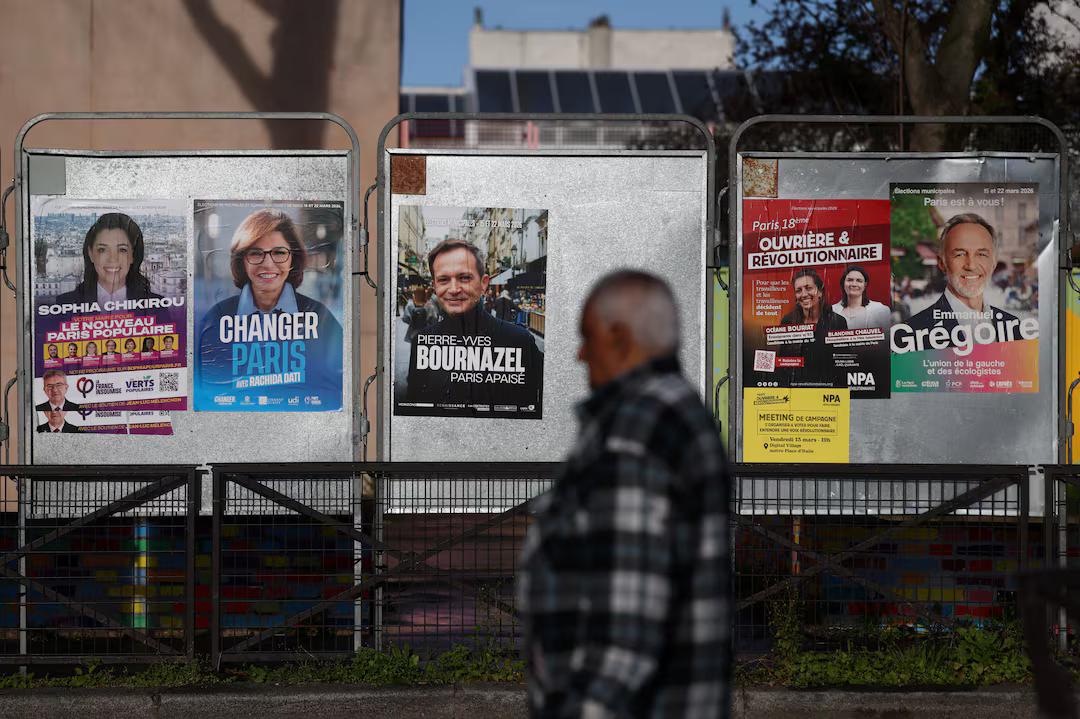
French mayoral votes in France assess the influence of the far-right ahead of the presidential election
French voters went to the polls on Sunday to elect their mayors in a closely monitored election viewed as a measure of the far-right’s influence and the endurance of mainstream parties in anticipation of next year’s presidential election.
Mayors oversee approximately 35,000 municipalities across the nation, ranging from large urban centers to small villages with just a handful of residents. Local outcomes can influence national dynamics, particularly as a presidential election approaches, with opinion polls indicating that the far-right National Rally (RN) may have a chance of victory.
Voting commenced at 8 a.m. (0700 GMT) and will conclude at 8 p.m., with preliminary results expected to be announced shortly thereafter. Many medium- to large-sized cities will have a second round on March 22.
By 5 p.m., voter turnout was recorded at less than 49%, an increase from the approximately 39% at the same point during the last mayoral elections in 2020, which took place amid the COVID pandemic, yet still lower than the 55% turnout seen in 2014.
A TEST FOR THE REGISTERED NURSE
The anti-immigration, Eurosceptic RN has encountered challenges in achieving significant progress in municipal elections.
With candidates in several hundred municipalities, the aim is to demonstrate increasing popularity and secure a few significant victories that would enhance its presidential campaign. “If the people of Marseille make a bold choice … it will inspire and inform the French about the decision they will face next year,” Franck Allisio, the RN candidate in France’s second-largest city, told Reuters.
Allisio is currently tied in first-round polls with the incumbent Socialist Mayor Benoit Payan, giving the RN an unprecedented opportunity to gain power in a significant French city.
At a polling station in Marseille, construction worker Serge expressed that he felt neither concern nor optimism regarding the RN.
They are not inferior to the others. It will not alter anything. “Nothing changes, and that is the problem,” said the 61-year-old, who chose not to disclose his last name, emphasizing that security is a key concern for him in this election.
Prioritize safety
The numerous individual municipal ballots frequently center around highly localized matters, such as public safety initiatives, local crime rates, and community policing efforts that directly impact residents’ daily lives.
The initial phase of local elections in France
However, opinion polls indicate that security remains the primary concern for voters, aligning with the RN’s emphasis on law and order.
One of the larger cities that the RN is focusing on is the southern city of Toulon, which has a population of 180,000. It may also achieve victory in Menton, a Riviera town where Louis Sarkozy, son of former President Nicolas Sarkozy, is a candidate supported by centrist parties.
Madani Sadaoui, a 70-year-old pensioner, cast his vote for right-wing candidate Rachida Dati as mayor of Paris due to security concerns. “The right is for security, and there is no security all over France,” he stated from a polling station in Paris’ tenth district.
Coalitions of Celebration
A crucial question is what alliances the RN will form with other parties between the two rounds and whether this election will challenge decades of tradition in avoiding the far-right.
The left performed strongly throughout France in the recent municipal elections of 2020. On a national level, its strength has now diminished. The ability to retain Paris, along with several cities it secured previously, like Nantes for the Socialists and Lyon and Strasbourg for the Greens, will be under careful observation.
Another important question is whether mainstream left-wing parties will form alliances with the hard-left France Unbowed (LFI) between the two rounds.
Maxim Loh, a 26-year-old resident of Paris, cast his vote for Socialist candidate Emmanuel Gregoire rather than LFI, aiming to prevent a three-way race in the second round.
“I aimed for continuity; I cycle, and I appreciate the many new green spaces that have been added,” he stated.
In all cities where no single list secures more than 50% of the votes, a second round of voting will be held.
The stakes are significant as we approach the April 2027 presidential election. “People want to turn the page, and they want to turn it with us,” stated Perpignan’s RN mayor, Louis Aliot, in an interview with Reuters.