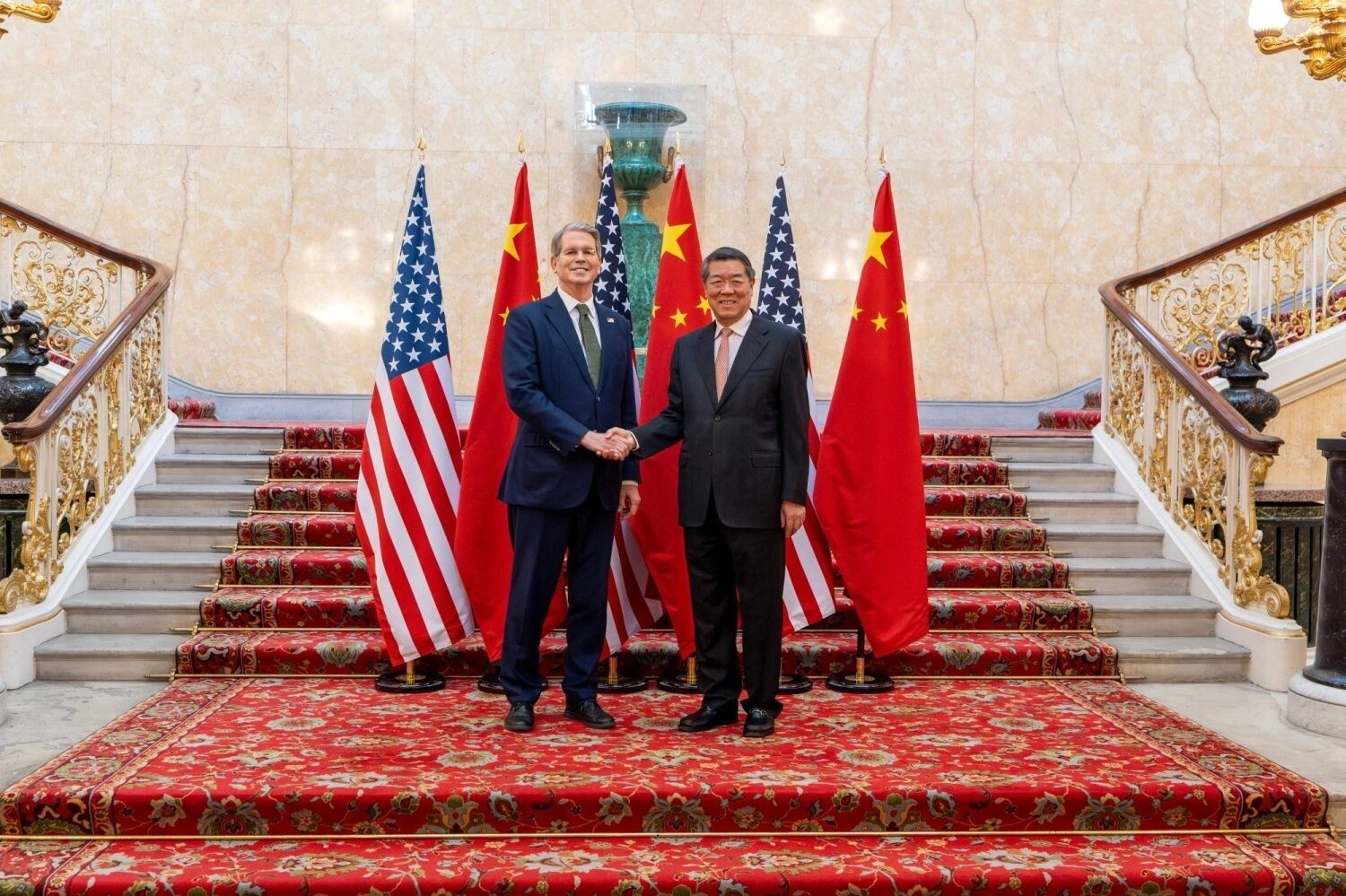
Economic leaders from the US and China convene in Paris to pave the way for a summit between Trump and Xi
Senior economic officials from the U.S. and China commenced a fresh series of discussions in Paris on Sunday, aiming to resolve issues in their trade agreement and facilitate a seamless visit for U.S. President Donald Trump to Beijing, where he is set to meet with Chinese President Xi Jinping at the end of March.
The discussions, spearheaded by U.S. Treasury Secretary Scott Bessent and Chinese Vice Premier He Lifeng, are anticipated to center on the adjustment of U.S. tariffs, the movement of Chinese-produced rare earth minerals and magnets to U.S. buyers, American high-tech export controls, and Chinese acquisitions of U.S. agricultural products.
On Sunday morning, discussions commenced at the Paris headquarters of the Organization for Economic Co-operation and Development, with expectations that they would carry on into Monday, according to a Treasury official. China does not belong to the group of 38 predominantly affluent democracies and regards itself as a developing nation.
U.S. Trade Representative Jamieson Greer, who is involved in the discussions, stated prior to his departure for Paris that U.S. officials aim to maintain stability in the U.S.-China relationship.
“We aim to ensure that we maintain access to the rare earths essential for our manufacturing base, that they continue purchasing the appropriate goods from us, and that the leaders have the opportunity to convene and ensure the relationship is progressing as desired,” Greer stated on Friday during an appearance on CNBC.
The discussions involving Bessent, He, Greer, and Chinese trade negotiator Li Chenggang come after a series of meetings held in European cities last year aimed at alleviating trade tensions that were on the verge of causing a significant breakdown in trade between the two largest economies in the world.
Analysts of U.S.-China trade have indicated that, given the limited time for preparation and Washington’s focus on the U.S. The chances for a significant trade breakthrough are minimal, whether in Paris or at the Beijing summit, due to the limited time for preparation and Washington’s focus on the U.S.-Israeli conflict regarding Iran. “Both sides, I believe, have a basic objective of convening a meeting, which helps maintain stability and prevents a breakdown and further escalation of tensions,” remarked Scott Kennedy, a China economics expert at the Center for Strategic and International Studies in Washington.
Trump may seek significant commitments from Beijing regarding new orders for Boeing aircraft and increased purchases of U.S. liquefied natural gas and soybeans. However, to achieve this, he might have to make some concessions concerning U.S. export controls, Kennedy noted, such as relaxing restrictions on technology transfers or allowing greater access to U.S. markets for Chinese goods.
Trump and Xi may have the opportunity to meet three additional times this year, including at a China-hosted APEC summit in November and a U.S.-hosted G20 summit in December, which could lead to more concrete advancements.
Concerns Regarding Oil in Relation to the Iran Conflict
The Iran war is expected to be a topic of discussion at the Paris talks, particularly concerning the rise in oil prices and the closure of the Strait of Hormuz, which is a crucial route for China, supplying 45% of its oil. Bessent on Thursday announced a 30-day waiver of sanctions to facilitate the sale of Russian oil stranded at sea in tankers, a strategic move to increase supplies.
On Saturday, Trump called on other nations to assist in safeguarding shipping in the Strait of Hormuz, following Washington’s bombing of military targets on Iran’s Kharg Island oil loading hub, with Iran warning of potential retaliation. A commentary from China’s state-run Xinhua news agency on Sunday suggested that “meaningful” progress in Sino-U.S. economic cooperation could help restore confidence in a global economy that is becoming increasingly fragile.
TRADE TRUCE ANALYSIS
The two parties are anticipated to assess their advancements in fulfilling the obligations set forth in the October 2025 trade truce announced by Trump and Xi in Busan, South Korea. The agreement prevented a significant escalation in tensions, reduced U.S. tariffs on Chinese imports, and temporarily halted China’s strict export controls on rare earths for a year. The U.S. has also paused the expansion of a blacklist that prohibits Chinese companies from purchasing high-technology U.S. goods, including semiconductor manufacturing equipment.
China has also committed to purchasing 12 million metric tons of U.S. soybeans for the 2025 marketing year and 25 million tons for the 2026 season, beginning with the autumn harvest.
U.S. officials, including Bessent, have indicated that China has thus far fulfilled its commitments under the Busan deal, referencing soybean purchases that aligned with initial targets.
While certain industries are obtaining rare earth exports from China, which leads in global production, U.S. aerospace and semiconductor companies are not receiving these materials and are encountering increasing shortages of essential components, such as yttrium, utilized in heat-resistant coatings for jet engines.
William Chou, a senior fellow at the Hudson Institute, a Washington think tank, stated that “U.S. priorities will likely focus on agricultural purchases by China and increased access to Chinese rare earths in the short term” during the Paris talks.
NEW TRADE INVESTIGATIONS
Greer and Bessent bring up another issue in the Paris talks, a “Section 301” investigation into unfair trade practices against China and 15 other major trading partners for having too much industrial capacity, which could lead to new tariffs soon.
Greer started a similar investigation into claims of forced labor in 60 countries, including China, which could result in a ban on certain imports to the U.S. These investigations aim to increase tariff pressure on trading partners after the U.S. Supreme Court ruled that Trump’s global tariffs were illegal. The ruling effectively lowered Trump’s tariffs on Chinese goods by 20 percentage points; however, he promptly enacted a 10% global tariff under a different trade law.
On Friday, China condemned the investigations and stated that it reserves the right to implement countermeasures. An editorial from the state-run China Daily noted that the investigations exemplify unilateral actions that hinder negotiations, which could further escalate trade tensions between the two countries and complicate future diplomatic efforts. “The new round of discussions presents both an opportunity and a challenge,” Xinhua stated. ” Progress in the forthcoming talks will significantly rely on the actions of the U.S. side.” Washington should engage in the negotiations with a logical and practical perspective, aligning actions with the foundational principles that support stable economic relations between China and the U.S., such as mutual respect, open communication, and a commitment to resolving differences through dialogue.