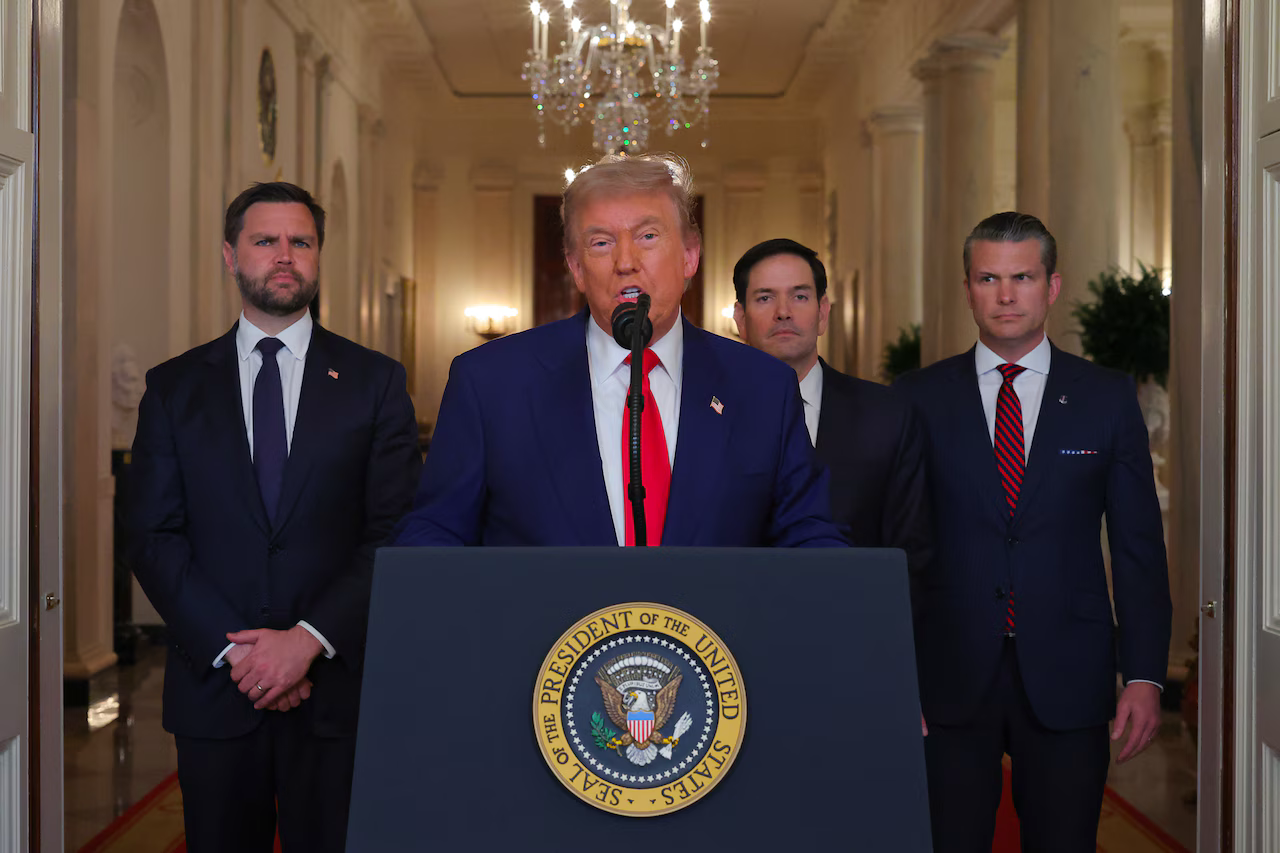
The timing and manner of declaring victory and concluding the Iran war significantly divide White House aides.
US President Donald Trump’s advisors disagree on when and how to declare victory in the ongoing conflict with Iran.
US President Donald Trump is encountering increasing internal pressure from aides and allies as the war with Iran reaches a pivotal moment, with various perspectives both inside and outside the White House advocating for different strategies to resolve the conflict.
Almost two weeks following the initiation of the military campaign against Iran, the Trump administration is facing challenges in defining success and concluding the conflict, all while navigating increasing economic and political risks.
Sources close to the discussions indicate that economic and political advisers have cautioned the president that rising oil prices and increased gasoline costs may diminish public backing for the war.
Officials from the Treasury Department and the National Economic Council have warned that disturbances in global energy markets could swiftly lead to political consequences domestically.
Political advisers, such as Chief of Staff Susie Wiles and Deputy Chief James Blair, are encouraging Trump to present the operation as limited in scope and approaching completion, suggesting that a definitive declaration of victory could help mitigate domestic backlash.
Nonetheless, assertive perspectives within the Republican Party are advocating for a different approach. Senators Lindsey Graham and Tom Cotton, along with conservative commentators, are advocating for ongoing military pressure on Iran to deter its nuclear weapons development and to respond decisively to attacks on US forces and shipping in the region.
Simultaneously, individuals associated with Trump’s populist base, such as strategist Steve Bannon and television personality Tucker Carlson, have cautioned against permitting the conflict to evolve into yet another extended US military involvement in the Middle East.
The conflicting pressures have influenced Trump’s evolving public remarks regarding the war.
During a rally in Kentucky on Wednesday, the president announced that the United States had already “won” the conflict while also implying that the military campaign could persist to “finish the job.”
The White House has dismissed claims that internal divisions are influencing policy decisions. Press Secretary Karoline Leavitt rejected claims of disagreements as mere speculation, emphasizing that although the president considers various perspectives, he ultimately holds the authority to make final decisions.
Since the war commenced on February 28, US and Israeli forces have conducted multiple air strikes on Iranian targets, resulting in the deaths of several high-ranking Iranian commanders and inflicting damage on the nation’s missile and naval capabilities.
Analysts project that approximately 2,000 individuals have lost their lives throughout the region during the campaign.
In response to those strikes, Iran has launched attacks on oil tankers and shipping infrastructure close to the Strait of Hormuz, a crucial passage for global energy supplies that typically sees about one-fifth of the world’s oil flow through it. The disruption has led to fluctuations in global energy markets and an increase in fuel prices.
The leadership in Iran has pledged to maintain its resistance against the offensive and has warned of keeping the strategic waterway closed, heightening concerns about a broader economic impact if the standoff continues.
Initially, Trump outlined the campaign with wide-ranging aims, including countering a looming Iranian threat and undermining its nuclear program. His recent comments, however, have shifted to portraying the conflict as a transient undertaking, implying that its main goals have largely been achieved.
Experts indicate that the ambiguity regarding the war’s goals and possible conclusion has complicated predictions about the conflict’s progression, particularly as hostilities extend across various nations in the Middle East.
For Iran’s leaders, merely enduring the US-Israeli assault could enable them to assert a sense of victory, despite the significant damage to their military infrastructure.
As midterm elections draw near in the United States and global energy markets remain unsettled, the pressure on Trump to articulate a definitive strategy for exiting the war is anticipated to escalate in the upcoming weeks.