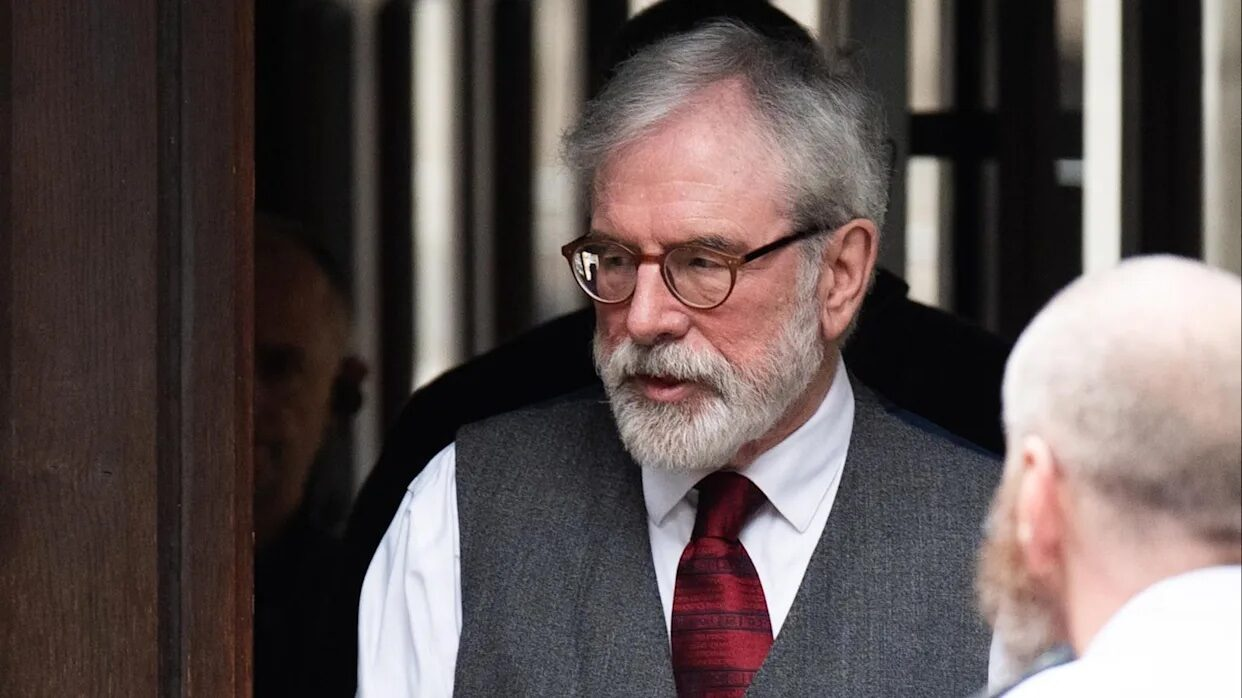
Three survivors of IRA bombings are pursuing a court ruling to hold Gerry Adams personally accountable for the London and Manchester attacks that occurred during the Troubles.
A civil court case initiated by three victims of IRA bombings has commenced in London, aiming to hold former Sinn Féin leader Gerry Adams personally accountable for the attacks executed in Britain during the Troubles.
The case commenced on Monday at the Royal Courts of Justice, where the claimants seek a ruling from the court that Adams was accountable for the decisions to plant car bombs in London and Manchester in 1973 and 1996.
The men are taking legal action against Adams for nominal damages of £1, stating that the lawsuit is mainly for “vindicatory purposes.”
The seven-day hearing is under the authority of Mr. Justice Swift.
The claim was submitted by John Clark, who sustained injuries in the 1973 bombing outside the Old Bailey, alongside Jonathan Ganesh and Barry Laycock, who were hurt in distinct IRA attacks in 1996 at London’s Docklands and near Manchester’s Arndale Centre.
The three bombings signify both the initial and final IRA attacks executed in Britain.
A car bomb exploded outside the Old Bailey in March 1973, inflicting significant damage and injuring over 200 individuals. Investigators later stated that they transported the explosive device by car ferry from Belfast to Liverpool before driving it to London.
Over twenty years later, on 9 February 1996, a truck bomb planted by the IRA exploded in London’s Docklands, resulting in the deaths of two individuals and injuring many others. Just a few months later, another bomb detonated close to Manchester’s Arndale shopping center in June 1996.
Over 200 individuals sustained injuries in the Manchester attack, characterized as the most potent bomb detonation in Britain since World War II.
Attorneys for the victims indicate that they will introduce testimony from multiple witnesses, including ex-IRA members, along with retired police officers and military personnel.
Attorneys for the victims will shield their testimony from public view by keeping two witnesses anonymous.
Next week, we anticipate Adams, now 77 years old, to provide his testimony in his defense. He has consistently refuted any connection to the attacks or to the IRA itself.
In the Andersonstown News last month, Adams dismissed the allegations.
“I expect several witnesses will provide hearsay evidence suggesting that, due to my position as a senior Republican during the conflict, I must be accountable for these particular events,” he stated.
“I was not involved in these explosions in any way, either directly or indirectly.”
“I will vigorously contest the unfounded hearsay assertions that form the foundation of the claimants’ case.”
The legal team representing the victims asserts that the upcoming proceedings will be the first instance in which Adams is subjected to cross-examination in an English court concerning allegations related to his leadership position within the Irish Republican Army.
The judge will assess liability according to the civil standard of proof known as “the balance of probabilities.”
The lawsuit commenced in 2022, just prior to the UK government’s Northern Ireland Troubles (Legacy and Reconciliation) Act 2023, which obstructed new civil claims related to the Troubles, a law that is presently facing attempts to be overturned.
The claimants have successfully raised over £100,000 via crowdfunding to back the legal action. The case is being pursued not just for their own sake, but for all victims of IRA violence.
As a result of a pre-trial ruling, Adams will not be able to recover his legal costs from the claimants, which are estimated to be in the six figures, even if he successfully defends the case.
The IRA accounted for approximately 1,700 deaths during the period referred to as the Troubles.
In 1978, Adams faced charges related to IRA membership; however, the case was ultimately dismissed because of a lack of sufficient evidence. In 2020, his only convictions related to the Troubles, which stemmed from two attempts to escape prison while interned without trial in the mid-1970s, were overturned.
He has been questioned under oath regarding his alleged IRA past, including during the Ballymurphy Inquest in Belfast in 2019 and in a libel case he initiated against the BBC in Dublin last year.