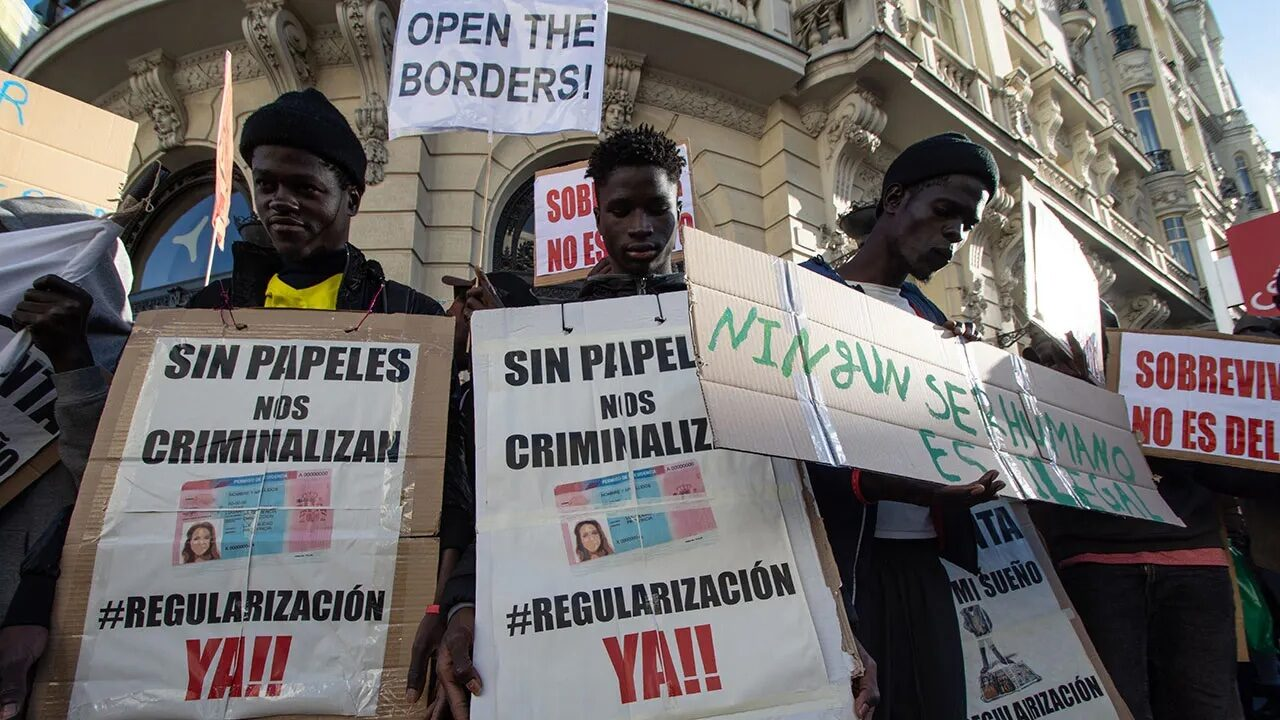
Spain is set to legalize up to 500,000 migrants through a residency amnesty, a move that has been positively received by workers
Spain is taking steps to provide legal status to hundreds of thousands of undocumented migrants, offering them jobs, stability, and potential economic benefits.
Undocumented migrants in Spain have expressed their approval of a government initiative aimed at providing legal status to hundreds of thousands of foreign nationals, stating that this action could significantly change their lives and bring much-needed stability.
Migrants recounted years of uncertainty while working without residency documents, facing informal jobs, exploitation, and restricted access to housing and banking services.
Diana, a 40-year-old migrant from Peru who arrived in Spain two years ago in search of financial and professional stability, expressed that the absence of legal status has compelled her to take on occasional work rather than the tourism career she had aspired to follow.
“It’s challenging to work without residency documents because employers may say one thing and then ask you to do something entirely different,” she stated. “At times, the payment received is lower than what was initially agreed upon, which creates challenges.”
She noted that undocumented migrants frequently encounter significant vulnerability. “It’s a challenging situation; exploitation can lead to not only financial struggles but also feelings of illness and isolation.”
Spain’s government has recently unveiled a regularization scheme aimed at legalizing the status of at least 500,000 migrants. According to the plan, applicants will receive a residency visa that can be renewed annually for one year.
Applications will be accepted from early April through late June. Migrants must demonstrate that they have resided in the country for at least five months and have no criminal history.
For migrants such as Diana, the program offers an opportunity to reconstruct their lives.
“It will assist us in every conceivable manner,” she stated. “It will benefit the government as well, since [these migrants] will contribute to taxes, create income, have the ability to invest, and establish businesses.”
There is a broad range of estimates regarding the number of migrants who may submit applications. The government anticipates approximately 500,000 applicants; however, a leaked report from the police’s National Centre for Immigration and Borders indicated that the actual number might fall between 750,000 and 1.1 million.
The coalition government, under the leadership of the Socialists, asserts that humanitarian considerations partially shape the policy. Prime Minister Pedro Sánchez has characterized immigrants as individuals “who have contributed to the progress of this country alongside us.”
Officials contend that the action is essential for economic reasons. Spain’s unemployment rate has reached an 18-year low, and the economy experienced a growth of nearly 3% last year, closely aligning with the combined growth of the UK, Germany, France, and Italy.
Elma Saiz stated that foreign workers have played a vital role in that growth.
“Foreign workers are crucial to Spain’s macroeconomic success, contributing significantly to GDP growth and the robustness of its labor market,” she stated.
Saiz observed that foreign nationals represent 14.1% of the 22 million registered workers in Spain.
“Since 2022, foreign workers have driven half of Spain’s economic growth,” she added. “This concerns values and human rights, while also recognizing the various challenges we encounter, and that our effective economic management is yielding positive outcomes.”
A report from the country’s central bank in 2024 highlighted the demographic challenges confronting Spain, estimating that approximately 25 million migrants will be necessary over the next thirty years to support its economy and social security system.
Migrants constitute a significant portion of Spain’s workforce in areas like elderly care, hospitality, and agriculture.
Government figures reveal that agriculture officially registers over 250,000 foreign workers, while thousands of undocumented migrants also work in this sector. A significant number originate from North Africa, Eastern Europe, and Latin America.
Francisco José García Navarrete, representing the ASAJA farmers’ association in Madrid, emphasized the crucial role of migrant labor in the industry.
“The absence of immigrant workers would pose a significant challenge for us,” he stated, noting that the organization generally endorses the regularization program.
“We support this new initiative, provided that the legalization of immigrants leads to them obtaining long-term contracts for work in the countryside,” he stated.
The CEOE, Spain’s primary employers’ association, has voiced its backing for the measure, characterizing “orderly” immigration as advantageous for the economy. Nonetheless, it has sparked worries regarding the government’s decision to implement the measure through decree instead of subjecting it to a parliamentary vote, raising concerns about the lack of democratic oversight and potential implications for immigration policy in the long term.
The initiative has faced strong backlash from opposition parties in Spain’s politically divided landscape.
Alberto Núñez Feijóo stated that the policy demonstrates what he characterized as the government’s inability to manage immigration effectively.
“Mass regularization signifies the absence of a coherent immigration policy,” he stated, contending that the number of applicants might reach nearly one million.
Santiago Abascal, the leader of the far-right party, cautioned that the policy might lead to an increase in migrant arrivals.
“These half million legalized migrants will lead to millions more arriving, which will worsen the collapse of healthcare, housing, and our security,” he stated.
The government has dismissed these claims, stating that the program has a well-defined timeframe designed to prevent any “pull effect.”
Spain has a history of implementing similar programs under both left-wing and conservative administrations. In the years 2000–2001, the People’s Party regularized over half a million migrants, and in 2005, a Socialist administration legalized an additional 577,000.
Nonetheless, the new scheme is introduced during a period when numerous other European nations are reinforcing their immigration regulations.
France and Germany have implemented more stringent residency requirements, whereas Italy has sanctioned the deployment of naval vessels to prevent migrant arrivals.
The European Commission has cautioned that migrants who receive residency in Spain should not utilize the permit to unlawfully establish themselves in other EU countries.
“Securing a residence permit in the European Union is not an automatic entitlement,” stated Magnus Brunner during his address to the European Parliament.
“Each state should refrain from making decisions that could adversely impact other members,” he added.
For numerous migrants currently residing in Spain, this policy presents an opportunity to step into the light.
Manuel, a Peruvian migrant who intends to apply, mentioned that the loss of his job following the rejection of his asylum claim has forced him to depend on his savings.
“Companies are reluctant to hire you without residency, and if they do, they tend to offer a salary below the minimum,” he stated.
“The regularization will enable me to work and contribute to the social security system.”
Immigration attorney Pilar Rodríguez stated that the measure could yield significant social and economic advantages.
“This will transform the lives of many individuals,” she stated.
“This measure holds significant importance for Spain, as it will enable many individuals to stay afloat, and through their contributions to the social security system, Spaniards will also reap the benefits.”