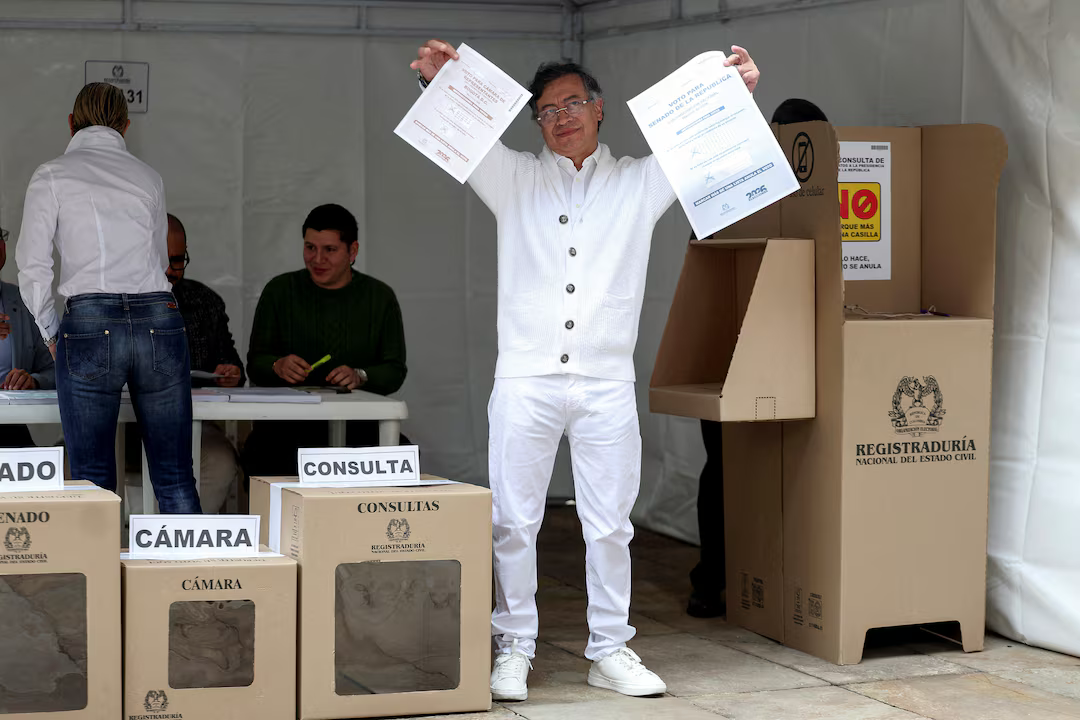
Colombians went to the polls on Sunday to elect a new Congress and select three presidential candidates who will compete in the elections this May. This vote will significantly influence the next president’s capacity to advance legislation and achieve their agenda, particularly as the election results will determine the composition of Congress and the ability to form a coalition government.
Voters will select from more than 3,000 candidates to occupy 102 Senate seats and 182 House seats in an election that analysts anticipate will be split among approximately two dozen parties, likely compelling the next president to establish a coalition government.
Approximately 41.2 million eligible voters will have the opportunity to engage in consultations where various right-wing, centrist, and left-wing parties will choose their presidential candidates. Several prominent candidates—including leftist Ivan Cepeda, right-winger Abelardo De La Espriella, and centrist Sergio Fajardo—will not take part in Sunday’s primaries. “It is crucial to come and exercise the right to vote.” “The most important thing is for Colombia to decide its future and for the results to be respected,” stated Federico Rodriguez, a 32-year-old business administrator, following his vote in northern Bogota.
“It is a source of pride that we can go out and exercise our right to vote and to democracy, but I also have uncertainty about the results, about knowing what Colombia’s future will be in the next four years,” said university student Isabella Suarez, 21.
The polls will be open from 8 a.m. local time (1300 GMT) until 4 p.m. (2100 GMT).
President Gustavo Petro, whose term concludes in August, has consistently raised concerns about the software designated for the vote count in the upcoming elections, suggesting potential irregularities that could undermine public trust in the electoral process. In contrast, National Registrar Hernan Penagos has assured the public of the vote’s transparency and stated that party observers will have the opportunity to verify the software’s results.
Defense Minister Pedro Sanchez announced this week that approximately 246,000 members of the military forces and the national police have been placed on high alert to thwart potential attacks by illegal armed groups aiming to disrupt the election or coerce voters into supporting specific candidates.