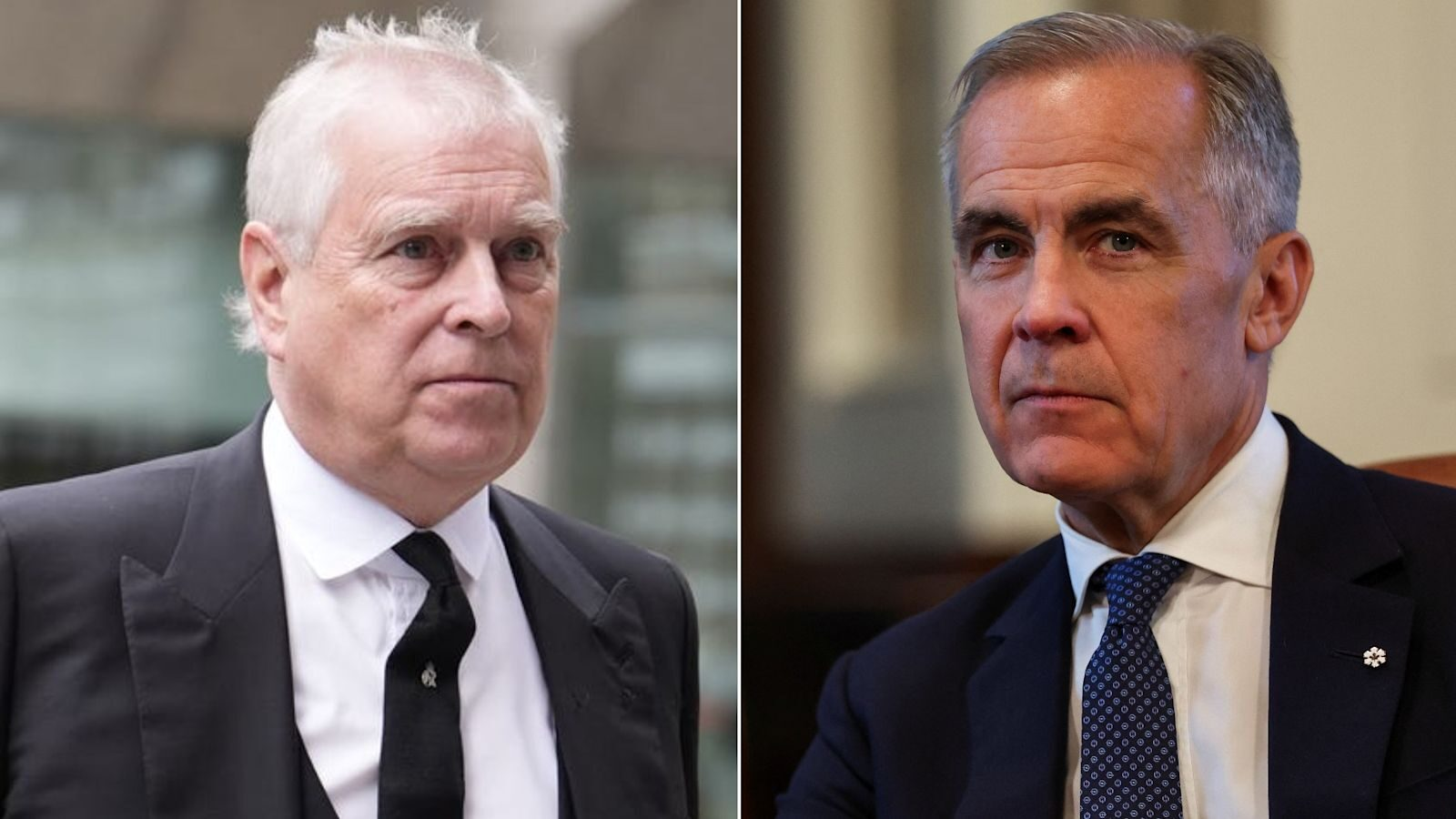
Canada’s Prime Minister, Mike Carney, urges the removal of Prince Andrew from the line of succession, referencing allegations of misconduct and connections to Epstein.
Mark Carney, Canada’s Prime Minister, has urged for the removal of Prince Andrew, the former Duke of York, from the royal line of succession.
Mountbatten-Windsor, eighth in line to the throne, was arrested last month on suspicion of misconduct in public office after allegations surfaced regarding the sharing of confidential material with the late financier Jeffrey Epstein. The former prince has refuted any allegations of misconduct associated with Epstein and has not provided a response to the BBC concerning the recent publication of millions of Epstein files in January.
While addressing reporters in Tokyo, Carney characterized Andrew’s actions as “deplorable” and stated that they warranted his removal from succession. “Although he is quite far along, the principle remains unchanged,” Carney stated.
Other Commonwealth leaders have made similar remarks in response to Carney’s call. Last month, Australian Prime Minister Anthony Albanese informed the UK’s Sir Keir Starmer that his government would back the removal of Mountbatten-Windsor from the line of succession. “These are serious allegations, and Australians regard them with the utmost seriousness,” Albanese stated.
New Zealand’s Prime Minister, Christopher Luxon, conveyed his support, stating, “No one is above the law, and once the investigation is concluded, we would back his removal from succession.”
In the UK, Defence Minister Luke Pollard stated that enacting legislation to bar Andrew from ever ascending to the throne would be “the right thing to do,” irrespective of the police investigation’s findings. Pollard confirmed that the government, in collaboration with Buckingham Palace, has been devising strategies to prevent the former prince from potentially assuming the throne.
Any removal would necessitate an act of Parliament and the approval of MPs and peers, as well as royal assent from King Charles III. Furthermore, the measure would require backing from the 14 Commonwealth nations where the King serves as head of state. In 1936, following his abdication, Edward VIII and his heirs underwent the most recent parliamentary removal.
Buckingham Palace has yet to make a public statement regarding the proposed legislation aimed at removing Prince Andrew from the line of succession.