US, Venezuela Agreement Reached to Restore Diplomatic Relations Following Maduro’s Capture
Washington and Caracas are taking steps to restore their relationship following the seizure of Nicolás Maduro by US forces, indicating a significant change in the geopolitical landscape.
The United States and Venezuela have come to an agreement to restore diplomatic and consular relations, signifying a significant change in their relationship just months after American forces apprehended Venezuelan President Nicolás Maduro in a surprise military operation authorized by Donald Trump.
In a collaborative statement, both nations expressed their commitment to fostering stability, aiding Venezuela’s economic recovery, and promoting political reconciliation, marking a notable advancement following years of tension between Washington and Caracas.
The relationship between the two countries had started to improve following the US military operation in January, during which Maduro and his wife were captured and brought to Manhattan to face charges related to alleged weapons and drug offenses. The leader of Venezuela has refuted the allegations and is anticipated to face trial in the United States later this month.
The reopening of diplomatic channels signifies a meaningful move toward reestablishing normal relations. The US embassy in Caracas, closed since 2019 amid heightened tensions between the two governments, has now resumed operations, with Washington appointing a new diplomat to head its mission in Venezuela.
Officials in Caracas announced their readiness to initiate what they termed a “new stage of constructive dialogue” with the United States, emphasizing that such engagement should be founded on mutual respect and focused on enhancing the welfare of Venezuelans.
The Venezuelan government expressed its expectation that the revitalized relationship will lead to the “social and economic happiness of the Venezuelan people.” Nonetheless, the statement from Caracas failed to address a political transition or upcoming elections, a point that the US State Department has consistently highlighted in its communications.
Washington has consistently accused Maduro and various members of his administration of heading a criminal organization engaged in activities such as illegal mining and drug trafficking, claims that Caracas has denied.
Diplomatic engagement is anticipated to increase in the upcoming weeks. According to sources, there are additional American diplomatic staff currently stationed at the US embassy in Bogotá. Colombia is expected to be transferred to Caracas to broaden the mission and enable officials from both sides to engage in face-to-face negotiations while also reinstating consular services.
The US State Department stated that its diplomatic efforts aim to assist Venezuelans through what it referred to as a “phased process” that may ultimately establish the conditions for a peaceful transition to a democratically elected government.
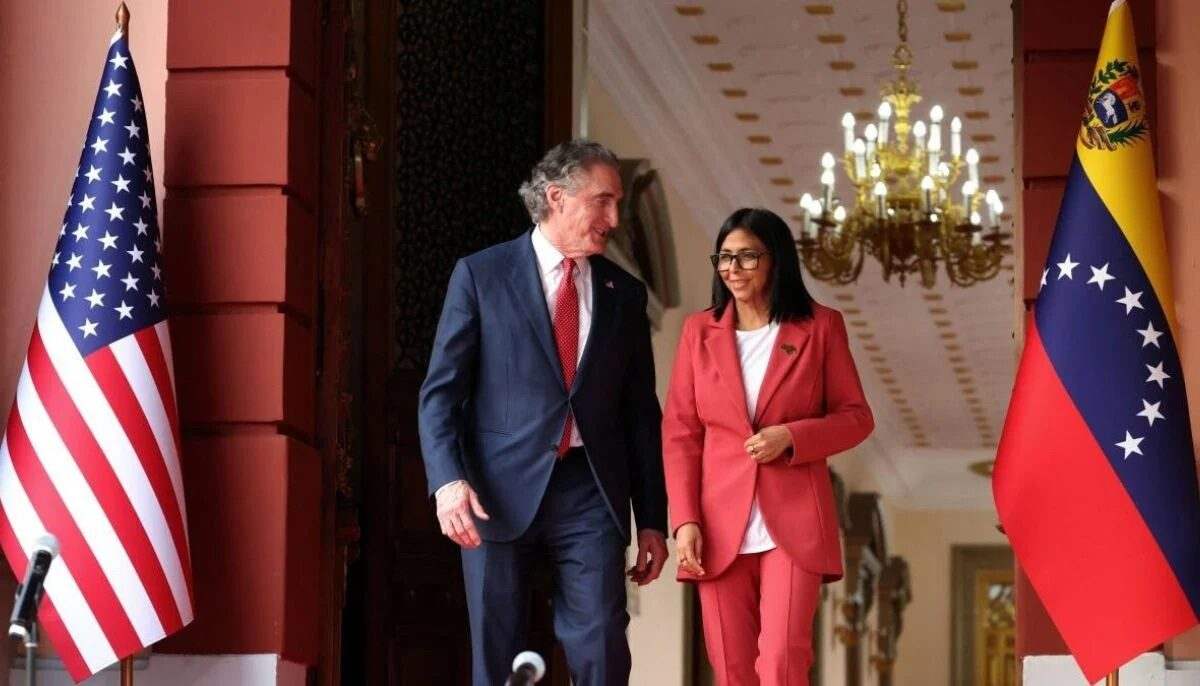
Before leaving for Washington, US Interior Secretary Doug Burgum spoke to reporters in Caracas, characterizing the intervention in Venezuela as a strategic choice made by the Trump administration.
Burgum described the decision to act against the Venezuelan government prior to addressing Iran as a “brilliant strategic move,” noting that the operation also aimed to safeguard American energy interests.
On 28 February, the US and Israel initiated military operations against Iran, resulting in the death of Iran’s Supreme Leader Ali Khamenei in the first wave of attacks.
Burgum stated that the intervention in Venezuela would also help guarantee that “oil will flow to America.”
Following Maduro’s capture and the US military intervention, Washington has swiftly intensified its economic involvement in Venezuela’s extensive energy sector. The US government has permitted Venezuela to sell sanctioned oil with American oversight, while Caracas has revised its legislation to facilitate greater foreign investment in its oil sector.
Energy collaboration has swiftly grown. On Wednesday, Venezuela’s interim president, Delcy Rodríguez, and Burgum announced their collaboration on the development of Venezuela’s mining sector.
Alongside having the world’s largest proven oil reserves, Venezuela is home to substantial deposits of gold, diamonds, rare earth elements, and various other essential minerals utilized in contemporary technologies, such as mobile phones.
The reestablishment of formal diplomatic relations signifies not just a political change but also the possibility of a substantial economic alliance between Washington and Caracas.