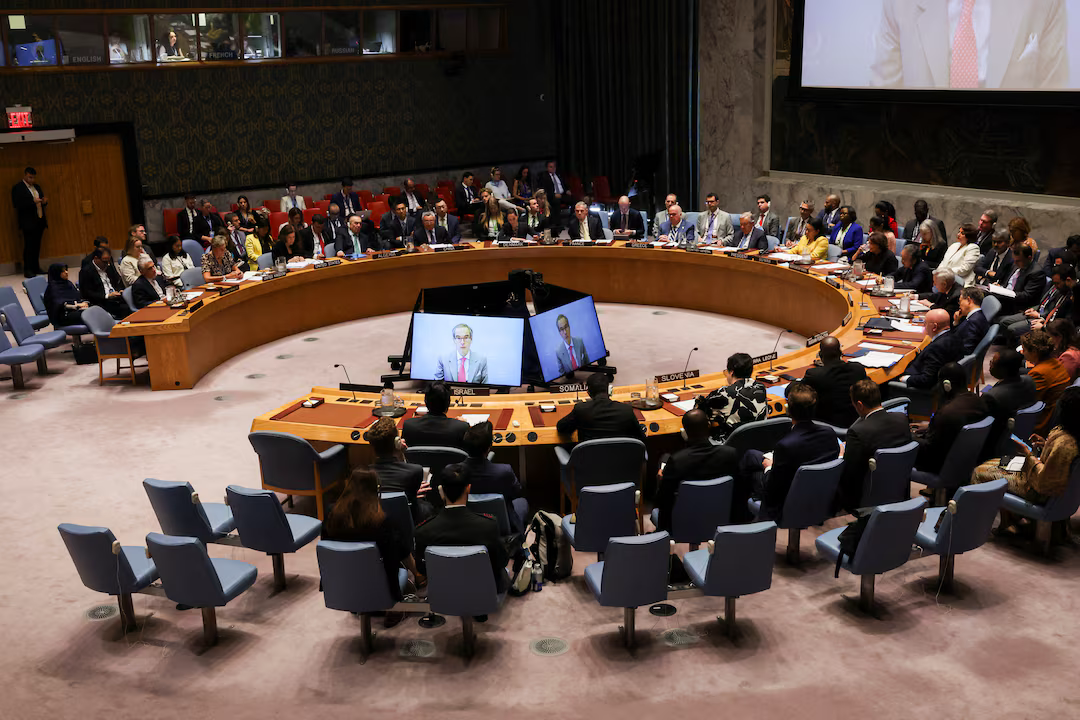
The UN has commenced its emergency meeting, cautioning against the potential for a broader regional conflict as oil prices prepare for an increase.
An emergency meeting of the UN panel has commenced following the US-Israel attacks on Iran.
“Military action carries the risk of igniting a chain of events that no one can control in the most volatile region of the world,” stated UN Secretary-General Guterres, noting that approximately 20 cities had been impacted in Iran.
He acknowledged the reports regarding the deaths of Iranian leaders but stated that he could not verify them independently.
Kaja Kallas, the European Union Foreign Policy Chief, announced that the bloc’s foreign ministers will convene for “extraordinary” discussions on Iran today.
“The Iranian regime’s indiscriminate attacks against its neighbors carry the risk of dragging the region into a broader war, and we condemn this.”
Iran has requested an emergency meeting of the UN nuclear watchdog to address what it termed as “baseless” claims from the US and Israel, which suggested that Tehran’s atomic program partially justified their military actions against the country.
Crude oil prices are anticipated to soar.
Oil prices are expected to increase when trading commences on Monday morning, as Tehran has consistently issued threats to blockade the Strait of Hormuz, an essential oil export route and a vital maritime passage.
Assuming all other factors remain constant, the increasing global price of crude oil benefits Nigeria, which has set its 2026 budget based on an anticipated oil production benchmark of 1.84 million barrels per day (bpd) and a price benchmark ranging from $60 to $64.85 per barrel.
In addition to its status as a significant oil producer, Tehran has consistently issued threats regarding a potential blockade of the Strait of Hormuz.
In 2024, around 20 million barrels of crude oil flowed through it each day, representing nearly 20 percent of global liquid oil consumption, as stated in a report by the US Energy Information Administration (EIA).