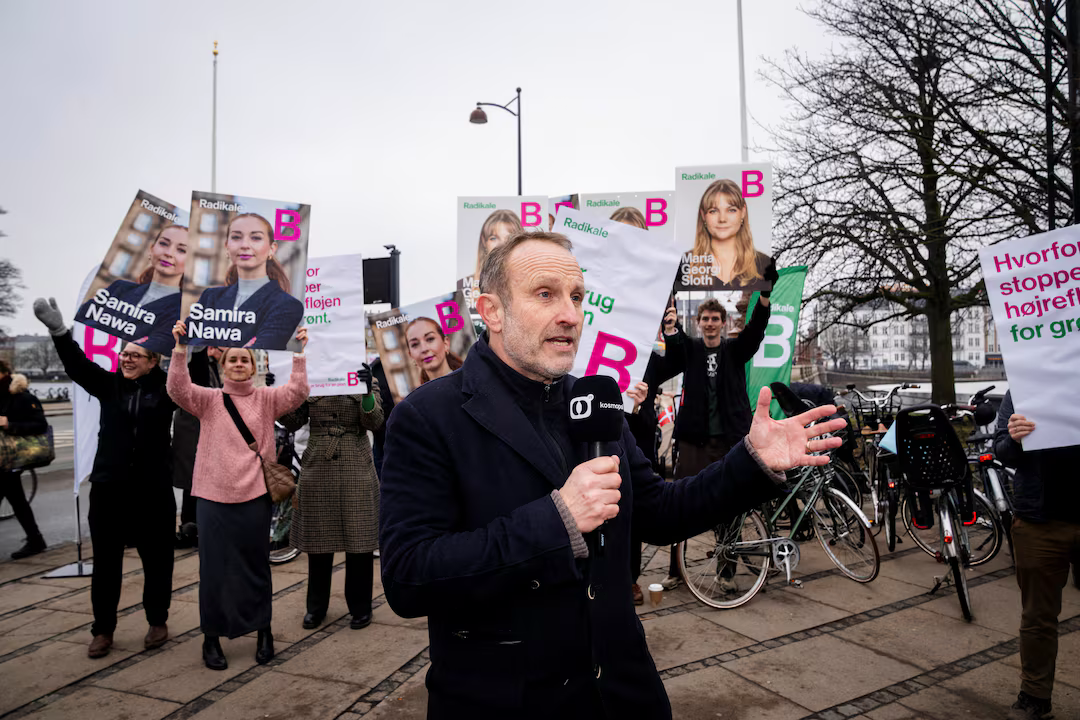
Prime Minister Mette Frederiksen announced on Thursday that Denmark will hold a parliamentary election on March 24, aiming to leverage the increased support for her resolute position against U.S. pressure regarding Greenland.
Frederiksen has dedicated recent months to uniting European leaders in opposition to President Donald Trump’s renewed interest in annexing the Arctic island, an initiative that opinion polls indicate has enhanced her popularity amid public discontent over increasing living costs and strains on welfare services. “This will be a pivotal election, as it is within the next four years that we, as Danes and Europeans, will truly need to stand independently,” Frederiksen stated. “We must clarify our relationship with the United States, and we must strengthen our defenses to guarantee peace on our continent.”
THE LOCAL RECORD IS ALSO UNDER EXAMINATION
The Greenland crisis has elevated Frederiksen’s visibility on the global stage, enhancing the reputation she established through her prompt handling of the COVID-19 pandemic and her efforts to garner European support for Ukraine.
The election will determine if voters will commend her for her international leadership and defense of Danish sovereignty, or if they will penalize her government for what critics describe as a neglect of domestic issues.
“The confidence in Mette Frederiksen as a leader and her capacity to manage the Greenland and Ukraine crises will be pivotal to the campaign,” political commentator Joachim B. Olsen stated. “Her challenge is that, after serving as prime minister for two terms, it becomes increasingly difficult to address solutions to the issues,” he continued. “She wishes to discuss inequality, yet voters may question why she has not tackled these issues until this moment.”
Denmark’s current government is a unique coalition that brings together Frederiksen’s Social Democrats, the center-right Liberal Party, under Defense Minister Troels Lund Poulsen, and the Moderates, led by Lars Løkke Rasmussen, who has previously held the position of prime minister twice and currently serves as foreign minister.
Established in 2022 as a crisis government, the coalition is projected to lose its majority, based on opinion polls, as parties realign themselves along more conventional left-right lines.
The Social Democrats experienced a notable setback in the 2025 municipal elections, relinquishing the Copenhagen mayoralty for the first time in 87 years.
Despite the party’s support dropping to 17% in December polls, it has recovered to 22% as Frederiksen’s approval ratings improved due to her management of the Greenland dispute. During the 2022 general election, the party secured 28% of the vote.
According to political scientist Rune Stubager, voters are expressing concerns about food prices, welfare, inequality, and immigration.
The government’s decision in 2023 to eliminate the Great Prayer Day public holiday in order to increase defense spending faced backlash, even though there was widespread public backing for military investment.
The Green Left party, a longstanding partner of the Social Democrats now in opposition, has committed to restoring the holiday if they gain power, a suggestion that the Social Democrats have not dismissed.
Frederiksen’s party seeks to highlight its stringent immigration policies, a position that contributed to its success in the 2019 election. In January, the government put forward a proposal to relax deportation regulations for foreign nationals, recognizing the possible conflict with European human rights standards.