Germany’s ruling conservatives on Saturday approved a motion to prohibit social media usage for individuals under 14 and to implement stricter digital verification measures for teenagers, gaining traction for these restrictions in Germany and across Europe.
During a party conference held in Stuttgart, Chancellor Friedrich Merz’s Christian Democratic Union advocated for imposing fines on online platforms that do not comply with these limits, as well as for the establishment of uniform age standards across the European Union.
An increasing number of nations, such as Spain, Greece, France, and Britain, are considering comparable bans or limitations on social media platforms like TikTok or Instagram.
It takes inspiration from Australia, which last year became the first nation to mandate that platforms restrict access for children.
European nations are increasingly intensifying their pressure on social media companies, potentially provoking a backlash from the United States.
President Donald Trump has issued warnings of tariffs and sanctions should EU nations implement new technology taxes or online regulations affecting U.S. companies. “We urge the federal government to establish a legal age limit of 14 for social network usage and to consider the unique need for protection in the digital realm up to the age of 16,” stated the motion that was approved on Saturday.
Merz’s coalition partners, the Social Democrats, have also supported restrictions on social media for children. The influence exerted by both factions within the coalition suggests a growing probability that the federal government will advocate for restrictions.
In Germany’s federal system, media regulation falls under state-level responsibility, requiring states to engage in negotiations to establish consistent nationwide rules.
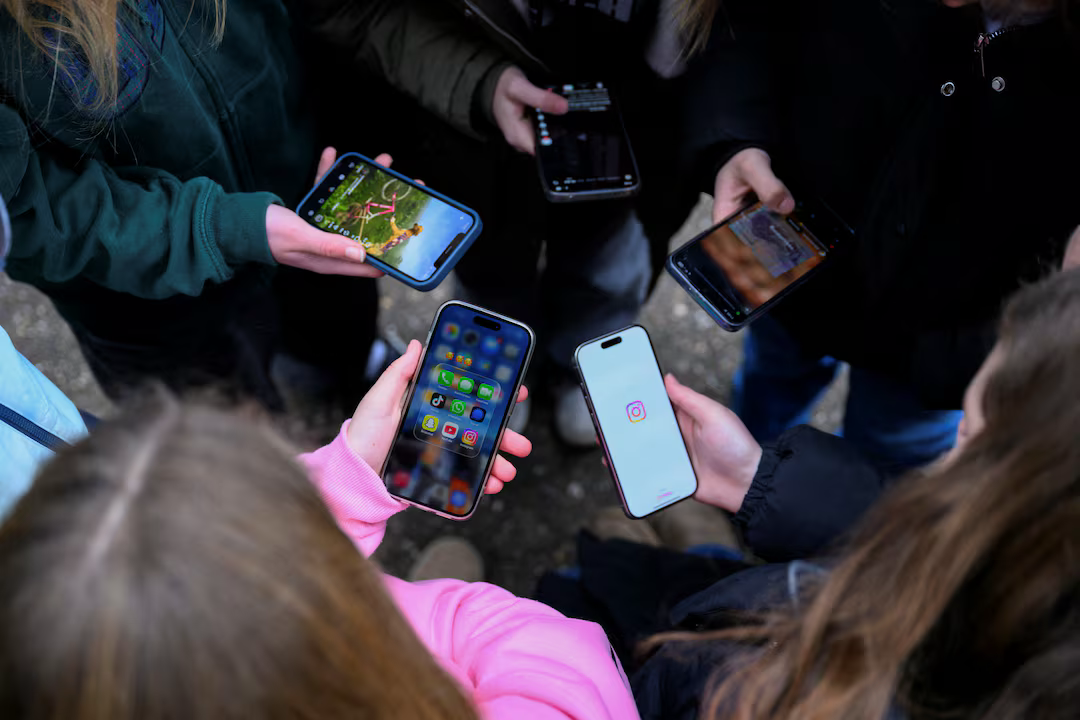
Students in Bonn engage in a discussion about the ban.
The ban may impact students at the Cardinal Frings Gymnasium in Bonn, where several were seen using their phones on school grounds just a day prior. “I think it’s fair, but I believe it should be the parents’ choice to impose restrictions, not the government,” stated 13-year-old Moritz, who claims he primarily watches YouTube. “I believe it should be prohibited for children under 12, but once they turn 12, they should be able to differentiate between fake news and real news.”
His classmate Emma, 13, primarily uses Snapchat, though she has set a time limit on her phone.
“A ban would be somewhat unusual, as you become accustomed to sending your snap in the morning before school, or what my friends do, like just scrolling through Instagram or TikTok for a bit,” she stated.
Ella, 12, browses social media multiple times each day. “I have TikTok and Instagram too, but I realize it’s all quite addictive; the more you scroll, the more you crave to see.”
Teacher Till Franke noted that for many of the children, “it would be a shock at first, due to their daily use of social media.”
However, he mentioned that the students would eventually adapt, as they would discover other avenues for communication among themselves.