South Korean court sentences former President Yoon to life imprisonment for insurrection
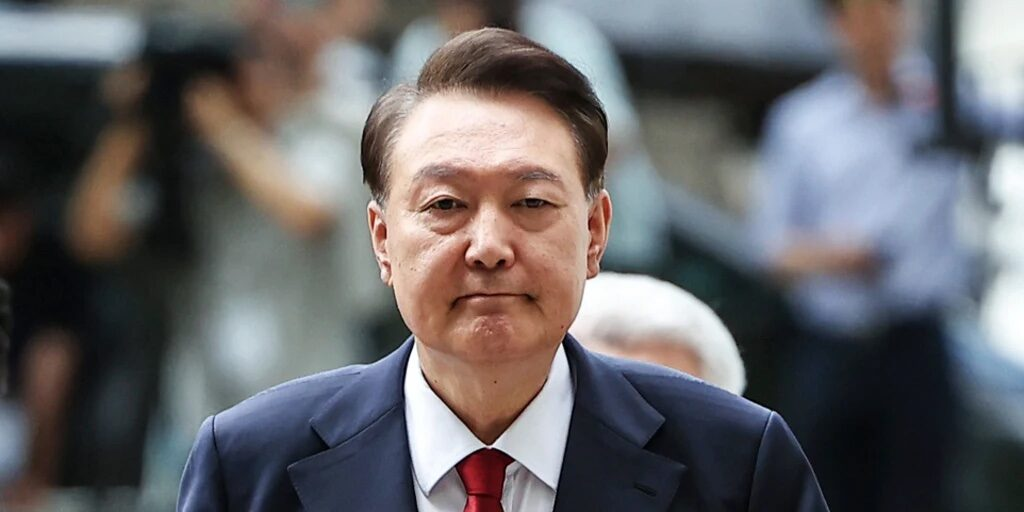
A South Korean court has sentenced former President Yoon Suk Yeol to life in prison, having found him guilty of orchestrating an insurrection related to his attempt to impose martial law in December 2024.
Prosecutors aimed for the death penalty in a case that garnered significant attention in a nation marked by deep divisions. This trial is the most significant in a series for the removed leader, whose actions sparked a national political crisis and challenged the strength of democracy.
Yoon collaborated with his former defence minister, Kim Yong-hyun, to undermine the constitutional order by sending troops to parliament, with the aim of incapacitating its operations, Judge Jee Kui-youn stated in a crowded courtroom. “The court finds that the deployment of armed troops to parliament … and the use of equipment to attempt arrests all represent acts of insurrection,” he remarked, representing the panel of three judges.
On December 3, 2024, Yoon directed several officials and troops in unlawful activities, resulting in significant social repercussions due to the declaration of martial law, as stated by Jee while delivering the life sentence for the former leader.
Clad in a dark navy suit without a tie, Yoon, 65, appeared ashen-faced as the sentences were announced for him and seven other defendants, including Kim, the former defence minister, who was sentenced to 30 years, along with former high-ranking police officials.
Yoon’s defence team will confer with him regarding the possibility of appealing the ruling. One of his lawyers, Yoon Kab-keun, stated that the decision entirely overlooked the fundamental legal principle of grounding findings in evidence.
A lawyer representing Kim stated that the former defence minister would “certainly appeal”.
A prosecutor indicated that the team experienced some “regret” regarding the sentencing but refrained from disclosing any intentions to appeal.
THE DANGER OF CAPITAL PUNISHMENT
Prior to announcing the verdict, Judge Jee examined the extensive history of treason and insurrection, tracing back from the Roman Empire and medieval times to the trial and execution of Charles I of England for his conflict with parliament.
Planning an insurrection can result in the death penalty or life imprisonment according to South Korean law. The last death sentence in the country was issued in 2016, yet no executions have taken place since 1997.
The sentencing trial of former South Korean President Yeol regarding his insurrection case is taking place in Seoul.
Yoon refuted the allegations. The former career prosecutor, who identifies as conservative, stated that he possessed presidential authority to declare martial law, asserting that his actions were intended to raise awareness about the obstruction of government by opposition parties.
The deposed former leader is expected to continue being held at the Seoul Detention Centre. He has the option to appeal the ruling and subsequently contest any decision made by the appellate court at the Supreme Court level.
Judicial guidelines indicate that the initial trial should be completed within six months, and the full process, including appeals, should take no longer than two years; however, trials frequently surpass these timelines.
Yoon, having undergone eight trial proceedings, is currently appealing a five-year prison sentence that was imposed on him in January during a separate trial. This sentence is related to charges that include hindering efforts by authorities to apprehend him following his declaration of martial law.
RIPPLE EFFECTS IN SOUTH KOREA
Yoon’s attempt to impose martial law was short-lived, lasting merely six hours before it faced significant street protests and was rejected by parliament. This move reverberated throughout Asia’s fourth-largest economy, a crucial U.S. security ally, and a nation often regarded as one of the world’s most resilient democracies.
Ko Jeong-suk, 65, who observed the court ruling at Seoul Station, expressed that the attempt at martial law intensified societal divisions. “I strongly believe it should have resulted in the death sentence to prevent this from becoming a repeated example.”
Hundreds of supporters gathered outside the court complex, demanding his release.
In a post on X, President Lee Jae Myung, a liberal who secured the presidency in a snap election in June following Yoon’s removal, praised the efforts of the Korean people in preventing the martial law.
“It was possible because it was the Republic of Korea,” Lee stated, referring to the official name of the country, whose citizens would serve as a historical example, he continued.
His post prior to Thursday’s ruling was linked to a newspaper article indicating that certain academics had suggested a Nobel Peace Prize nomination for the Korean public, who confronted troops and police to resist martial law peacefully.