Ivory Coast is contemplating a reduction in the price it compensates farmers for cocoa beans to match Ghana, according to two government sources who spoke to Reuters, as the leading producers of this essential chocolate ingredient confront a significant crisis.
Senior officials from Ivory Coast indicated that all options remain under consideration as the government deliberates on whether to align with Ghana, which has already reduced its farmgate price by 28.6% for the remainder of the 2025/2026 main crop season, in coordination with Abidjan, in response to falling prices.
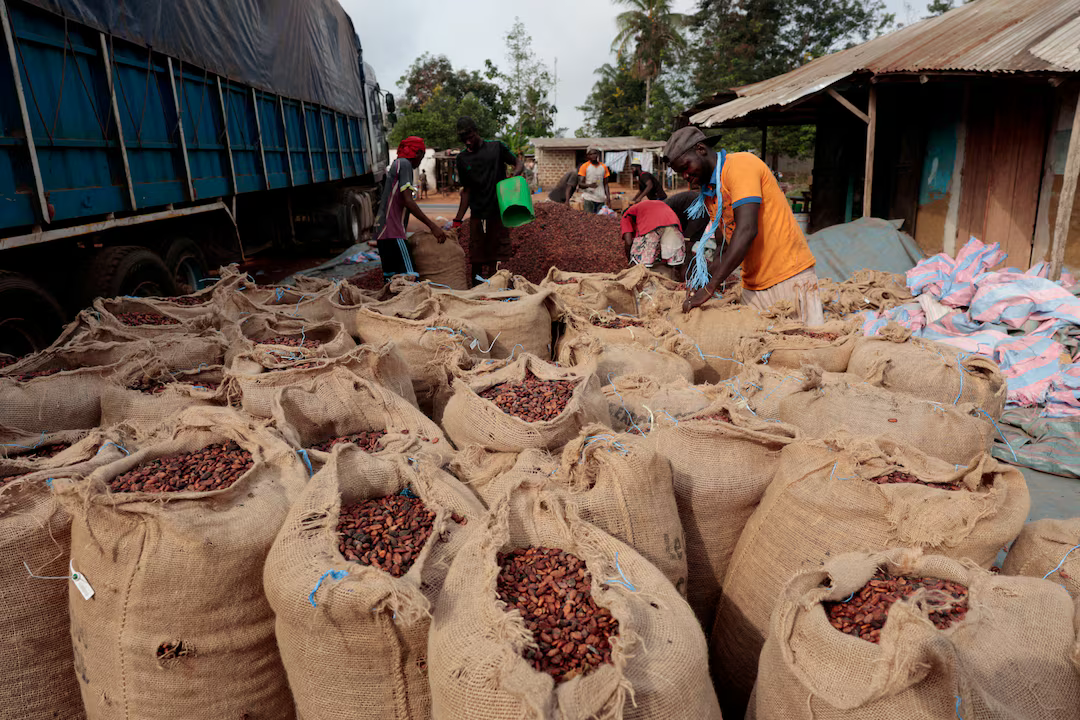
The farmgate price, established at the beginning of the harvest season, represents the sum of money that farmers obtain for their products immediately after harvest, prior to any value being added by intermediaries, exporters, processors, traders, or cooperatives.
The conversations with Ghana, as well as the internal discussions within the Ivory Coast government regarding a price adjustment to match Ghana’s, have not been reported before.
Meanwhile, the Ivory Coast–Ghana Cocoa Initiative (ICCIG) announced that the two African nations, which together represent approximately 60% of global production, have been working closely since the beginning of the crisis in the sector. “We have considered all options, and discussions are advancing positively.” A first official from Ivory Coast, speaking on the condition of anonymity due to restrictions on discussing the matter, stated, “Courageous and realistic decisions will be taken soon.”
The second official stated that the ongoing decline in prices, which has resulted in cocoa dropping by nearly 50% in recent months, has left the government with limited options to navigate the situation.
Cocoa futures on the ICE exchange reached their lowest point in 2-1/2 years on Tuesday, as worries about unsold cocoa stocks in Ivory Coast and Ghana persisted, putting downward pressure on prices.
“We must consider the survival of the cocoa sector in Ivory Coast.” “We must take action; changes are in progress,” the source stated, opting not to reveal additional information.
According to the two sources, an inter-ministerial committee has convened to discuss the matter, and a decision may be forthcoming shortly.
The Ivory Coast government spokesperson did not provide a response to a request for comment from Reuters.
MEASURES TO AVOID STRUCTURAL DAMAGE
Alex Assanvo, the executive secretary of ICCIG, stated that the two countries were adjusting to the unexpected market reversal and had implemented measures to avert structural damage.
The trading rooms of Ivory Coast’s Coffee and Cocoa Council and Ghana’s COCOBOD maintained consistent communication.
Assanvo also supported the Living Income Differential, which was introduced in 2019 to enhance farmers’ earnings, noting that recent market volatility highlighted its importance.
ICCIG is organizing a meeting between the two countries to enhance coordination as farmers encounter financial challenges.
“The organization is actively engaged in coordinating policies in both countries,” Assanvo stated, noting that all stakeholders in the sector would be brought together to assess market developments and suggest enhancements to price-stabilization mechanisms.
Exporters and buyers anticipate that Ivory Coast will soon announce a cut, asserting that the issue is no longer about if, but rather when. “The country is holding firm, but for how much longer?” “I don’t anticipate Ivory Coast taking a different approach than Ghana,” stated the head of an export company based in Abidjan.