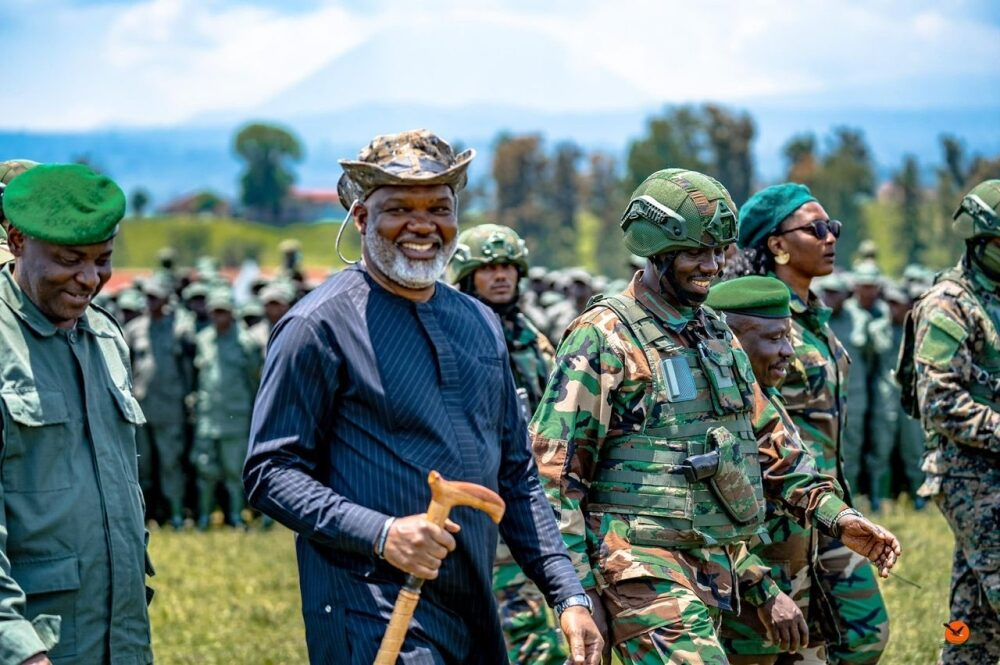
AFC/M23 ‘does not acknowledge’ the ceasefire initiated by Luanda
The AFC/M23 movement has stated that it does not acknowledge the ceasefire suggested by Angolan President João Lourenço, even though the Congolese government has formally accepted the initiative.
In an interview with The New Times on Monday, February 16, AFC/M23 spokesperson Oscar Balinda stated that the movement was neither consulted nor obligated by the ceasefire anticipated to commence on February 18.
“We are not informed about that ceasefire; our focus remains on the ongoing Doha process,” Balinda stated.
His comments come in the wake of several official statements about a suggested ceasefire. On February 12, a statement was issued by the Angolan presidency following a meeting in Luanda attended by Lourenço, Congolese President Felix Tshisekedi, Togolese leader and African Union-appointed mediator Faure Gnassingbé, and former Nigerian President Olusegun Obasanjo.
The suggested ceasefire between the Congolese government and the AFC/M23 rebels is set to commence at 12:00 on February 18, contingent upon public approval of the date.
On February 13, the Congolese government announced that Tshisekedi had “accepted the principle of a ceasefire, in a spirit of responsibility, appeasement, and the pursuit of a peaceful solution to the conflict.”
Nonetheless, the AFC/M23 asserts its commitment to the Qatar-mediated peace talks, which have already set up a structured mechanism to oversee the formal ceasefire process. Balinda observed that the Doha process was launched in April 2025 at the behest of President Tshisekedi following an unsuccessful round of discussions in Luanda.
Under the Doha process, the parties agreed to a mandate that details the implementation and monitoring of the ceasefire, which encompasses the deployment of verification mechanisms.
On February 2 in Doha, a significant milestone was achieved as the parties reached an agreement on a ceasefire mechanism. This mechanism will be monitored by the UN peacekeeping mission, MONUSCO, in collaboration with the International Conference on the Great Lakes Region (ICGLR).
Balinda stated that the movement is presently concentrating on the procedural steps arising from the signed mandate.
“MONUSCO, as a component of the monitoring mechanism, arrived in Goma to assess the situation on the ground.” The Extended Joint Verification Mechanism (EJVM+) of ICGLR is organized with a team under the leadership of a Zambian General,” he stated.
On January 13, a significant meeting in Zambia appointed Brig Gen Charles Simuyuni Nakeempa as the new commander of the Expanded Joint Verification Mechanism, with Col Arlindo Sebastiao Vandunemu Fernandes from Angola serving as his deputy. The ICGLR is anticipating the signing of a Memorandum of Understanding (MoU) by both DR Congo and the AFC/M23, which is a crucial step in the operationalization of the Doha ceasefire framework.
“We are awaiting the signing of the MoU, after which we will move forward with the next steps,” Balinda stated. “As the Luanda process continues, President Felix Tshisekedi appears to be aligning with the ceasefire, even as his true focus remains on a military solution on the ground.”
He stated that if the ceasefire had been mutually agreed upon within the current framework, the movement would have officially conveyed its stance. ‘Fragmented efforts’
On February 13, following Kinshasa’s confirmation of the ceasefire, AFC/M23 coordinator Corneille Nangaa issued a statement reiterating the movement’s commitment to implementing the mechanism agreed upon in Doha.
“In light of the renewed calls for a ceasefire, the AFC/M23 reiterates its commitment to promptly and sincerely implement the mechanism established within the framework of the Doha process,” Nangaa stated.
He accused Kinshasa of engaging in a strategy of “diplomatic fragmentation.”
“The AFC/M23 condemns the strategy of diplomatic fragmentation employed by the illegitimate and corrupt regime in Kinshasa, marked by the proliferation of frameworks and parallel initiatives that operate outside of a centralized and consensual process,” Nangaa stated.
He contended that this approach “undermines the coherence of mediation efforts, weakens the credibility of commitments made, and risks delaying the emergence of a serious and sustainable political settlement.”
The rebel leader emphasized that the situation on the ground was at odds with the government’s public statements.
“In clear contradiction to its recent announcement of adherence to the ceasefire call, the Kinshasa regime is demonstrating, through verifiable facts on the ground, the continuation of acts of belligerence,” he stated.
Nangaa referenced offensives conducted in heavily populated areas and the employment of mercenaries as proof of “a deliberate choice of military escalation, in total breach of the spirit and letter of the public commitments undertaken.”
He expressed concerns regarding regional dynamics, highlighting the role of Burundi, where President Evariste Ndayishimiye has recently taken on the chairmanship of the African Union.
The Burundian leader was described as someone who “contributes to the persistence of targeted violence against the Banyamulenge communities.”
He urged the international community and continental institutions to maintain ongoing vigilance in order to prevent any escalation and to mitigate worsening ethnic tensions and the humanitarian crisis in the region.