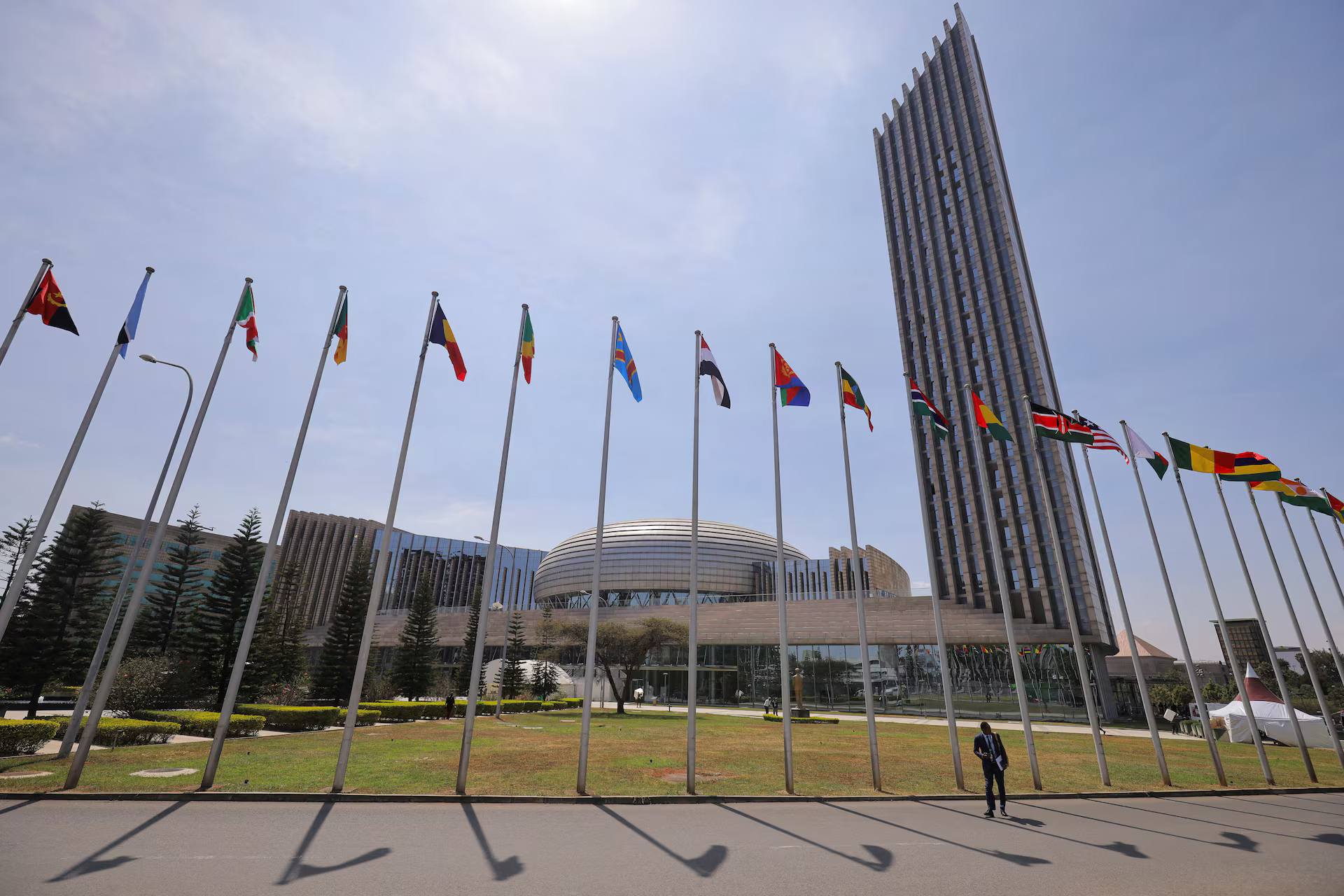
The African Union summit is overshadowed by the rivalry between Saudi Arabia and the UAE in the Horn of Africa
A conflict between Saudi Arabia and the United Arab Emirates in the Horn of Africa is casting a shadow over this weekend’s African Union summit, although the majority of the continent’s leaders are expected to steer clear of taking sides, according to nine diplomats and experts.
The rivalry that originated in Yemen has extended across the Red Sea into a region fraught with conflicts, encompassing the wars in Somalia and Sudan, the tensions between Ethiopia and Eritrea, and the divisions within Libya.
In recent years, the UAE has emerged as a significant force in the Horn, which includes Sudan, Somalia, Ethiopia, Eritrea, and Djibouti, by means of substantial investments, strong diplomatic efforts, and subtle military assistance.
Saudi Arabia has maintained a more understated presence, yet diplomats indicate that Riyadh is forging an alliance that encompasses Egypt, Turkey, and Qatar.
A senior African diplomat informed Reuters, “Saudi has awakened to the possibility of losing the Red Sea.” “They have been unaware all along while the UAE was taking action in the Horn.”
The rivalry, which initially centered on the Red Sea and the Gulf of Aden—both vital shipping routes—has now extended further inland.
“Currently, the situation is unfolding in Somalia, but it is also occurring in Sudan, the Sahel, and other regions,” the diplomat stated.
FORCED TO MAKE A DECISION
Although these conflicts are driven by local factors, the involvement of Gulf nations is compelling countries, regions, and even warlords to take a stance, according to diplomats.
Michael Woldemariam, an expert on the Horn of Africa at the University of Maryland, noted that regional actors such as Eritrea, Djibouti, Somalia, and the Sudanese Armed Forces (SAF) have become increasingly apprehensive about the UAE’s assertive foreign policy.
“Saudis might aim to restrict or reduce UAE influence in the Horn, but it is yet to be seen how that will unfold,” he stated. “The UAE possesses significant influence throughout the region, characterized by its expeditionary military presence and extensive financial connections.”
Officials from Saudi Arabia assert that the actions of the UAE in Yemen and the Horn pose a threat to their national security.
Senior Emirati officials assert that their strategy fortifies states against extremists, whereas U.N. experts and Western officials contend that it has at times exacerbated conflict and bolstered authoritarian leaders, allegations that the UAE refutes.
The officials and diplomats who were interviewed for this story chose to remain unnamed due to the sensitive nature of the issue.
PREVENTING CONFLICT AMONG GULF NATIONS
Israel’s acknowledgment of Somaliland’s quest for independence stands as the most prominent illustration to date of escalating tensions.
Somalia has severed all connections with Abu Dhabi, alleging that it has played a role in Israel’s acknowledgment of Somaliland. Mogadishu has recently entered into a defense agreement with Qatar, while Turkey has dispatched fighter jets to the capital as a demonstration of strength.
Tensions are escalating between Ethiopia, the host of the African Union, and its neighboring country Eritrea, which has been on the brink of war for several months. The leader of Eritrea recently made a visit to Saudi Arabia, a journey that analysts interpreted as an indication of Saudi support.
According to all the sources and experts interviewed, the UAE and Saudi Arabia support opposing factions in the conflict in Sudan. The UAE faces allegations of offering logistical assistance to the RSF paramilitary, whereas countries aligned with Saudi Arabia predominantly support the SAF.
According to security officials, Egypt, an ally of Saudi Arabia, has positioned Turkish-made drones along its border with the SAF and has utilized them to target the RSF in Sudan.
Analysts indicated that Ethiopia gains from the support of the UAE, and Reuters discovered this week that Ethiopia is hosting a base in western Ethiopia where RSF fighters are being recruited and trained.
Ethiopia has not made any public statements regarding the story. ‘ACTING THROUGH ALLIES AND PROXIES’
Experts noted that throughout the region, Saudi Arabia frequently operates via allies and proxies instead of taking direct action.
Woldemariam indicated that African countries would probably proceed with caution.
“Even those actors in the Horn who were concerned about UAE influence may be wary of how deeply they wish to engage in a conflict between these two Gulf powers,” he stated.
The Horn is just one of the crises on the AU summit’s agenda.
Conflict persists in the Democratic Republic of Congo, while insurgencies connected to al Qaeda and the Islamic State are expanding throughout the Sahel region.
However, those conflicts are expected to remain secondary to the Horn.
According to Alex Rondos, who previously served as the EU’s special representative for the region, the Horn has transformed into a secondary battleground for rivalries in the Middle East.
“Do the Saudis and UAE … completely understand the implications?” he inquired. “Will the Horn of Africa permit itself to be fragmented by these external rivalries and their African collaborators?”