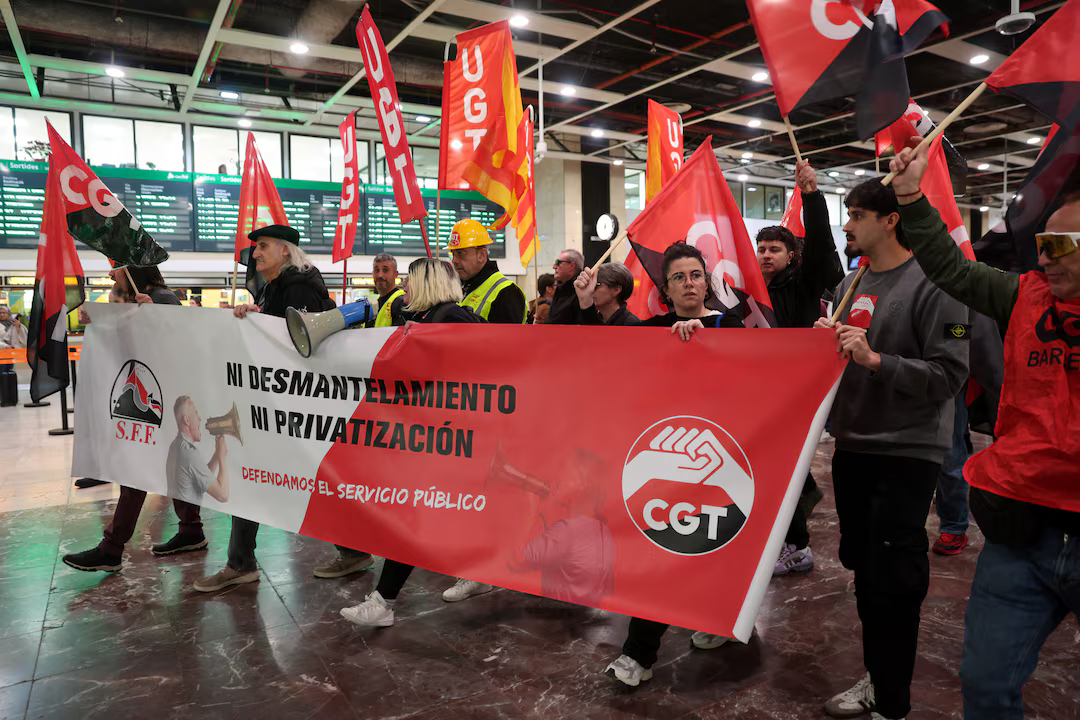
Spanish train drivers are set to initiate a three-day nationwide strike due to concerns regarding rail safety, prompted by two fatal crashes that occurred in January.
Train drivers in Spain are poised to initiate a three-day nationwide strike on Monday, expressing their concerns over what they consider insufficient safety guarantees throughout the country’s rail network. The industrial action comes in the wake of two fatal train accidents in January, which have sparked significant worries regarding the state and oversight of Spain’s rail infrastructure.
On 18 January, a tragic incident took place in Adamuz, southern Spain, where a high-speed train derailed and collided with another train heading in the opposite direction, resulting in the loss of 46 lives. The event represented the most severe rail catastrophe in Spain in over ten years. Only two days later, another accident near Barcelona resulted in the tragic death of a trainee driver and left at least 37 passengers injured following the derailment of a local train.
The January crashes led to significant disruption for travellers and tarnished the reputation of Spain’s previously lauded rail system. Following the incident, safety inspections revealed issues and maintenance shortcomings on multiple routes, intensifying worries among rail workers.
The train drivers’ union, Semaf, stated that the strike aims to compel authorities to tackle what it described as the “constant deterioration of the rail network.” The union is calling for the hiring of more staff, along with enhanced investment and maintenance to elevate safety standards.
A preliminary investigation into the Adamuz crash by Spain’s rail accident investigation commission, CIAF, revealed grooves on the wheels of the derailed train as well as on three earlier trains, indicating that a fracture in the track happened prior to the train’s passage over it. The findings have heightened examination of infrastructure integrity along key routes.
In the Catalonia accident, rail officials suspect that a wall collapsed as the train was passing, hitting the driver’s cab before causing the train to derail and inflicting significant damage to the first carriage, where the majority of the injured passengers were seated.
Semaf has characterized the two collisions as a “turning point,” emphasizing that immediate and thorough actions are necessary to ensure the safety of railway operations across the country.
The crisis has extended into the realm of politics. Spain’s Prime Minister, Pedro Sánchez, is anticipated to encounter rigorous scrutiny in parliament later this week regarding the shortcomings in the rail system and the government’s handling of the accidents.
The levels of investment in the rail network have faced significant examination. The government, led by the Socialist party, has dismissed allegations of underfunding, highlighting that €700 million has been allocated to enhance the Madrid-Andalusia line in recent years, including the area where the Adamuz crash took place.
Transport Minister Óscar Puente rejected claims that the accidents resulted from inadequate maintenance or obsolete infrastructure. “We are not considering an issue of insufficient maintenance, we are not considering an issue of outdated infrastructure, and we are not considering an issue of inadequate investment,” he stated.
Even with these reassurances, the upcoming strike indicates increasing friction between rail workers and the government, as concerns regarding safety, accountability, and the future of Spain’s rail network persist.