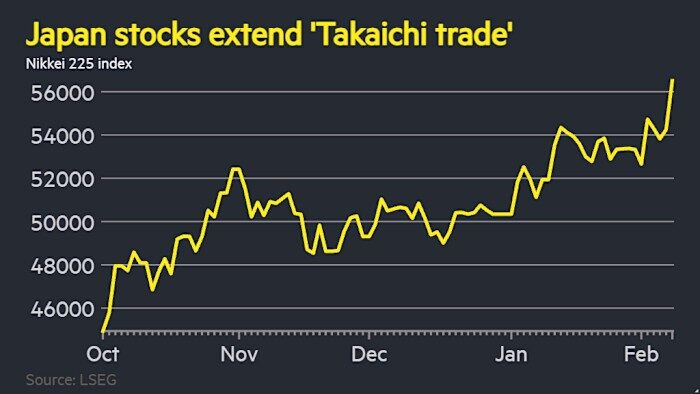
Japanese stocks reached an all-time high following Prime Minister Sanae Takaichi’s significant election win, which secured a two-thirds majority in parliament.
Japanese stocks soared to an all-time high on Monday as markets responded to Prime Minister Sanae Takaichi’s decisive election win, which provided an extraordinary parliamentary mandate for her Liberal Democratic Party (LDP).
The Nikkei 225 index surged over 5 percent in early trading, momentarily surpassing the 57,000 threshold for the first time, as investors embraced political stability and the potential for pro-business reforms.
In Sunday’s election, the LDP obtained 316 of the 465 seats in the lower house, representing the first occasion a single party has achieved a two-thirds majority since the establishment of Japan’s parliament in its current form in 1947. The coalition partner of the party, the Japan Innovation Party, secured an extra 36 seats, raising their overall total to 352.
The decisive outcome reflects a strategic risk that proved successful for Takaichi, who announced a snap election last month shortly after taking office as Japan’s first female prime minister. Her victory stands in stark contrast to the situations faced by her two immediate predecessors, during whose tenures the LDP lost its majority due to corruption scandals and grappled with escalating living costs.
The clear mandate now allows Takaichi to pursue her economic agenda without extended discussions with opposition parties. During her remarks on Sunday, she stated that her government would adopt a “responsible yet aggressive” fiscal policy and affirmed that she would not be reshuffling a cabinet established less than four months prior.
Market analysts indicate that the election result has bolstered investor confidence. Yuka Marosek, an investment analyst, informed the BBC that anticipations regarding stimulus measures, tax adjustments, and deregulation might offer “additional fuel for an existing bull trend” in Japanese markets.
Even with historically low inflation, Japan has grown more aware of the increasing cost of living in recent years. At polling stations, voters expressed to the BBC that rising grocery prices and rent were significant issues throughout the campaign. The economy faces challenges due to an ageing population, a declining workforce, and increasing social welfare expenses.
Takaichi has committed to reducing taxes and enhancing growth by increasing public spending, although critics have raised concerns about the financing of these plans in light of Japan’s already substantial government debt. Some caution that aggressive fiscal expansion might contribute to instability in an economy that remains fragile.
“We carry a significant responsibility to consistently fulfill the campaign promises we have made,” Takaichi stated, as reported by Kyodo News, as the extent of the victory became evident.
Takaichi has garnered backing from conservative members within the LDP by reintroducing enduring objectives like amending Japan’s pacifist constitution and highlighting traditional values. Simultaneously, she has resonated with younger voters, as her unique handbags and pink pens have transformed into surprising emblems of her ascent.
The international response was immediate. US President Donald Trump expressed his congratulations to Takaichi on her victory, stating it was a “honor” to have endorsed her prior to the election. Only a week after assuming her role last October, Takaichi welcomed Trump in Tokyo, marking a significant moment in her diplomatic debut.
She is set to travel to Washington in March for a second meeting with the US president, as her government aims to convert electoral momentum into economic revival and enhanced international partnerships.