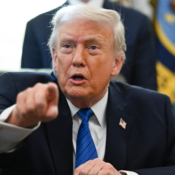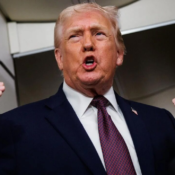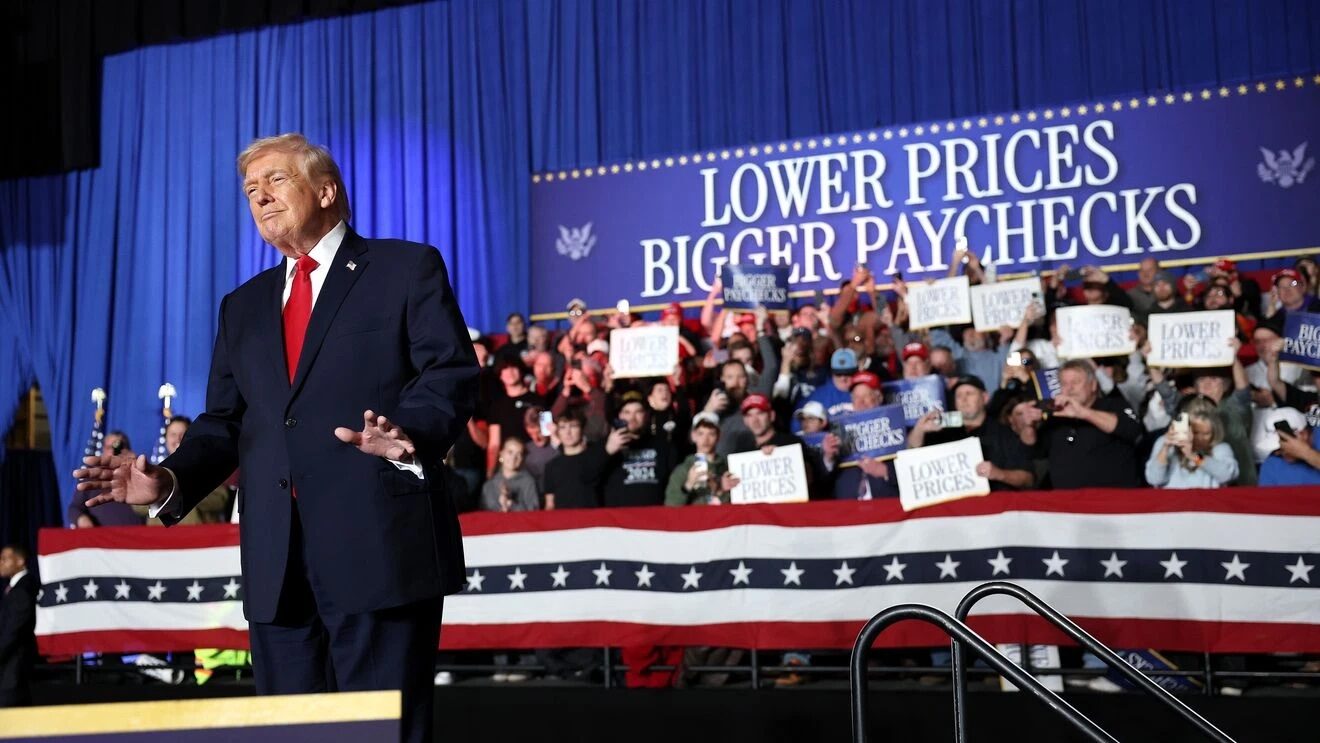
In his economic speeches, Trump asserts victory over inflation nearly 20 times, despite the ongoing impact of rising prices
Donald Trump has positioned himself as the primary spokesperson for Republicans regarding the cost of living in an election year. However, a review of his speeches by Reuters reveals a president who consistently claims that inflation has been conquered, while seldom recognizing the ongoing challenges that many Americans report experiencing.
Since December, Trump has delivered five speeches on the economy, claiming that inflation has been defeated or significantly reduced nearly 20 times and stating that prices are decreasing almost 30 times. These assertions contradict economic data and the daily experiences of voters. A significant portion of the remaining time was devoted to grievances and various issues, such as immigration, the status of Somalia as a country, and assaults on opponents.
The speeches collectively depict a president grappling with the challenge of aligning his primary assertion — that he has resolved the cost-of-living crisis — with the reality of inflation hovering around 3% in the past year and the experiences of voters facing higher prices for essential groceries. The cost of ground beef, for instance, has risen by 18% since Trump assumed office a year ago, whereas ground coffee prices have increased by 29%.
Republican strategists informed Reuters that his inconsistent messaging on the primary concern for voters threatens to establish a credibility gap for him and the Republican Party as the November midterms approach, where control of Congress hangs in the balance. Voter sentiment reflects significant dissatisfaction with Trump’s economic management.
“He cannot persist in making assertions that are clearly untrue, especially to the detriment of Republicans in tight House districts or Senate contests,” stated Rob Godfrey, a Republican strategist. Trump “needs to be disciplined and focused,” he added.
A source close to the White House indicated that the president should address the issue of affordability more forcefully and through personal visits to key districts. “The message needs to be taken out to the people because it isn’t resonating,” the source remarked, requesting anonymity to speak more openly about the matter.
Kush Desai, a spokesman for the White House, stated that Trump’s emphasis on illegal immigration in his speeches is directly linked to his assertion that individuals residing in the country illegally negatively affect the economy. Desai stated that it leads to “public services being overburdened, business activity disrupted by crime, housing markets flooded, and workers’ wages depressed.”
Trump has consistently emphasized that significant efforts are still needed to address the economic turmoil he attributes to his Democratic predecessor, Joe Biden, Desai noted.
TRUMP DEVIATES FROM MESSAGE TO SPEAK ON IMMIGRATION
The analysis by Reuters revealed that Trump, aside from proclaiming victory over inflation, spent almost half of his speaking time addressing grievances and various other topics.
During approximately five hours of speaking, he dedicated around two hours to discussing roughly 20 topics that were not related to prices, according to the Reuters review. When he deviated from the main topic, his primary focus was illegal immigration, a subject he discussed for approximately 30 to 40 minutes.
In his speeches, he disparaged Somali Americans in Minnesota, who cast their votes against him in the 2024 election. He described Somalia as “not even a country” and, in four speeches, criticized Somali-born Minnesota congresswoman Ilhan Omar.
A prominent Democrat and Muslim, Omar has consistently criticized Trump, particularly regarding his immigration policies. “Whenever the president of the United States opts to employ hateful rhetoric against me and the community I represent, my death threats increase dramatically,” Omar stated last month, following an incident where a man sprayed a foul-smelling liquid on her during a town hall event.
Trump discussed various topics including men participating in women’s sports, Venezuela, Iran, the Islamic State militant group, Greenland, Ukraine and Russia, military recruitment, his unsubstantiated assertion regarding the 2020 election being rigged, U.S. weaponry, his inflated claim of having ended eight wars, and even the affection a Fox News anchor has for him.
Trump’s wandering thoughts concern strategists.
Inflation has been halted. Incomes have increased. “Prices are down,” Trump stated during a speech in Iowa on January 27.
In just two of the five speeches, Trump recognized that prices remain elevated, yet he attributed this issue to Biden. Trump was elected in 2024 due to voter dissatisfaction with Biden’s management of inflation, which surged to over 9% in 2022, as well as concerns regarding illegal immigration.
At a rally in Pennsylvania on December 9, Trump stated that Democrats were responsible for causing prices “to be too high.” “However, they are now descending.”
During the same speech, he referred to the term “affordability” as a Democratic “hoax”. Following a public backlash, he has stopped making that statement in his more recent speeches.
The Reuters review found that in four of the speeches, Trump frequently and unpredictably shifts topics, often while discussing the economy.
Four Republican strategists interviewed by Reuters indicated that Trump’s meandering style, which he proudly refers to as “the weave,” could overshadow his fundamental economic argument that he has successfully reduced inflation and prices.
During his address to world leaders at the World Economic Forum in Davos, Switzerland on January 21, Trump dedicated the initial 22 minutes to the main topic. However, he then shifted gears for the next 22 minutes, directing insults at Europeans, claiming they would be speaking German without America’s intervention, labeling NATO as ungrateful, and criticizing the “crooked” media, before returning to discuss the U.S. economy.
Doug Heye, a Republican strategist, stated that voters are interested in understanding what Trump is doing to reduce costs. “However, they lack recollection of Trump’s statements regarding economic matters due to the sheer volume of his own rhetoric.”
A source acquainted with the White House’s perspective indicated that Trump is expected to utilize his State of the Union address on February 24 to launch a more vigorous domestic travel campaign aimed at enhancing his message on affordability.
Trump does provide solutions.
For numerous Americans, the economy continues to seem harsh. Prices continue to be elevated, despite a slight decrease in the inflation rate since Trump assumed office, dropping from 3% to 2.7%. Economists emphasize that a lower inflation rate does not indicate that prices are falling; rather, it signifies that they are increasing at a reduced rate.
During the 12 months leading up to December 2025, food costs increased by more than 3%, whereas average hourly earnings rose by just 1.1% compared to the previous year. The unemployment rate stood at 4.4% in December, an increase from 4% when Trump assumed office in January 2025, as reported by government data.
In certain speeches, Trump accurately points out a decrease in prices for several common items, such as eggs and gas. The price of eggs decreased by approximately 21% in December compared to the same month the previous year, following a period when prices were 60% higher during the initial months of Trump’s presidency. Gas prices have decreased by approximately 4% since January of the previous year.
However, the price of a typical grocery basket has increased. Over the past year, there has been an increase in the prices of coffee, beef, and certain fruits, among other items.
Trump presents various solutions in his speeches, such as the recent tax cuts that began last month, which are expected to yield significant savings for millions of families. He discusses the elimination of taxes on tips, overtime, and Social Security payments, as well as his strategy to lower mortgage interest rates. Additionally, he proposes measures to decrease housing prices and negotiate with health insurance companies to lower drug costs.
Many economists anticipate that U.S. households and the broader economy will gain advantages in the coming months due to the tax cuts. However, some economists informed Reuters that Trump’s latest proposals are not expected to significantly affect the cost of living from now until November. Some economists have cautioned that one of Trump’s proposals—to cap credit card interest rates at 10% for a year—might inadvertently backfire by restricting access to credit for lower-income families.
Mike Marinella, a representative for the National Republican Congressional Committee, which backs candidates for the House of Representatives, stated that Trump and Republicans were assisting working families. “Voters are recognizing this distinct difference, and the finest is still ahead.”
According to a January 25 Reuters/Ipsos poll, approximately 35% of Americans express approval of Trump’s overall management of the economy, showing a slight increase from 33% in December. However, it is significantly lower than his initial 42% rating on the issue when he first assumed office a year ago.
Falling into Biden’s trap
Former economic officials from past administrations suggest that Trump is repeating the mistakes made by Biden in 2024 when faced with ongoing high inflation.
Biden consistently asserted that the U.S. economy was robust and encouraged voters to consider alternative economic data. The strategy was unsuccessful, resulting in significant repercussions for the Democrats at the polls.
The officials concurred on the significance of presidents demonstrating to voters their comprehension of economic hardships, particularly during an election year.
“We certainly communicated in a way that may not have resonated with everyone regarding inflation,” Jared Bernstein, the head of Biden’s Council of Economic Advisers, stated in an interview.
“Our usual approach was to state, ‘A new report has just been released regarding jobs, and it shows very positive results,’ which was entirely accurate. However, the reality is that there was limited action we could take regarding the price level.