US will reduce tariffs on India to 18%, while India has agreed to cease its purchases of Russian oil
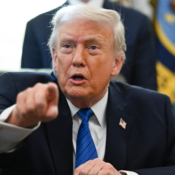
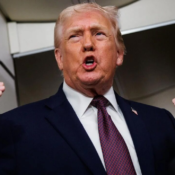
U.S. President Donald Trump on Monday revealed a trade agreement with India that reduces U.S. tariffs on Indian products from 50% to 18%, contingent upon India ceasing its purchases of Russian oil and easing trade restrictions.
Trump shared the news of the deal on social media after a conversation with Indian Prime Minister Narendra Modi, highlighting that India would now purchase oil from the U.S. and possibly Venezuela.
A White House official informed Reuters that the U.S. is lifting a 25% duty on all imports from India related to its purchases of Russian oil, which had been in addition to a 25% “reciprocal” tariff rate.
Shares of major Indian companies listed in the U.S. surged following the announcement. IT consulting firm Infosys increased by 4.3%, consultancy Wipro saw a rise of 6.8%, HDFC Bank experienced a gain of 4.4%, and the iShares MSCI India exchange-traded fund surged by 3%.
Trump’s announcement contributed to an optimistic outlook for semiconductor manufacturers and artificial intelligence, propelling major indexes into positive territory for the day.
Modi also pledged that India would “BUY AMERICAN at a much higher level,” alongside a commitment to purchasing over $500 billion in U.S. energy, including coal, as well as technology, agricultural, and other products, Trump noted.
“They will also proceed to eliminate their Tariffs and Non Tariff Barriers against the United States, bringing them to ZERO,” Trump stated regarding India.
Before Trump took office and increased U.S. tariff rates to double-digit levels last year, India maintained some of the highest tariffs globally, featuring a simple applied rate of 15.6% and an effective applied tariff of 8.2%, as reported by World Trade Organization data.
Limited information is accessible.
Trump’s message on Truth Social offered limited information, lacking specifics on the commencement date for the reduced tariff rates, the timeline for India to cease Russian oil imports, the reductions in trade barriers, and the U.S. products that India had pledged to buy.
As of late Monday afternoon, the White House had yet to issue a presidential proclamation or a Federal Register notice necessary to formalize the changes.
A spokesperson from the White House provided no additional information, and India’s commerce and foreign ministries did not respond promptly to inquiries made after working hours. The Russian embassy in Washington has yet to provide a response to a request for comment.
Previous trade agreements with significant Asian trading partners such as Japan and South Korea have featured pledges to invest hundreds of billions of dollars into U.S. industries; however, the announcement regarding India did not specify any particular investments.
The agreement aligns India with its Asian counterparts regarding tariff rates, which range from 15% to 19%, according to Madhavi Arora, an economist at Emkay Global. She noted that this would remove an undue burden on India’s exports and its currency, the rupee.
Indian markets faced significant challenges following the imposition of tariffs by Washington, resulting in the worst performance among emerging nations in 2025, accompanied by unprecedented outflows of foreign investors.
U.S. business groups responded with a mix of caution and criticism. The U.S. Chamber of Commerce, a longstanding proponent of a trade deal with India, described Trump’s announcement as a step forward in that direction. “We are hopeful that this marks the beginning of a comprehensive trade agreement that will facilitate greater private sector collaboration, and we eagerly anticipate reviewing the details of the deal,” stated Chamber CEO Suzanne Clark.
A coalition of over 800 small businesses known as “We Pay the Tariffs” has urged Americans to refrain from celebrating the deal, labeling it a “600% tax increase on American businesses compared to 2024.””The group observed that U.S. tariffs on Indian imports were approximately 2% to 3% at that time, but they would now be 18% and could increase further if India does not completely reduce its reliance on Russian oil. ‘BIG THANKS’ FROM MODI
It was a pleasure to converse with my esteemed friend, President Trump, today. Modi expressed his pleasure in a social media post on X, stating that Made in India products will now benefit from a reduced tariff of 18%. “A heartfelt thank you to President Trump on behalf of the 1.4 billion people of India for this remarkable announcement.”
India’s Trade Minister Piyush Goyal stated that the agreement would bring the U.S. and Indian economies closer together.
This agreement opens up remarkable opportunities for farmers, MSMEs, entrepreneurs, and skilled workers to create in India for the global market, design in India for the global market, and innovate in India for the global market. Goyal stated in a post on X that it will assist India in acquiring technology from the U.S.
The agreement follows closely on the heels of India’s recent signing of a long-anticipated trade deal with the European Union, which aims to eliminate or reduce tariffs on 96.6% of traded goods by value. The agreement does not include tariff reductions for EU soybeans, beef, sugar, rice, and dairy.
The Trump administration has been working swiftly to finalize framework trade agreements with key trading partners ahead of the U.S. Supreme Court’s decision on the potential repeal of Trump’s “reciprocal” tariffs under the International Emergency Economic Powers Act.
Officials from the Trump administration finalized an agreement with Taiwan last month, asserting that similar arrangements are anticipated to persist regardless of the court’s decision, as they plan to reinstate tariffs through alternative authorities.
OIL IN THE WESTERN HEMISPHERE
On Saturday, Trump hinted at a possible agreement for India to purchase Venezuelan oil following the U.S. capture of Venezuelan President Nicolas Maduro during a military operation in early January.
The agreement came after several months of intense trade discussions between the two largest democracies in the world.
In August, Trump increased duties on imports from India to 50% to compel New Delhi to halt its purchases of Russian oil, and earlier this month indicated that the rate might increase further if it did not reduce its acquisitions.
Buying Venezuelan oil could assist in substituting a portion of the Russian oil that India, the world’s third-largest oil importer, acquires.
India depends significantly on oil imports, fulfilling approximately 90% of its requirements. The acquisition of more affordable Russian oil has contributed to reducing its import expenses since Moscow’s invasion of Ukraine in 2022 and the subsequent sanctions imposed by Western nations on its energy exports.
India has recently started to reduce its purchases from Russia. In January, the figures stood at approximately 1.2 million barrels per day, with projections indicating a decrease to about 1 million bpd in February and 800,000 bpd in March, as reported by Reuters.