Trump Cautions Britain Regarding Relations with China While Starmer Celebrates Economic Renewal in Beijing
Trump threatens Britain over greater China relations as Starmer supports economic reset with Beijing during high-profile visit.
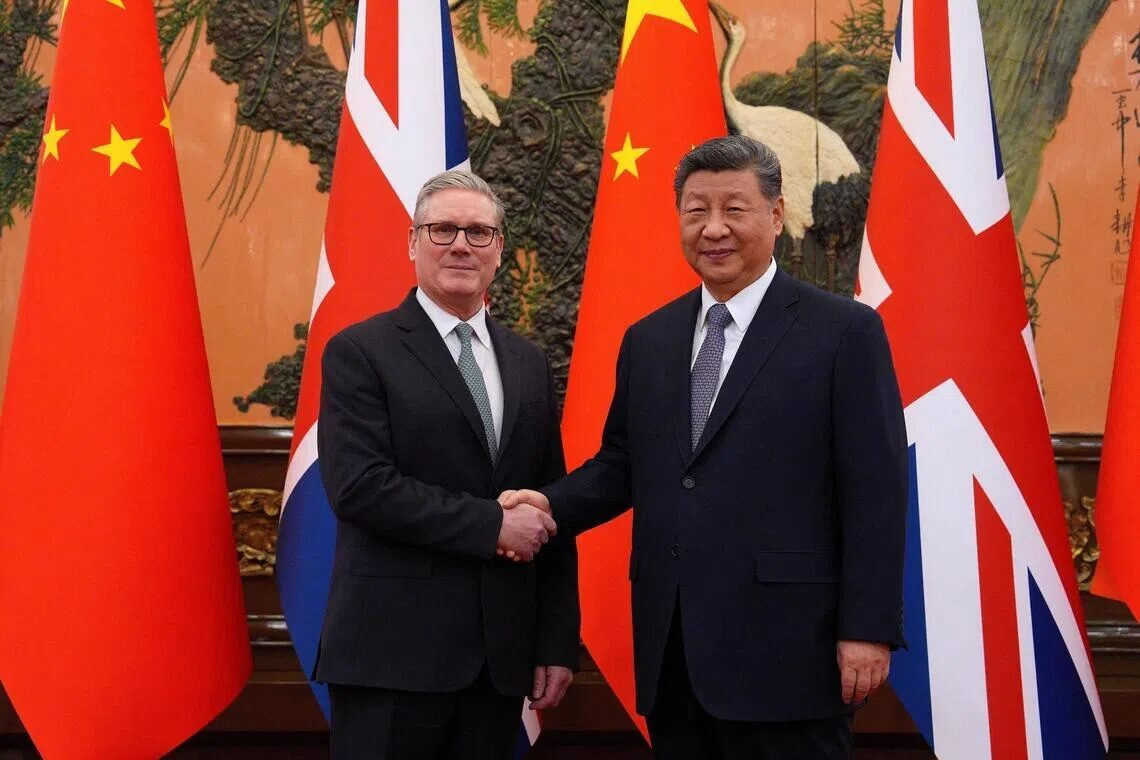
During a high-profile visit to China, Prime Minister Keir Starmer defended his government’s choice to restore relations with Beijing, while US President Donald Trump warned that Britain’s efforts to strengthen commercial ties with China are “very dangerous.”
Ahead of the Melania movie’s Kennedy Center premiere, Trump made the comments in Washington while answering questions from reporters over Starmer’s trip to China. He did not elaborate on his comments.
Trump remarked, “Well, it’s very dangerous for them to do that,” in reference to Britain’s increasing ties with China.
At a time when friends are struggling with Trump’s erratic foreign policy stance, Starmer is the most recent Western leader to visit Beijing. His arrival coincides with increased global tensions and fresh US threats of trade sanctions.
During three-hour meetings with Chinese President Xi Jinping on Thursday, Starmer urged for a “more sophisticated relationship” between the two countries, asking for improved market access, cheaper tariffs and new investment agreements. The British prime leader said discussions spanned from trade to culture, including football and Shakespeare.
Around the time Trump made his warning, Starmer addressed the UK–China Business Forum in Beijing, hailing his meetings with Xi as “very warm” and adding they had delivered “real progress.”
As “really important access, symbolic of what we’re doing with the relationship,” he cited deals on visa-free travel and lower tariffs on British whisky.
“That is the way that we build the mutual trust and respect that is so important,” Starmer said.
Starmer met top Chinese business executives, such as Chery CEO Yin Tongyue, before continuing on to Shanghai. During the visit, a local official stated Chery aims to construct a research and development centre for its commercial vehicle division in Liverpool.
Strengthening relations with the second-largest economy in the world has been a top objective for Starmer’s Labour government, which has struggled to achieve the economic growth it promised.
The visit also comes as Trump prepares for his own trip to China in April. Last week, the US Trump threatened to put tariffs on Canada after Prime Minister Mark Carney negotiated trade accords with Beijing during a recent visit.
Trump’s administration has likewise adopted a harsh position openly. The Republican-led US House Foreign Affairs Committee cautioned on social media that “China sells nothing but cheap products and cheap friendships.”
US Commerce Secretary Howard Lutnick shared that scepticism, questioning if Britain would profit from tighter commercial ties with Beijing.
“The Chinese are the greatest exporters and they are very, very difficult when you’re trying to export to them,” Lutnick added. “So good luck if the British are trying to export to China … it’s just unlikely.”
Asked whether Britain may face US tariffs akin to Canada’s, Lutnick said such action was unlikely unless London publicly confronted Washington.
“Unless the prime minister of Britain sort of takes on the United States and says very difficult things, I doubt it,” he said.
Despite the criticism, Starmer argued Britain could maintain good ties with both Washington and Beijing. Speaking to reporters aboard his trip to China, he said the UK’s relationship with the United States remained one of its closest.
Citing defense, security, intelligence, and commerce collaboration, Starmer stated, “We have one of the closest relationships with the United States.”
He also mentioned Trump’s September visit to the UK, which revealed £150 billion in US investment, and said that Britain will not have to pick between the two powers.
Speaking on condition of anonymity because of the delicate nature of the subject, a British government official claimed that Washington was informed in advance of the goals of Starmer’s travel to China. Neither Downing Street nor China’s foreign ministry quickly responded to calls for comment.
In recent weeks, Starmer—who generally avoids direct criticism of Trump—has adopted a stronger tone. He urged the US president to apologise for what he termed as “frankly appalling” remarks indicating some NATO troops avoided frontline fighting and said he would not cave to demands to acquire Greenland.
Other European leaders are also developing engagement with Beijing. German Chancellor Friedrich Merz is set to visit China soon, following travels by Carney and French President Emmanuel Macron, who accompanied Xi on a rare visit outside Beijing in December.
As global trade tensions build, Britain’s balancing act between its closest ally and a crucial economic partner is poised to face growing scrutiny.