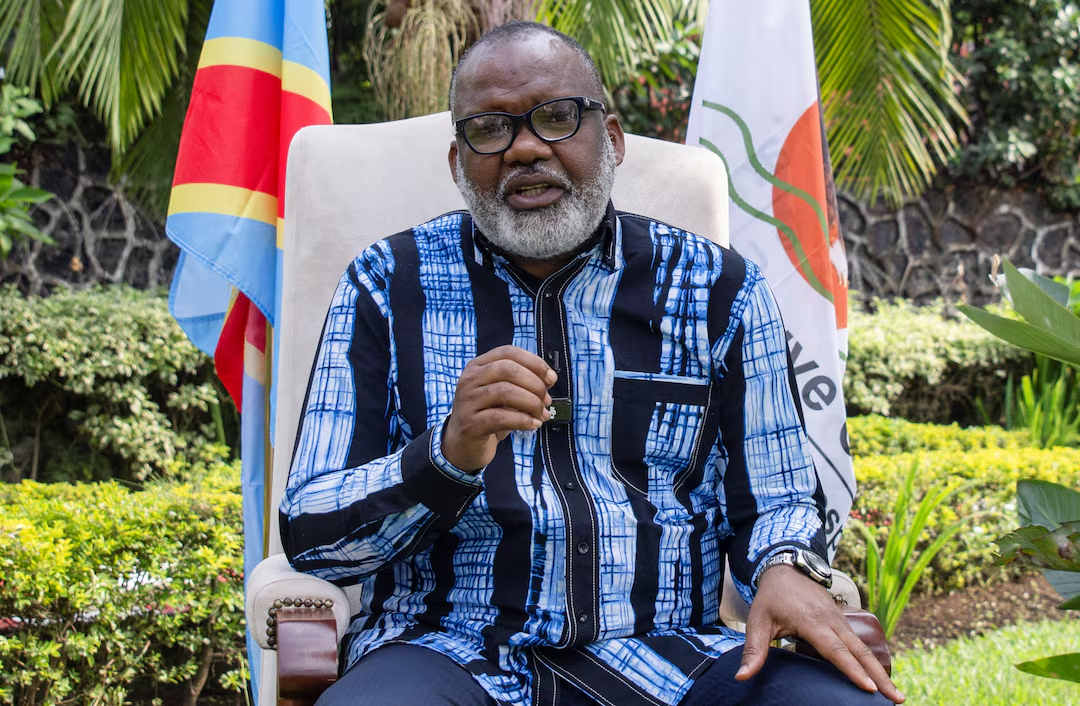
The M23 group is part of a Congolese rebel coalition whose head said a deal between Kinshasa and Washington over vital minerals in the war-torn area was unconstitutional and had serious flaws, raising questions about its implementation.
The Alliance Fleuve Congo (AFC) leader, Corneille Nangaa, was referring to a strategic partnership agreement signed in Washington on December 4 that would give the United States more access to the vital minerals of the Democratic Republic of the Congo in return for investment and security cooperation.
Nangaa said that the plan had legal issues and a lack of openness in an interview with Reuters in Goma on Monday. He cited “the opacity surrounding the negotiations” and “procedural flaws, particularly the violation of the Constitution and the law.”
Nangaa’s critique of the arrangement raises fresh questions about the practicality of U.S. investment in war-battered eastern Congo one year after M23 seized Goma, the region’s major city, as part of a lightning onslaught.
PRESIDENCY CALLS CONTRACT CONCERNS ‘SPECULATIVE’
The M23, which has taken control of important mining zones like Rubaya in North Kivu, now controls the majority of the essential minerals found in eastern Congo, including coltan.
“The Americans may have signed it, but they should know that they signed it with an illegitimate regime, and a corrupt one at that,” Nangaa stated, adding that mining sites offered to Washington might eventually become the focus of problems because they might have already been extended to other partners.
When contacted, the Congolese government denied Nangaa’s charges, stating that the collaboration “fully falls within the constitutional prerogatives” of the elected government and president.
It labeled fears over potential disagreements with existing contract holders “speculative”, and said any cooperation would respect legitimate contracts and adhere with Congo’s mining legislation.
Congo’s government has announced the cooperation will be offered to MPs for approval in March. “We have a sound majority in parliament, so we believe that we will get the parliament’s approval,” Deputy Prime Minister and Minister of National Economy Daniel Mukoko Samba told Reuters in Davos last week.
RELATIONS WITH RWANDA
In the interview with Reuters, Nangaa said the AFC worked with nearby Rwanda and Uganda on security matters but denied receiving support from Kigali.
Rwanda denies helping M23, however a report by a United Nations group of experts in July judged that it exerted command and control over the rebels.
The study highlighted training which the experts said Rwanda had provided to M23 recruits and military equipment they said Rwanda had deployed – especially “high-tech systems capable of neutralising air assets” – to give the rebels “a decisive tactical advantage” against Congo’s beleaguered army.
Last week, Rwanda’s ambassador to the United States declared in a statement that Kigali engages in “security coordination” with AFC/M23.
The conquest of Goma, a metropolis of more than two million people on Congo’s border with Rwanda, marks one of the worst escalations in years of fighting in eastern Congo.
Nangaa told Reuters that security had improved in places under rebel control since the takeover, adding that schools and hospitals were working properly and that displaced residents had returned home.
The U.N. Human Rights Office said M23, Congolese armed forces and other armed groups have perpetrated significant rights breaches, some of which may amount to war crimes. All sides deny misconduct.
Nangaa claimed that ceasefire promises made during negotiations in Doha, brokered by Qatar with support from the United States, had not been carried out and accused Kinshasa of obstructing peace efforts. The Congolese government dismisses the assertions, blaming the rebel group for the continuous carnage.
M23 soldiers temporarily entered the town of Uvira in December declaring it wished to stop attacks on residents, but eventually departed. Nangaa cautioned that future action should not be ruled out if insecurity continued.