Kosovo’s ruling party secures victory following a prolonged political stalemate
Nationalist Prime Minister Albin Kurti’s party secured over half of the votes in Sunday’s election, paving the way for the formation of a new government following a year-long political deadlock that has stalled parliament and postponed crucial international funding.
This marks the second vote in Kosovo this year, following the Vetevendosje party led by Kurti not achieving a majority in February. After months of unsuccessful coalition negotiations, President Vjosa Osmani decided to dissolve parliament in November and announce an early election.
Kurti’s party was in the lead with 50.2% of the vote on Sunday, with 87% of the votes counted following the closure of polls at 7 p.m. (1800 GMT). Analysts indicate that predicting whether Kurti can independently form the government without a coalition to obtain the 61 seats in the 120-seat assembly is challenging.
“The results are not conclusive, and I find it hard to believe that Kurti will be able to form the government on his own; however, it would be quite feasible for him to govern with a minor coalition,” remarked Ismet Kryeziu from the Kosovo Democratic Institute think tank.
Kryeziu stated that Kurti requires a handful of votes from Albanian or minority parties to establish the new cabinet.
The two primary opposition parties, the Democratic Party and the Democratic League, stood at 20.7% and 14%, respectively.
“The desires of the citizens are now in the ballot boxes.” “It is crucial to safeguard this will for the integrity and trustworthiness of the electoral process,” Kurti stated in a video message following the release of exit polls.
The inability to establish a government and reconvene parliament would extend the crisis during a pivotal moment. In April, lawmakers are required to elect a new president and approve 1 billion euros ($1.2 billion) in loan agreements from the European Union and World Bank, which are set to expire in the upcoming months.
The opposition parties in the Balkan country have declined to collaborate with Kurti, expressing concerns over his management of relationships with Western allies and his strategy regarding Kosovo’s ethnically divided north, which is home to a Serb minority. Kurti holds the opposition responsible for the deadlock.
To attract voters, Kurti has promised an extra month of salary each year for public sector employees, 1 billion euros annually in capital investment, and the establishment of a new prosecution unit to combat organized crime. Opposition parties have concentrated on enhancing living standards, which is a primary concern for voters.
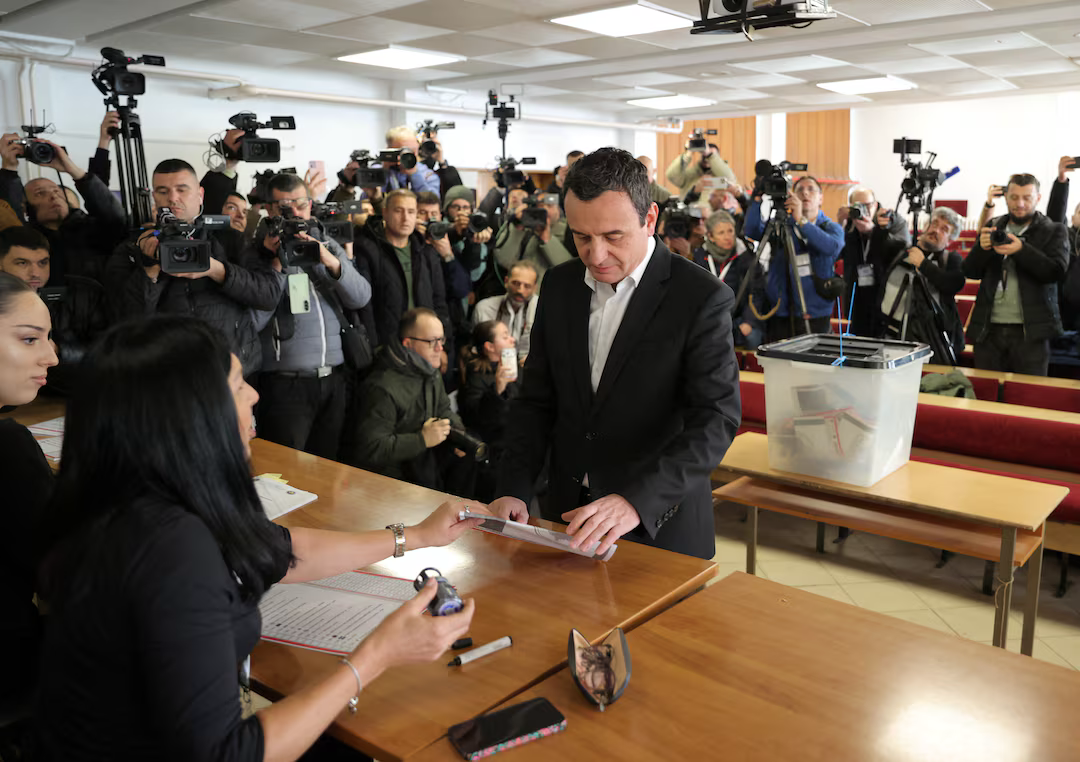
Kosovo is conducting a snap parliamentary election.
“We hope the upcoming government will establish an environment that encourages young people to remain here rather than seek opportunities elsewhere,” said 58-year-old voter Rexhep Karakashi in the capital, Pristina, during an interview with Reuters.
Although opinion polls were not released in Kosovo, some that were viewed by Reuters prior to the vote indicated support for Kurti. Certain voters expressed that they did not anticipate the vote to result in substantial change.
“Whether Kurti wins or the opposition prevails, there is unlikely to be any significant joy.” “This country requires significant transformation, and I don’t foresee that transformation occurring,” stated Edi Krasiqi, a doctor.
Kurti encouraged the public to participate in the voting process.
Following his vote in Pristina, Kurti encouraged citizens to participate, stating that increased turnout would enhance the legitimacy of the parliament.
“Once the election results are announced, we will take all necessary steps to establish the parliament promptly and move forward with forming a new government,” he stated.
The results indicated a turnout of 45%.
Kosovo proclaimed its independence from Serbia in 2008, supported by the United States, which included a NATO bombing campaign in 1999 aimed at Serbian forces attempting to suppress an uprising by the 90% ethnic Albanian majority.
Even with international backing, the nation of 1.6 million has faced challenges related to poverty, instability, and organized crime. Kurti’s tenure, which commenced in 2021, marked the inaugural instance of a Pristina government fulfilling a complete term.
In 2023, tensions with Serbia escalated, leading the EU to implement sanctions on Kosovo. The bloc announced this month that it would lift the measures following the election of ethnic Serb mayors in northern municipalities; however, these measures likely resulted in Kosovo incurring costs amounting to hundreds of millions of euros.