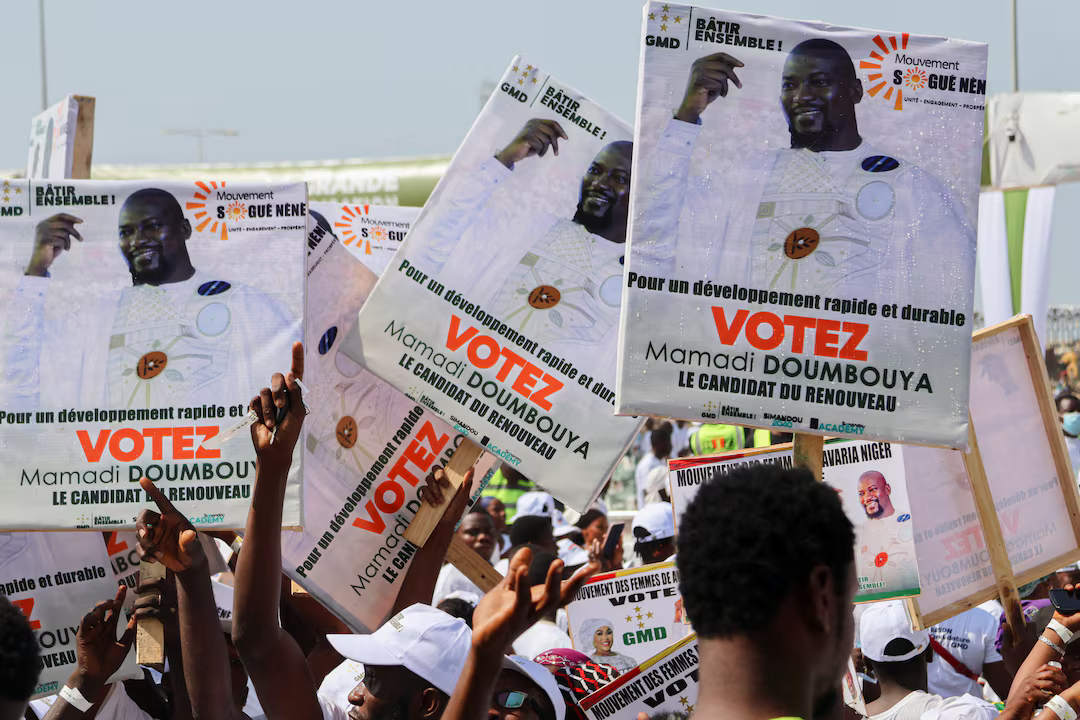
Guinea’s return to civilian government was completed on Sunday when voters cast ballots in a presidential election that was mostly anticipated to give Mamady Doumbouya, who took over in a coup in 2021, a seven-year term.
In a crowded field with no formidable opponent, the former special forces commander, who was believed to be in his early 40s, squared up against eight other contenders. Longtime opposition leader Cellou Dalein Diallo and ousted President Alpha Conde are still living in exile.
After polling places in Conakry closed at the appointed time of 6 p.m. (1800 GMT), vote counting got underway, according to a Reuters correspondent. No significant disruptions were reported.
Conakry, the capital, saw a low turnout as several voters characterized the election as inevitable.
“The nation’s return to normalcy is the most crucial thing. I’m realistic. Shopkeeper Moussa Kaba told Reuters, “I voted for the one who is in office and who guarantees the continuity of the state.”
Doumbouya arrived to cast his ballot at a voting place at a health center in Conakry, surrounded by dozens of armed commandos. He was accompanied by his wife and was dressed in a white robe and sunglasses.
In two to three days, preliminary results are anticipated.
BAUXITE AND IRON ORE RICH
Guinea’s Simandou iron ore mine, which was finally opened last month after years of delay, has the richest untapped iron ore deposit and the greatest bauxite deposits in the world.
Doumbouya has asserted responsibility for advancing the project and guaranteeing Guinea gains from its results.
This year, in response to a refinery dispute, his government also canceled the license of Guinea Alumina Corporation, a subsidiary of Emirates Global Aluminium, and transferred the unit’s assets to a state-owned company.
In addition to his relative youth in a nation where the median age is roughly 19, his shift toward resource nationalism—which is repeated in Mali, Burkina Faso, and Niger—has increased his appeal.
“For us young people, Doumbouya represents the opportunity to send the old political class into retirement,” Conakry mechanic Mohamed Kaba stated. “There is a lot of corruption right now, but I hope these things will be sorted out.”
DOUMBOUYA IS ANTICIPATING POWER
According to Benedict Manzin, chief Middle East and Africa analyst at risk consultancy Sibylline, Doumbouya “will likely utilise his position to further entrench his power and that of the military over Guinea” if elected.
“In particular he is likely to position his allies and associates to benefit from the expected economic boom associated with the launch of production” in Simandou. Manzin went on.
Following the coup, a transition charter was adopted that prohibited junta members from running for office. However, a new constitution that eliminated that provision, increased presidential terms to seven years, and included a Senate was overwhelmingly approved by Guineans in September.
Opposition figures contested the official results, which reported a 92% ballot turnout.
On Sunday, civil engineer Abdoulaye Barry told Reuters that he would not cast a ballot, complaining that the nation was “allowing a man who swore not to run to do so.”
LIMITED OPPOSITION ACTIVITY DURING THE CAMPAIGN
Under Doumbouya, political discourse has been stifled. His government is accused by civil society organizations of curtailing opposition activity, prohibiting protests, and limiting press freedom.
According to U.N. rights chief Volker Turk, the campaign time “has been severely restricted, marked by intimidation of opposition actors, apparently politically motivated enforced disappearances, and constraints on media freedom,” on Friday.
A request for response from the government was not answered.
Throughout the campaign, Doumbouya maintained a low profile, allowing his followers and officials to speak for him.
He danced with his wife during Congolese star Koffi Olomide’s performance at a closing rally on Thursday in Conakry, but he did not give a speech.
“Generation for Modernity and Development” was the name of his movement, which was printed on his track jacket and white baseball cap.