Thailand and Cambodia have reached a second truce, ending their intense border battle
Thailand and Cambodia concluded weeks of intense border clashes on Saturday with a second ceasefire in recent months, marking the most severe fighting in years between the Southeast Asian nations.
A Thai Defence Ministry spokesperson, Rear Admiral Surasant Kongsiri, informed Reuters that the ceasefire was holding approximately two hours after it took effect at noon (0500 GMT).
“Up to this point, there have been no reports of gunfire,” he stated.
Cambodia’s Ministry of National Defence reported no clashes following what it described as a Thai airstrike early on Saturday prior to the ceasefire announcement.
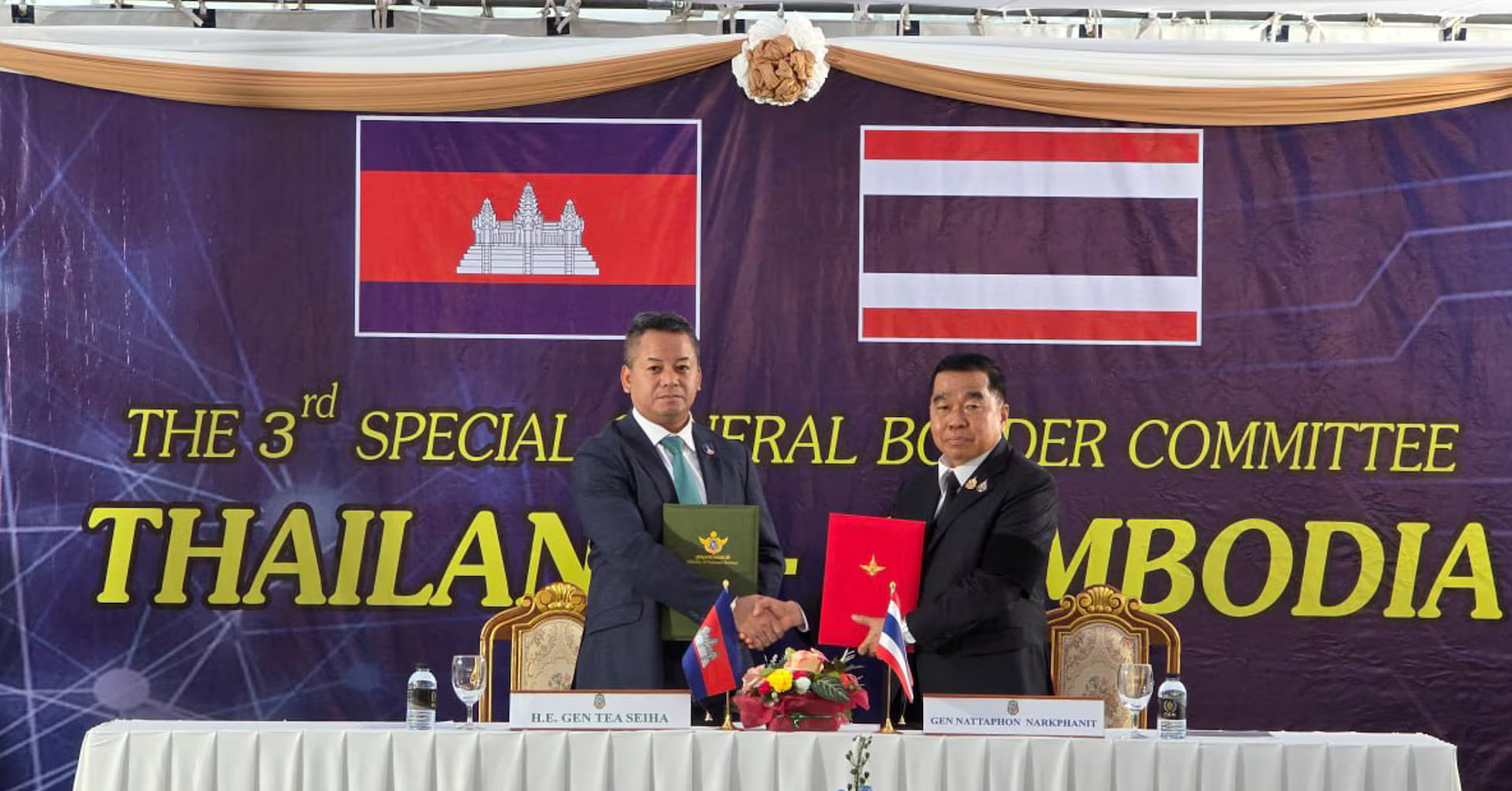
The agreement, signed by Thai Defence Minister Natthaphon Narkphanit and his Cambodian counterpart Tea Seiha, concluded 20 days of conflict that resulted in the deaths of at least 101 individuals and displaced over half a million people on both sides, featuring fighter-jet sorties, rocket fire exchanges, and artillery barrages.
ASEAN WILL OVERSEE CEASEFIRE, BILATERAL DISCUSSIONS TO PERSIST
Early this month, the clashes resumed following the collapse of a ceasefire that had been facilitated by U.S. President Donald Trump and Malaysian Prime Minister Anwar Ibrahim to stop an earlier wave of violence.
The ministers stated in a joint statement on the ceasefire that both sides have agreed to maintain current troop deployments without any further movement.
Cambodia stated on social media that “any reinforcement would heighten tensions and negatively affect long-term efforts to resolve the situation.”
Cambodia’s leading diplomat, Prak Sokhonn, along with his Thai counterpart, Sihasak Phuangketkeow, is set to meet with Chinese Foreign Minister Wang Yi in Yunnan province, China, on Sunday and Monday to address the border situation, as stated by the Cambodian foreign ministry and a Thai official.
For over a hundred years, Thailand and Cambodia have disputed sovereignty at several undemarcated locations along their 817-km (508-mile) land border – a conflict that has sometimes escalated into skirmishes and fighting.
Thailand and Cambodia reach an agreement to cease hostilities along their border.
According to Natthaphon, the new ceasefire will be overseen by an observer team from the Association of Southeast Asian Nations bloc, along with direct coordination between the two countries.
“Simultaneously, there will be direct communication at the policy level between the minister of defence and the chief of the armed forces from both sides,” he informed reporters.
Civilians are set to return, with demarcation efforts remaining unaffected.
Tensions between the two neighbours escalated in July, culminating in a five-day clash along certain sections of the frontier, resulting in at least 48 fatalities and displacing 300,000 individuals before Trump stepped in to broker a truce.
The ceasefire collapsed in early December, with both sides blaming one another for actions that resulted in confrontations.
Anwar, who is presently serving as the ASEAN chair, and Trump have faced challenges in establishing another ceasefire, as hostilities have expanded from the wooded areas near Laos to the coastal provinces along the Gulf of Thailand.
A renewed ceasefire was established following a special meeting of ASEAN foreign ministers in Kuala Lumpur on Monday, which was succeeded by three days of discussions between the conflicting parties at a border checkpoint, where the two defence ministers convened on Saturday.
They reached an agreement on the return of individuals displaced from the impacted border regions, emphasizing that neither party would resort to any form of violence against civilians.
According to the agreement, Thailand will return 18 Cambodian soldiers in its custody following the July clashes, provided that the ceasefire is fully maintained for 72 hours.
However, Saturday’s agreement will not affect any ongoing border demarcation activities between the two countries, leaving the resolution of disputed areas along the frontier to the established bilateral mechanisms.
“Conflict and violence do not bring happiness to either country or its people,” stated Thailand’s Air Chief Marshal Prapas Sornjaidee during a press briefing. “I would like to emphasize that the Thai people and the Cambodian people are not in conflict with one another.”