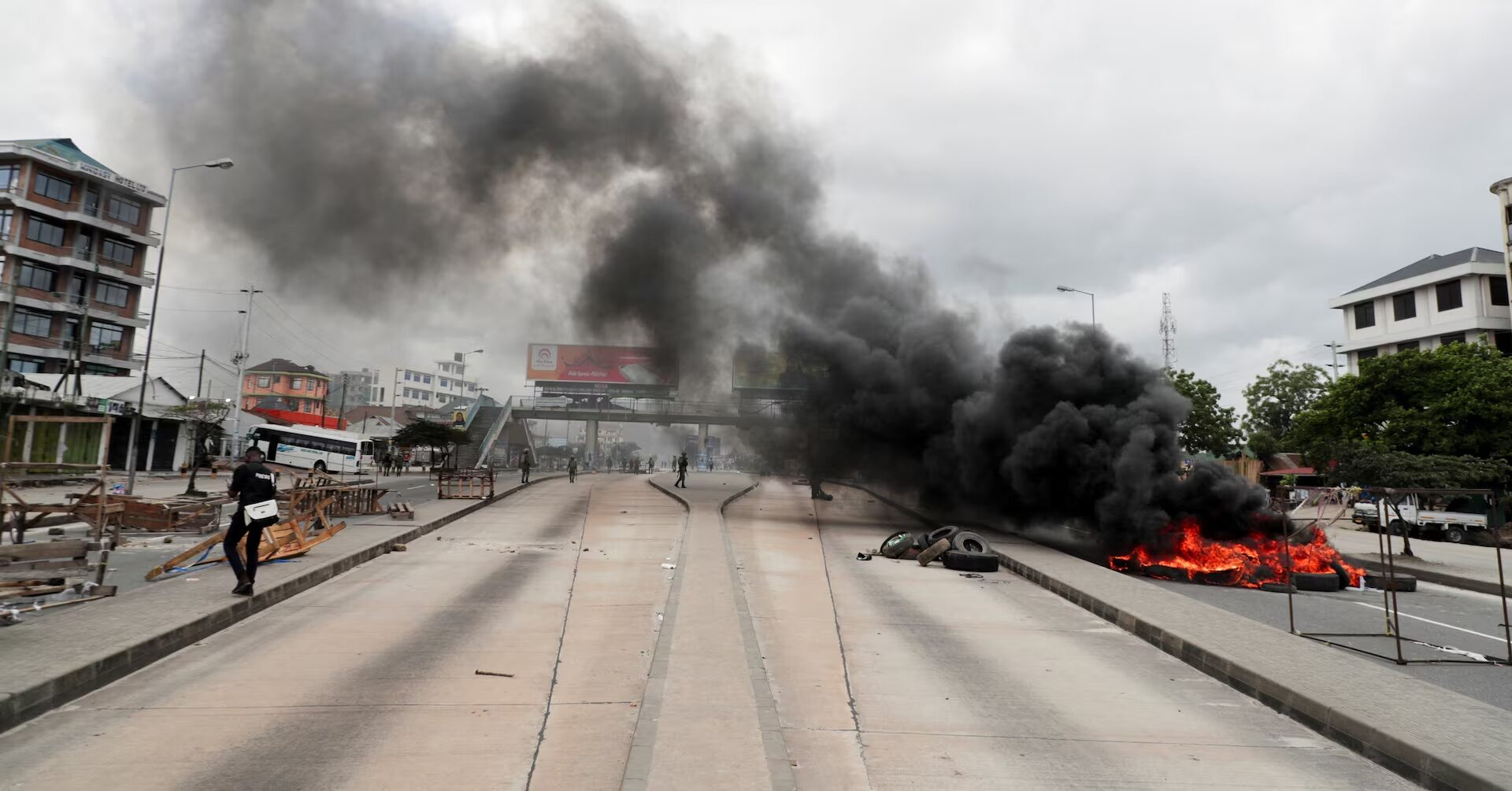
Tanzanian police used tear gas and gunfire Thursday to scatter crowds of demonstrators who had returned to the streets one day after a general election that was tainted by violent protests, according to witnesses.
The removal of President Samia Suluhu Hassan’s two main rivals from the presidential campaign, together with what protesters claim is growing government brutality, sparked protests in Wednesday’s vote in Dar es Salaam, the commercial city, and other cities.
Government offices and other buildings were set on fire, prompting police to impose an overnight curfew in the almost seven million-person city of Dar es Salaam.
On Thursday, internet service that had been interrupted during the election seemed to be sporadically restoring.
Reuters was informed by Tanzanian human rights campaigner Tito Magoti that he had heard of at least five fatalities during the demonstrations on Wednesday. A diplomatic source, who wished to remain anonymous, stated that there were credible reports of at least ten fatalities in Dar es Salaam.
These stories were not independently verified by Reuters, and calls for response from government and police officials were not answered.
The results of the preliminary election were announced by the state-run Tanzania Broadcasting Corporation, which revealed that Hassan had won sizable majorities in a number of constituencies.
New March Plans Are Discussed by Protesters
On Thursday, dozens of demonstrators took to the streets of at least three Dar es Salaam neighborhoods, where police used tear gas and firearms, according to a Reuters witness.
In the northern cities of Mwanza and Arusha, several witnesses reported that police used tear gas on Thursday to quell minor demonstrations.
According to the British government, the airports in Arusha and Mount Kilimanjaro were closed, and international flights to and from Dar es Salaam were canceled.
Because of the high risks of traveling by road and the cancellation of numerous foreign flights, the U.S. Embassy encouraged its nationals to stay indoors.
“The people are rewriting our political culture from being cows, if I use this word respectfully … to being active citizens,” Magoti claimed.
Hassan, who received praise for reducing censorship and harassment of opponents after taking office in 2021 after her predecessor John Magufuli stepped up censorship, is put to the test by the crisis.
However, in recent years, opposition politicians and rights activists have charged the administration with mysteriously kidnapping its critics.
Hassan claimed that although she had requested an investigation into accusations of kidnappings last year, the results have not yet been made public.
CIVIL SERVANTS MAY NOT LEAVE THEIR HOMES
Government spokesperson Gerson Msigwa announced on his Instagram account that a directive for civil servants to work from home will be extended until Friday. Also, it advised anyone else who didn’t have an urgent cause to leave the house to work from home.
The election, which also included voting for representatives to the parliament and officials for the semi-autonomous Zanzibar archipelago, was marked by protests, according to CHADEMA, Tanzania’s biggest opposition group.
Its head, Tundu Lissu, was accused of treason, and CHADEMA was disqualified in April for refusing to sign a code of conduct.
The opposing party’s candidate, ACT-Wazalendo, was also dismissed by the commission, leaving Hassan vulnerable to challenge from minor parties.