Trump Presents a Global Leaders-Supported Peace Plan for Gaza, But Hamas Is Not on Board
The US peace plan provides Gaza reconstruction, hostage exchanges, and transitional rule while Hamas considers terms for approval.
Despite uncertainty about Hamas’s willingness to accept the new US peace plan for Gaza, European and Middle Eastern governments have praised the initiative.
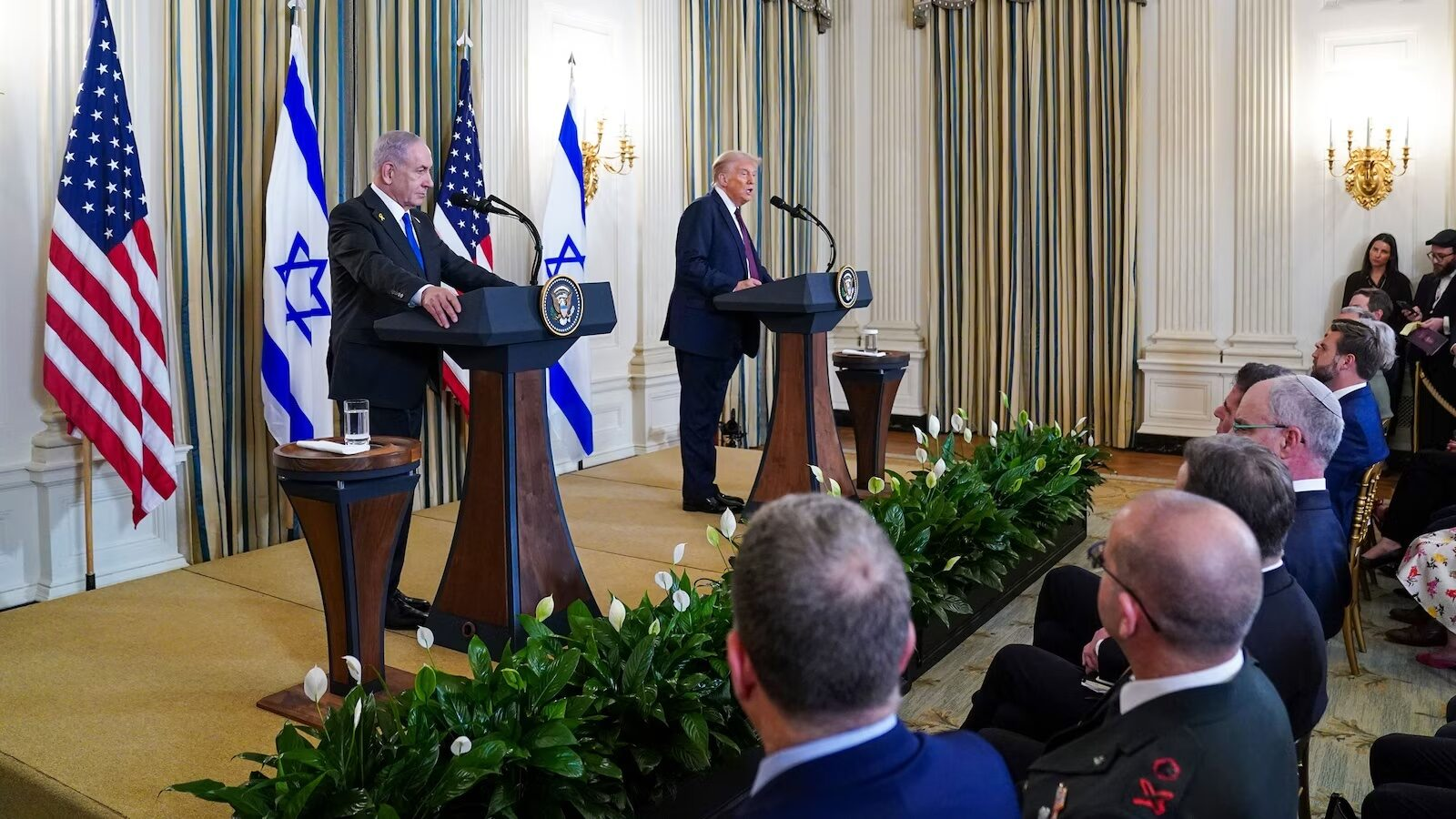
President Donald Trump and Israeli Prime Minister Benjamin Netanyahu unveiled the plan at the White House, which outlines a framework for putting an end to the conflict that has ravaged Gaza since October 2023. It demands that hundreds of Palestinian inmates be released in exchange for an immediate end to hostilities, the repatriation of the remains of over two dozen more people thought to be dead, and the release of 20 Israeli hostages within 72 hours.
Hamas officials have been presented with a 20-point agreement by Qatari and Egyptian mediators, which states that the militant organization will not be involved in the future governance of Gaza.
The enclave would instead be run by a technocratic Palestinian committee under the direction of an international transitional organization known as the “Board of Peace,” which Trump would serve as its chair. The committee will be in charge of governance and reconstruction, and former UK Prime Minister Tony Blair is scheduled to serve on it.
Trump called the effort “a historic day for peace,” but he also cautioned Hamas that if it does not pass, the US will support Israel to “finish the job of destroying the threat of Hamas.”
If the strategy didn’t work, Netanyahu reaffirmed that message by stating that Israel will “finish the job.” He did, however, reaffirm his opposition to a Palestinian state in a subsequent video message, despite the fact that the US proposal admits the possibility.
Though Netanyahu took a tough stance, the plan was supported by a number of states. Trump’s efforts were hailed by the Palestinian Authority as “sincere and determined,” and collaboration with Washington and regional partners was pledged. Trump’s “leadership” was praised in a joint statement by the foreign ministers of Saudi Arabia, Egypt, Qatar, Jordan, Turkey, the United Arab Emirates, Indonesia, and Pakistan. They also emphasized that the deal should result in a two-state solution with Gaza integrated into the West Bank.
Antonio Costa, president of the European Council, urged all sides to “seize this moment to give peace a genuine chance,” saying he was “encouraged by Prime Minister’s positive response.” Emmanuel Macron, the president of France, and Sir Keir Starmer, the prime minister of the United Kingdom, also offered their support, with Macron promising that France would be willing to help carry out the agreement. “Potential turning point” is how Italian Prime Minister Giorgia Meloni characterized the plan.
The plan calls for the demolition of Hamas weapons sites and tunnels, a phased Israeli military withdrawal, and significant financial investment to restore Gaza. Israel is not allowed to occupy or annex Gaza, and Palestinians are promised “the opportunity to build a better Gaza” rather than being driven out.
Despite not having formally replied, Hamas has indicated that it disagrees with some aspects of the plan. The group is open to considering offers, but any agreement must ensure Israel’s complete withdrawal from Gaza and protect Palestinian rights, including the creation of a state with 1967 boundaries, according to a senior official. The weaponry of Hamas must remain “a red line” until the occupation is over, he insisted.
Netanyahu made the declaration a few days after he angrily addressed the UN General Assembly, calling recent Western endorsement of Palestinian independence a “mark of shame.” In response to that speech, dozens of diplomats left.
Hamas attacked southern Israel on October 7, 2023, killing over 1,200 people and taking 251 hostage. This sparked the start of the war in Gaza. According to Gaza’s health ministry, Israel’s retaliatory attack has killed almost 66,000 civilians. There is starvation in Gaza, according to a UN-backed authority, and a UN commission recently found that Israel has committed genocide—a claim that Israel vehemently disputes.
International pressure on both sides is growing as the humanitarian crisis worsens, but it is unclear if the new plan will overcome resolute views.