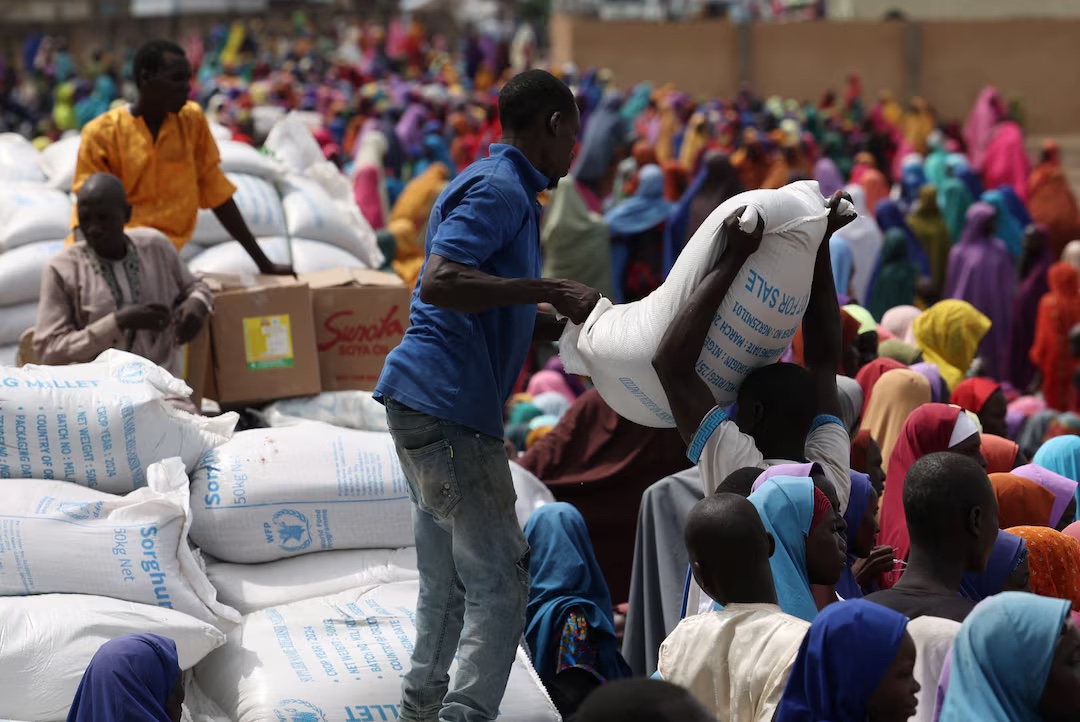
A decrease in humanitarian funding from the United States and other Western countries has left nutrition centers shuttered or food shortages for impoverished people displaced by fighting in northeastern Nigeria.
More than any other country, the United Nations reports that 31 million people in Africa’s most populous country are experiencing food shortages. The worst catastrophe is in the northeast, where the army and Islamist militants have been at war for 15 years, forcing 2.3 million people from their homes and farmlands.
It has been ten years since Hadiza Ibrahim was evicted. She is taking refuge at a camp in Dikwa, Borno State, the epicenter of the conflict, together with her spouse and their eight children. The local nutrition center they depend on is running low on supplies.
Ibrahim remarked, “I might not be able to eat tomorrow,” as she waited in line to get the scant supplies.
According to Ali Abani, who is in charge of site security, several recipients who had been fed for more than ten years arrived this month to discover that nothing remained for them.
The United States accounted for 60% of humanitarian activities in Nigeria until this year. That was abruptly stopped in January when President Donald Trump said other nations should step up and froze help.
Instead, major donors like Germany, France, and Britain have reduced their own aid expenditures, and other countries have also made cuts public.
Devastating outcomes have been observed in Nigeria. While some relief organizations have completely closed, the U.N. World Food Programme (WFP) has closed 150 nutrition centers in the northeast during the lean season between harvests, which spans from June to November.
“It resulted in hundreds of thousands of children no longer receiving necessary care, and the number of children requiring hospitalization increased dramatically,” stated Chi Lael, the World Food Program spokesperson in Nigeria.
Disregarding undernourished children
Mothers and malnourished children were seen by Reuters reporters at the Dikwa camp, which is managed by many NGOs, laying on mats on the floor of a health center since all 15 of its beds were taken.
A health professional was giving one of the kids a packet of Ready-to-Use Therapeutic Food (RUTF), which is a very nourishing paste that is usually mixed with peanuts, sugar, milk powder, oil, vitamins, and minerals. However, the center’s supplies were insufficient to care for every youngster being brought in.
Bukar Tijjani, a physician with the humanitarian organization InterSOS, stated, “We’re turning away patients,”
The humanitarian organization Save the Children said last week that just 64 percent of the 629,000 cartons of RUTF required to survive the lean season had been obtained, despite the fact that it projected that 3.5 million children in Nigeria needed treatment for severe acute malnutrition.
According to the WFP, the catastrophe that children are confronting is of an unparalleled magnitude. Children who are acutely malnourished have a much higher risk of dying from common diseases than children who are fed properly.
“We know that 600,000 children are at risk of mortality — a figure we’ve never experienced before,” Lael said.
The U.S. government will give $32.5 million to the World Food Program (WFP) to help internally displaced individuals in conflict-affected areas with food and nutrition support, the U.S. embassy in Nigeria announced Wednesday.
The reason behind the decision to provide the monies, a portion of the total amounts needed and of U.S. donations in prior years, was not mentioned.
A request for response from the WFP was not immediately answered.
Following the suspension of U.S. aid, the U.N.’s initial budget of $910 million to fulfill Nigeria’s humanitarian needs this year was reduced down to about $300 million since there was no realistic chance that other contributors would make up the difference.
The U.N. Office for the Coordination of Humanitarian Affairs said that by August, just roughly half of the lower figure had been raised.