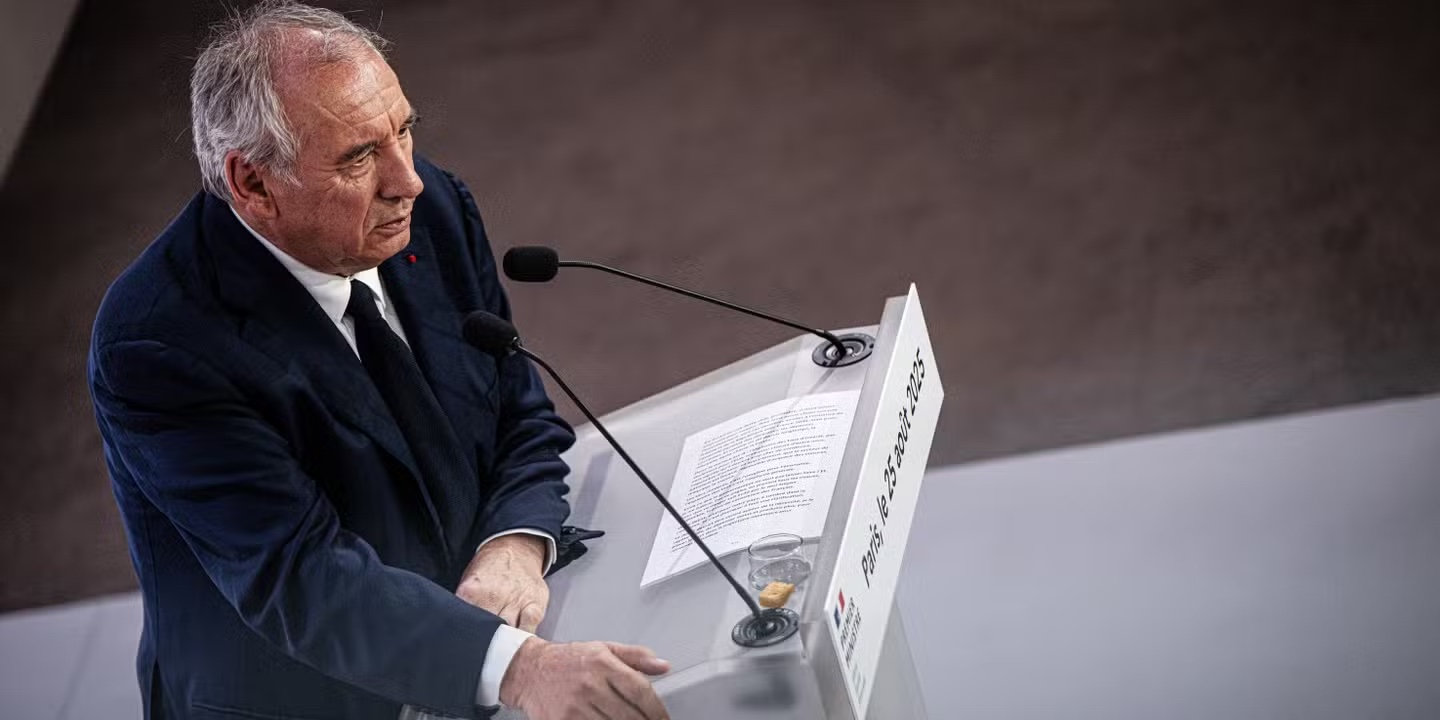
François Bayrou, the prime minister, faces the possibility of losing power as opposition parties promise to oppose his vote of confidence on the contentious budget cuts.
On September 8, Prime Minister François Bayrou called for a vote of confidence on his plans for drastic budget cuts, and opposition parties in France have declared they will not support him.
France is facing a “worrying and therefore decisive moment,” Bayrou warned as he called the vote on Monday. Bayrou has been in charge of a minority government since last December. With France’s fiscal deficit growing, he stated, “Yes, it’s risky, but it’s even riskier not to do anything.”
Socialists, Greens, and French, from the National Rally on the right Opposition parties gathered to declare their intention to vote against him, unbowed on the left.
Two days prior to protests being scheduled throughout France to “block everything,” Bayrou called the vote.
After Bayrou revealed proposals for around €44 billion (£38 billion) in budget cuts in July, the Bloquons tout movement—which started on social media but has now gained support from the unions and extreme left—brought to life.
France’s CAC-40 share index dropped 1.59% on Monday and continued to decline 2% on Tuesday morning in response to the vote reports.
“Working together, we must figure out how to create a recovery budget for 2026,” stated Finance Minister Eric Lombard on Tuesday.
According to Bayrou, France is in danger and parliament will be asked “to choose the path that allows us to escape from this curse [of indebtedness]” after last year’s budget deficit reached 5.8% of GDP.
President Emmanuel Macron named Bayrou prime minister following the fall of Michel Barnier’s administration in a confidence vote on expenditure cutbacks last December.
With little backing from the National Assembly, Bayrou and his shaky government face a gloomy future.
He was promptly rejected by the leaders of the far-right National Rally party. Its president, Jordan Bardella, said that Bayrou had announced “the end of his government,” while Marine Le Pen, the leader, stated that only by dissolving the parliament would France be able to make its own decisions.
The extreme left in France, ecologists, and communists When Olivier Faure, the head of the Socialist party, told the newspaper Le Monde that “it’s unthinkable the Socialists will give François Bayrou a vote of confidence,” it seemed as though Bayrou’s destiny was sealed. All of the unbowed people threatened to vote against the government.
“The goal of accelerating the election calendar is not to create chaos,” Faure stated. “François Bayrou is responsible for political instability because he put forward a budget that nobody, not even his voters, can support.”
Bayrou has little chance of surviving unless he can convince them otherwise. The finance minister stated that although there was potential for compromise, he was adamant about reducing the budget by €44 billion.
The administration may have some leeway to address the elimination of two French national holidays, which is another aspect of Bayrou’s budget plans.
Bayrou’s decision to call a vote of confidence on September 8th was hailed by his ministerial colleagues, who were not given much notice of it on Monday.
In an interview on French TV on Tuesday, Justice Minister Gérald Darmanin described the prime minister’s action as “very democratic and extremely courageous.”
President Macron will have to decide whether to retain Bayrou as leader of a caretaker administration, appoint a new prime minister, or hold fresh elections if the cabinet does fall.
The prime minister’s plans were fully detailed to Macron by Bayrou, who made his revelation after visiting the president while on vacation in the southern French city of Fort Brégançon.
Although Macron has declined to step down and his mandate is scheduled to serve until 2027, his decision to hold early elections in 2024 resulted in a minority government composed of right-wing Republicans and centrists controlling France.